Tacky fiblerglass

SweeperForce

Chief Petty Officer
Joined
Feb 7, 2010
Messages
487
Hello,
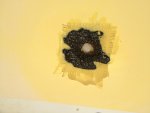
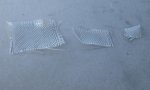
I had a small swim deck on my outboard which is loose so I removed it (didn't use it anyway). So I filled in the holes with silicone chalk. Leave it cure for a few weekend. Yesterday I sanded the area around the holes down past the gel coat to the fiberglass. Mixed up a batch of polyester resin with 10 drops per ounce. Cut three small pieces with each piece being smaller than its previous. Applied the glass and let sit. 24 hours later it is still tacky. Is this normal? I live is southern PA hot and humid.
I also heard that old resin can take up to a month to cure. After it cures I plan to apply gelcoat. Three of the hole are below the water line.

Glassing_0006A.jpgGlassing_0008A.jpgGlassing_0010A.jpg

Thanks,
Tom
 

jbcurt00

Moderator
Staff member
Joined
Oct 25, 2011
Messages
25,258
Re: Tacky fiblerglass

How much resin did you add '10 drops of MEKP' to? Use metric volumes, the math is MUCH easier to get correct.

Whose resin did you use?

Poly resin cures w/ 1-2% MEKP by volume. So 10oz poly resin & 0.15oz MEKP is an average catalyst rate. Depending on temps & conditions, you can increase or decrease the %MEKP. More catalyst, quicker cure time, less will give you more working time. Using too little or too much MEKP both have consequences. Metric helps prevent that.

Did you use a wax added resin or add wax to the resin when you mixed it? If not it will take some time for the resin to cure, if it ever does fully cure.

EDIT: Thanks for catching the math error YD
 
Last edited:

Woodonglass

Supreme Mariner
Joined
Dec 29, 2009
Messages
25,932
Re: Tacky fiblerglass

Hopefully you remove the caulk (not Chalk) before attempting to glass!
 

SweeperForce

Chief Petty Officer
Joined
Feb 7, 2010
Messages
487
Re: Tacky fiblerglass

I agree metic is much easier but being a novice at this I just followed the directions on the back of the resin It said to add 10-12 drops of MEKP to 1 ounce(29.5mL) of polyester resin I used Bondo brand. No wax was added.
I didn't remove the silicone but I did make it flush with the boat.

Tom
 

GT1000000

Rear Admiral
Joined
Jul 13, 2011
Messages
4,916
Re: Tacky fiblerglass

The resin you used does contain a wax additive in it according to the manufacturer, 3M Products.
It should be fully cured within 48 hrs.
If not you may want to check it and see if it will peel off of the surface.
If it is OK, you will have to sand the surface to remove the wax layer before applying the gel coat.
The sealant that I see in the holes really should have been removed, and the holes filled with a thickened resin, but that is somewhat optional.
You can make the thickened resin by cutting up some of the cloth you have into fine pieces with scissors and adding them to the resin to create a paste-like consistency, then adding the required amount of catalyst.
The cloth that you have there may not be ideal for multiple layers.
A better material for that is called CSM {Chopped Strand Mat}
Here is a link that shows the different types...Fiberglass Mat
If the glass ends up too high above the surface, you will have to reduce it to add gel-coat...if the layers of cloth get too thin, you may want to "dish out" the repair area more and re-apply the cloth layers so that the finished repair is below the surface by about the thickness of a penny, which is about the thickness you want for the gel-coat patch.
 

Woodonglass

Supreme Mariner
Joined
Dec 29, 2009
Messages
25,932
Re: Tacky fiblerglass

GT1M is exactly right about your patch. The resin and cloth is not ideal for this patch. He described the appropriate material and method. Your resin does indeed contain wax which means you must apply all the layers at one time else you will need to sand between each layer. Dishing out the repair area is another good technique. A final wash down with acetone is also highly recommended. You need to get down to good fresh glass to allow the new glass to adhere properly and have the patch look natural after you sand and fair the area. Prep of the damage is essential to a good final outcome.

Let us know if we can be of further assistance.:)
 

Yacht Dr.

Vice Admiral
Joined
Feb 26, 2005
Messages
5,581
Re: Tacky fiblerglass

I agree metic is much easier but being a novice at this I just followed the directions on the back of the resin It said to add 10-12 drops of MEKP to 1 ounce(29.5mL) of polyester resin I used Bondo brand. No wax was added.
I didn't remove the silicone but I did make it flush with the boat.

Tom

You are correct in your mixing. Normally the Bondo stuff kicks off Very quickly. You might have had a bad batch but I have never had a pot of poly NOT kick.

How much resin did you add '10 drops of MEKP' to? Use metric volumes, the math is MUCH easier to get correct.

Whose resin did you use?

Poly resin cures w/ 1-2% MEKP by volume. So 10oz poly resin & 1.5oz MEKP is an average catalyst rate. Depending on temps & conditions, you can increase or decrease the %MEKP. More catalyst, quicker cure time, less will give you more working time. Using too little or too much MEKP both have consequences. Metric helps prevent that.

You might want to edit this statement .. I think your going 10% ratio ..

Did you use a wax added resin or add wax to the resin when you mixed it? If not it will take some time for the resin to cure, if it ever does fully cure.

What can I say JB .. your wrong .. totally wrong. [Edit: Please dont take this the wrong way .. Im not slamming ya :) ]

CC and OZ's are basically the same thing !

Wax adds are not going to screw up your kick with your poly resins .. unless its too much Wax. ( Again I dont agree with wax additives for lams or builds.)

YD.
 

joelybob

Petty Officer 1st Class
Joined
Jun 30, 2012
Messages
224
Re: Tacky fiblerglass

The resin you used does contain a wax additive in it according to the manufacturer, 3M Products.
It should be fully cured within 48 hrs.
If not you may want to check it and see if it will peel off of the surface.
If it is OK, you will have to sand the surface to remove the wax layer before applying the gel coat.
The sealant that I see in the holes really should have been removed, and the holes filled with a thickened resin, but that is somewhat optional.
You can make the thickened resin by cutting up some of the cloth you have into fine pieces with scissors and adding them to the resin to create a paste-like consistency, then adding the required amount of catalyst.
The cloth that you have there may not be ideal for multiple layers.
A better material for that is called CSM {Chopped Strand Mat}
Here is a link that shows the different types...Fiberglass Mat
If the glass ends up too high above the surface, you will have to reduce it to add gel-coat...if the layers of cloth get too thin, you may want to "dish out" the repair area more and re-apply the cloth layers so that the finished repair is below the surface by about the thickness of a penny, which is about the thickness you want for the gel-coat patch.

where does it say on can that it has wax in it. I have a can right in front of me. and I don't see it
 

matt167

Rear Admiral
Joined
Sep 27, 2012
Messages
4,323
Re: Tacky fiblerglass

where does it say on can that it has wax in it. I have a can right in front of me. and I don't see it

It almost never says it on any store bought resin, but unless fiberglass is listed as laminating resin it almost certainly is waxed resin
 

Woodonglass

Supreme Mariner
Joined
Dec 29, 2009
Messages
25,932
Re: Tacky fiblerglass

where does it say on can that it has wax in it. I have a can right in front of me. and I don't see it
It does not say it on the can, but...if you call the 3M representative, (which GT1M did) and talk to them they will tell you it does. I think you can research it on the web and find the specs as well. Resin with out wax takes a long time to cure to a non-tacky surface. The wax promotes the cure to this non-tack surface. Gelcoat is a resin based product and thus the use of wax or PVA to promote the Non Tack final surface for it. Hope this helps clarify some things.;)

As for the Metric system and OZ there are 30 cc in 1 Oz So if you mix 10 oz of Resin 300 cc's (that's a little more than a cup) you would want to use between .3 cc & .6 cc (1-2%) of hardener/catalyst to catalyze the resin. One drop is about .05 cc. Soooooo somewhere between 6-12 drops should be the ratio for that much resin. Unless my Okie math is wrong. I never was very good at math!!!!:eek:
 

GT1000000

Rear Admiral
Joined
Jul 13, 2011
Messages
4,916
Re: Tacky fiblerglass

where does it say on can that it has wax in it. I have a can right in front of me. and I don't see it

A few months back, this discussion came up in another thread and I emailed the 3M technical department and they wrote back saying that all of their resin products are considered finishing resins and have the wax additive.
 

jbcurt00

Moderator
Staff member
Joined
Oct 25, 2011
Messages
25,258
Re: Tacky fiblerglass

You might want to edit this statement .. I think your going 10% ratio ..

What can I say JB .. your wrong .. totally wrong.

CC and OZ's are basically the same thing !

Wax adds are not going to screw up your kick with your poly resins .. unless its too much Wax. ( Again I dont agree with wax additives for lams or builds.)

YD.
Corrected the math error in my post, thanks.

Do you mean ml (milliliters) & cc (cubic centimeters) are the same thing ^^^? Because I don't think oz & cc's are:

1 cc = 0.0338140227 US fluid ounces

I don't think I misspoke about the lack of wax in layup slowing the cure. Plus not knowing what conditions & etc the work was done in, it could take a very long time to cure (looking back, he did say PA~hot & humid, but I missed it, sorry OP). AND IF (which at that point there wasn't enough info to KNOW) 10 drops wasn't enough MEKP, the resin MIGHT not fully cure, particularly if it was un-waxed.

We've seen several MEKP ratio's that were off, and several more that used old MEKP, and on numerous occasions the resin in those layups didn't cure to a tack free surface & the parts were scrapped or the resin was removed. Most of those were using laminating resin that was un-waxed.

It was never the wax that I was claiming had 'screwed' up the kick. I agree that un-waxed resin should be used in layups & etc. That's only 1 of the reason's I'd avoid off the shelf resin at an auto parts/wally world/HD type store, it is, as the OP now knows, generally a wax added resin. At this point, the PO hasn't said if it finally did cure tack free or not.

And now back to our regular programming: Tacky Fiberglass..

Since it's likely past the 48hr mark, has the resin kicked to a tack free surface?
 

joelybob

Petty Officer 1st Class
Joined
Jun 30, 2012
Messages
224
Re: Tacky fiblerglass

A few months back, this discussion came up in another thread and I emailed the 3M technical department and they wrote back saying that all of their resin products are considered finishing resins and have the wax additive.

Good to know. Thanks GT1000000
 

73Chrysler105

Chief Petty Officer
Joined
Sep 10, 2009
Messages
407
Re: Tacky fiblerglass

I want to know if it ever did kick off, it's possible that it never kicked cause it wasn't mixed right.
 

Yacht Dr.

Vice Admiral
Joined
Feb 26, 2005
Messages
5,581
Re: Tacky fiblerglass

Corrected the math error in my post, thanks.

Do you mean ml (milliliters) & cc (cubic centimeters) are the same thing ^^^? Because I don't think oz & cc's are:

1 cc = 0.0338140227 US fluid ounces


I don't think I misspoke about the lack of wax in layup slowing the cure.

Yes .. the cc and ml are the same thing.. .. basically. We for sure dont go mixing 1 cc of gel or resin on its own right :) ..

A qt of resin or a liter of resin is Basically the same Volume ..The same cat rate is the same CC that you could do for a liter or a qt. ( most of us dont kick off just 1 oz or 30cc of resin and drip 10-12 drops into our mix )

I will try to do this on another Thread.

YD.
 
Top