No spark 55 HP Evinrude triumph 1969

sad boater

Cadet
Joined
Mar 23, 2026
Messages
11
Let me start by saying that the boat prior to a burnt connection to the stator it was running great. I was a mechanic of car and stuff but honestly boats confuse me a little.. I do have the repair manual but I don't own the tools needed for the tests. So what I have found was the stator short overloaded the rectifier and ignition coil causing cracks in both. My question is about the amplifier is there a way to test it with modern equipment? It is a 3 wire amplifier and I do have the 12v incoming voltage. I was able to do the ohm check for the stator I got 1.0 ohms and no sign of short to ground. Second question what else should I check? I'm kinda lost on this.....

Thanks for any help, the sad boater
 

Crosbyman

Admiral
Joined
Nov 5, 2006
Messages
6,023
post exact mdl ans ser#... if the kill circuit is not the cause the " amplifier" is suspect according to Chat...
this may.. help but if you have no tools to test ....shop time may be on the horizon. techs for 1969 engines are getting rare..and $$$$
 

Attachments

  • Evinrude 55hp 1969 CDI tests.pdf
    2.8 MB · Views: 2
Last edited:

sad boater

Cadet
Joined
Mar 23, 2026
Messages
11
No this doesn't help it's a completely different system than the video shows. From what I can tell there is no kill switch circuit on my boat. Never has been. That was the first thing I searched for. The model number is 55973A serial number J11067. It ran before the stator wires burned up, bad connection. After that I found both my rectifier and ignition coil cracked. I'm assuming I fried everything. I replaced the rectifier and ignition coil. I get 12v to the amplifier but only 5v coming out going to the points. The attached file does give me a couple ideas to check. I did all the tests I could in the book. There is no signs of stator overheating or short. It has 1.1 ohms when I checked the two yellow wires and neither showed short to ground.

Thank you
 

sad boater

Cadet
Joined
Mar 23, 2026
Messages
11
post exact mdl ans ser#... if the kill circuit is not the cause the " amplifier" is suspect according to Chat...
this may.. help but if you have no tools to test ....shop time may be on the horizon. techs for 1969 engines are getting rare..and $$$$
The only thing I can't check is the amplifier. It is available but cost is $400 not trying to throw $400 darts at y boat.....lol I was a diesel mechanic for 20 years but honestly that means nothing when I look at the electrical system on this boat motor.
 

sad boater

Cadet
Joined
Mar 23, 2026
Messages
11
No. Not that I can tell. I did the test in the book and I have no visible spark from the coil. It is new as is the rectifier. I was really hoping that was all it would be. I'm not that lucky. It ran great when I had it out.... until it didn't.
 

racerone

Supreme Mariner
Joined
Dec 28, 2013
Messages
39,424
The stator and rectifier are only part of the battery charging circuit.---Anti reversing spring checked?----Part # and source of coil?
 

sad boater

Cadet
Joined
Mar 23, 2026
Messages
11
No I haven't pulled the flywheel off and checked anything underneath it. I was hoping to avoid that. Marineengine.com part number 0502882. The day the wires burnt it only started for a second then died. Still cranks just fine. The battery is new.
 

Crosbyman

Admiral
Joined
Nov 5, 2006
Messages
6,023
wild guess again ( I admit not knowing your engine but yout mdl # shows it to operate with a break point)

reading other sources indicates that if you simply tap a quick GRD on the wire from the breaker point the"amplifier" should fire the ignition coil and you should
see spark. all the breaker does is provide ground pulses to fire the coil.


?? is this your engine......the main ignition coil should at least show a HV sent over to the distributor if plugs are to fire. It happears to be the main origin of high voltage.
if you don't see HV there I would work backwards. Pulling the FW may show something.

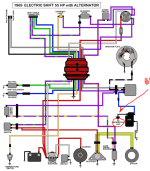
did you inspect and clean up all connections in the fat red connector ??


1774409987647.png
 
Last edited:

racerone

Supreme Mariner
Joined
Dec 28, 2013
Messages
39,424
????---You have to pull the flywheel.-----Check breaker point gap.----Clean rotor and distributor cap.---Check anti-reversing spring.
 

sad boater

Cadet
Joined
Mar 23, 2026
Messages
11
Yes this is my motor. I recently purchased the boat. I did all the pre-water maintenance like cleaning the carburetors and changing the oil in the lower end. I fixed a lot of wiring before the engine, there in no actual plug on my boat the harness runs through from the key switch to the engine. I did not do a good enough job looking at the wiring on the engine. I'm sure I would have noticed the plug becoming weak. Excitement got the best of me. I had it running and spent hours on the lake. I did not do the tap test, I don't have the 12v that wire is supposed to have I only have 5v. So I never tried it because I figured it wouldn't do anything. I will try it tomorrow before I remove my flywheel.
????---You have to pull the flywheel.-----Check breaker point gap.----Clean rotor and distributor cap.---Check anti-reversing spring.

????---You have to pull the flywheel.-----Check breaker point gap.----Clean rotor and distributor cap.---Check anti-reversing spring.
That's the plan today as long as the weather stays nice. I will pull the flywheel and post my findings here. Thank you for the help and advice. Hopefully I can get It figured out.
 

Crosbyman

Admiral
Joined
Nov 5, 2006
Messages
6,023
5v heading back to the breaker point may in fact be normal voltage... That wire is there only to "sense" the ground furnished by the points. I have no info or voltages specs on the internal desing of that " amplifier box" and how it increases the voltage burst going to the main ignition coil.

One alternative here is if someone had an identical engine and could test the voltage to the points. but only few options will come out of this...

  • 5v is normal yet the amplifier does not fire the ignition coil
  • points are not functionning properly ( hence a tap test to simulate them)
  • the ignition coil is bad
  • distributor is bad
  • wiring to the plugs is bad
 

Crosbyman

Admiral
Joined
Nov 5, 2006
Messages
6,023
here is one comment from an intelligent source....subject to approval.. :)
flywheel

On your 1969 Evinrude 55 HP (model 55973A) you do NOT have a steady “voltage feed” going to the points like on a simple automotive ignition.
That system is a battery-powered CD ignition with breaker points acting as a trigger, so what you measure depends how you measure it.

What you should expect on the wire going to the points (under the flywheel)​

  • Static / key ON / engine not cranking:
    👉 Typically little to no steady DC voltage (often near 0 V)
  • While cranking (with a normal multimeter):
    👉 You may see only a few volts or erratic readings (this is misleading)
  • Actual signal (with proper peak-reading/DVA meter):
    👉 A short pulse signal, not continuous voltage
    👉 Roughly 0.5 V to a few volts trigger pulse (points open/close event)

Key point (this is what trips people up)​

  • The points do NOT receive power to fire the coil
  • They only trigger the amplifier (power pack)
  • The amplifier then sends high voltage (~200–300 V pulses) to the ignition coil (you won’t see that at the points)

What voltage should be present elsewhere (for reference)​

  • Feed from key switch to amplifier:
    👉 about 12 V (must stay above ~9.5 V while cranking)

Practical diagnostic takeaway​

If you're probing the wire going to the points:
  • Seeing 0 V steady → normal
  • Seeing low/erratic voltage → normal
  • What matters is:
    • Points open/close mechanically
    • Wire not grounded accidentally
    • Amplifier gets full battery voltage

Simple test (more useful than voltage reading)​

Disconnect the points lead from the amplifier and:
  • Tap it to ground while key ON
    👉 You should get spark each time it makes/breaks contact
    (This simulates what the points do)

Q: so basically the wire to the breaker points is a "sense wire" checking for ground taps as the points open and close... tellingthe amplifier to fire the ignition coil

Yes — that’s exactly the right way to think about it.
On your 1969 Evinrude 55 HP, the breaker points wire is essentially a trigger / sense line, not a power feed.

What it’s actually doing​

  • The wire from the points to the amplifier is:
    👉 Grounded when the points are closed
    👉 Open (no ground) when the points open
  • The amplifier is “watching” that line:
    • Closed (grounded) → it charges / prepares internally
    • Open (points break contact) → it fires the ignition coil

In simple terms​

You can picture it like this:
  • Points closed = “hold” / charge
  • Points open = “fire now”
So yes — it’s basically:
a ground-interrupt signal telling the amplifier exactly when to fire

Important nuance (worth knowing)​

It’s not just “any ground tap” — the timing of when the ground is removed (points opening) is what matters. That moment defines ignition timing.

Why your voltage readings seemed odd​

Because:
  • The wire is not supplying voltage
  • It’s just switching between:
    • ground (0 V)
    • floating/open (which a meter can misread)
 

sad boater

Cadet
Joined
Mar 23, 2026
Messages
11
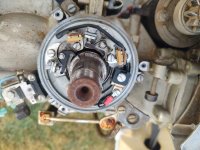
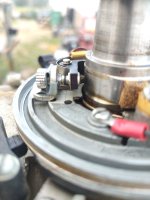
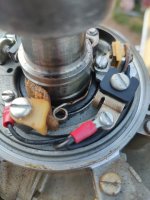
Ok awesome! That helps a little bit, I just pulled the flywheel off, the stator looks ok to me and tested at 1.0 ohms off the engine. The points look dirty to me and out of adjustment. I'm working on it now. Gotta dig out my feeler gauge. I don't see anything wrong with the cap or rotor. Going to clean points and adjust them. Then I will reassemble and do the tap test. Anti-reversing spring looks good moves freely and as described. Not grounded going clockwise grounded going counter clockwise.
 

Attachments

  • IMG_20260325_082256278_HDR.jpg
    IMG_20260325_082256278_HDR.jpg
    2.4 MB · Views: 2
  • IMG_20260325_080142945_HDR.jpg
    IMG_20260325_080142945_HDR.jpg
    1.6 MB · Views: 4
  • IMG_20260325_080116934_HDR.jpg
    IMG_20260325_080116934_HDR.jpg
    1.5 MB · Views: 4
  • 17744454869398416125156581688009.jpg
    17744454869398416125156581688009.jpg
    1.2 MB · Views: 4
  • 17744456248357912387804631981289.jpg
    17744456248357912387804631981289.jpg
    2 MB · Views: 3

sad boater

Cadet
Joined
Mar 23, 2026
Messages
11
????---You have to pull the flywheel.-----Check breaker point gap.----Clean rotor and distributor cap.---Check anti-reversing spring.
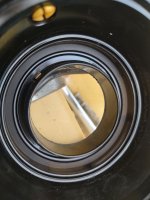
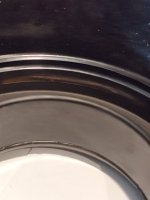
I found 3 distinct rub marks on the underside of the distributor, is this normal? Or should this be replaced? Cleaned and adjusted points, checked anti reversing spring, it's good.
 

Attachments

  • IMG_20260325_094856692.jpg
    IMG_20260325_094856692.jpg
    2 MB · Views: 2

sad boater

Cadet
Joined
Mar 23, 2026
Messages
11
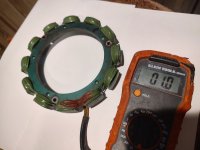
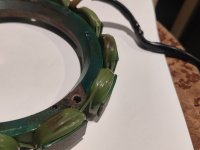
Question about the stator. I see some spots that appear burnt on the underside of the stator each spot coincides with the plug wire locations. Is this normal or a sign of spark escaping from my distributor?
 

Attachments

  • IMG_20260325_081959642_HDR.jpg
    IMG_20260325_081959642_HDR.jpg
    2.3 MB · Views: 1

Crosbyman

Admiral
Joined
Nov 5, 2006
Messages
6,023
hard to say for me anyway maybe Racerone can comment .. any burn marks are not very good and may indicate arcing althoug the stator is an AC generator not HV as in the ignition coil.

arcing may have taken place from a close by " hot spot" due to a " better" ground proximity than plug gaps. other than replacing suspect parts the only way to suppress arcing is what use to be called HV silicon or dorona dope which was more common in older TVs .. to stop arcing from the HV coils. looked it up but did not see such productsavailable...seems they call it " grease now" maybe it could help...stop any arcing

I will let racerone or other experts comment on this one.

but here is a comment from an intelligent source...


Q:....How can I stop arcing across 2 parts of an outboard ignition system does silicone corona dope exist like in the old TV days

Yes — what you remember from the old TV days does still exist, and your instinct is right… but with outboards, you have to be careful: arcing is almost always a symptom of a fault, not just an insulation problem.

🔧 Why arcing happens (same physics as CRT TVs)​

High-voltage ignition (20–40 kV) will always take the easiest path to ground. If it’s jumping somewhere it shouldn’t, it means:
  • Insulation is compromised (cracked coil, wire, boot)
  • Moisture or contamination is present
  • Gap somewhere is too large (plug gap, bad connection)
  • Internal component failure (coil, condenser, etc.)
For example, cracked coils or damaged insulation will let voltage leak or arc externally .

🛠️ Proper fixes (ranked from “correct” → “temporary”)​

1. Fix the root cause (best solution)

Do this first — otherwise any “dope” is just masking:
  • Inspect coil housing for cracks or carbon tracking
  • Replace old or brittle plug wires
  • Check boots for cuts or poor seating
  • Clean and dry everything (moisture is a big trigger)
  • Verify spark plug gap and condition
👉 Even a slightly loose terminal can raise voltage enough to force arcing elsewhere

2. Repair insulation (acceptable in some cases)

If the problem is clearly minor insulation damage, you can seal it:
  • Liquid electrical tape (neoprene dip)
  • RTV silicone (high-voltage rated)
  • Heat-shrink tubing (best for wires)
This is actually used in outboards:
sealing cracked coils or wires with insulating coating can restore insulation and stop leakage

3. Dielectric grease (limited use)

  • Good for sealing out moisture
  • Helps prevent tracking on boots
  • BUT it is an insulator, so:
    • use only a thin film
    • never fill connectors (can cause misfire)

⚡ What about “corona dope”? (your main question)​

✔ YES — it still exists​

  • Still sold as “corona dope” / insulating varnish
  • Used in:
    • high-voltage electronics
    • transformers
    • coil windings
Typical modern equivalents:
  • Insulating varnish
  • Glyptal / red enamel
  • MG Chemicals “Super Corona Dope”

⚠️ BUT for outboards:​

It’s not the preferred fix because:
  • Outboards vibrate → coating cracks
  • Salt/moisture → creeps under coating
  • If arcing is strong, it will burn through again
  • Usually indicates a failing coil or lead anyway
👉 In CRT TVs it worked well because parts were static and enclosed
👉 On an outboard, it’s usually temporary at best

👍 Practical recommendation (what I’d do)​

If you see arcing:

Step-by-step:​

  1. Run engine in the dark → locate exact arc point
  2. Clean + dry area thoroughly
  3. Inspect for:
    • cracks
    • carbon tracking (black lines)
  4. If damaged:
    • replace wire/coil (best)
  5. If minor:
    • apply liquid tape or RTV silicone
  6. Use dielectric grease only at boots (lightly)

💡 Bottom line​

  • ✔ Yes, corona dope still exists
  • ❌ But it’s not a real fix for most outboard ignition arcing
  • ✅ Best fix = eliminate the reason voltage is escaping

 
Last edited:
Top