Interesting article about tank condensation

jmarty10

Chief Petty Officer
Joined
Aug 6, 2007
Messages
560
Re: Interesting article about tank condensation

It seems like the guys who have fewer problems are the ones in the cold northern midwest. On the Atlantic coast it's a constant problem.

I think thats exactly the case. I ran my boat last week for first time of the year with 1/4 tank of gas from fall and new seperator. No problems this year or in years past. (As I knock on my wood desk)
 

smokeonthewater

Fleet Admiral
Joined
Dec 3, 2009
Messages
9,838
Re: Interesting article about tank condensation

The writer of the article failed to understand the cycle that produces the water in the tank.... At night the temp goes down and the air in the tank contracts and air is drawn in... at the same time the air in the tank is not able to hold as much moisture as it did at a higher temp so condensation occurs. The next day as temps rise the air in the tank expands and (slightly drier) air is pushed out the vent. The next night the cycle continues. If it gets say 5 drops per night for 6 months then what's that come to?
 

jeeperman

Lieutenant Commander
Joined
Aug 2, 2001
Messages
1,513
Re: Interesting article about tank condensation

From the article:

Research produced the following values for the maximum amount of liquid water in air at the following temperatures:

30C/86F 30 grams/cubic meter
20C/50F 17 grams/cubic meter
10C/13F 9 grams/cubic meter

I stopped reading at this point because:
20C=68F
10C=50F

If his research can't convert temperatures properly. I do not put much faith in it.:facepalm:

So what do you think 10C and 20C should be???
 

sublauxation

Lieutenant
Joined
Oct 13, 2008
Messages
1,317
Re: Interesting article about tank condensation

With some rough math it's about 450 average drops per fl oz, give or take 100. 15-20 drops per ML, and 29 ml per oz
 

wifisher

Chief Petty Officer
Joined
Mar 9, 2011
Messages
578
Re: Interesting article about tank condensation

So what do you think 10C and 20C should be???

Just as it says in my first post. Twenty degrees celcius is equal to sixty eight degrees fahrenheit. Ten degrees celcius is equal to fifty degrees fahrenheit.

It is not what I think it should be, it is what it is accepted to be by the entire scientific community.
 

emilsr

Senior Chief Petty Officer
Joined
Dec 16, 2010
Messages
774
Re: Interesting article about tank condensation

I say store full....because gas isn't likely to be cheaper in the spring. :cool:
 

dingbat

Supreme Mariner
Joined
Nov 20, 2001
Messages
17,014
Re: Interesting article about tank condensation

If it gets say 5 drops per night for 6 months then what's that come to?
How often do you refill the tank? Any excess moisture would be absorbed by the new "drier" gas you put into the tank and the answer would be little to none.
I keep my tanks 1/2 empty unless I need the extra fuel just for that reason.
 

lkbum

Chief Petty Officer
Joined
Sep 1, 2008
Messages
445
Re: Interesting article about tank condensation

The writer of the article failed to understand the cycle that produces the water in the tank.... At night the temp goes down and the air in the tank contracts and air is drawn in... at the same time the air in the tank is not able to hold as much moisture as it did at a higher temp so condensation occurs. The next day as temps rise the air in the tank expands and (slightly drier) air is pushed out the vent. The next night the cycle continues. If it gets say 5 drops per night for 6 months then what's that come to?

I think smokeonthewater has it correct...
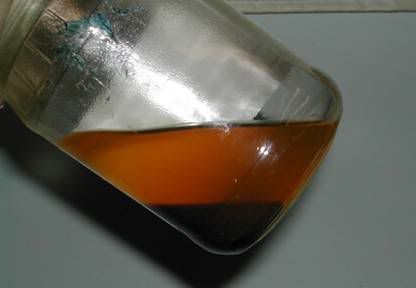
here's a photo of gas where the ethanol has become saturated and fallen out. I keep my tanks full.

gunk.jpg
 

smokeonthewater

Fleet Admiral
Joined
Dec 3, 2009
Messages
9,838
Re: Interesting article about tank condensation

How often do you refill the tank?

During long term storage???????????????? nobody fills the tank regularly during long term storage which is what this whole debate is about......:facepalm:


Now during the summer I struggle to keep it over 1/4.. If I can afford more gas then I go boating more :D
 

HT32BSX115

Supreme Mariner
Joined
Dec 8, 2005
Messages
10,083
Re: Interesting article about tank condensation

I always store my things with a full tank..... never had a problem with water in the tank....

That's good. I own a 1947 Stinson 108-2 Station Wagon. (that's an airplane for those that are aviation challenged) It has 22 gallon fuel tanks (1 in each wing....40 total usable)

I have owned it since 1981 (that's 30 years for those that are math challenged)

I've NEVER consistently stored it with full tanks. I've NEVER drained water from either tank.

My 1987 Four Winns Liberator has a 44 gallon tank. It was NEVER consistently stored with a full tank(I store it with about 1/4 tank) I removed the tank expecting to find water, when I bought it from my brother(who bought it new) about 6 years ago.

There was no evidence of water.

What should I conclude?
 

lkbum

Chief Petty Officer
Joined
Sep 1, 2008
Messages
445
Re: Interesting article about tank condensation

That's good. I own a 1947 Stinson 108-2 Station Wagon. (that's an airplane for those that are aviation challenged) It has 22 gallon fuel tanks (1 in each wing....40 total usable)

I have owned it since 1981 (that's 30 years for those that are math challenged)

I've NEVER consistently stored it with full tanks. I've NEVER drained water from either tank.

My 1987 Four Winns Liberator has a 44 gallon tank. It was NEVER consistently stored with a full tank(I store it with about 1/4 tank) I removed the tank expecting to find water, when I bought it from my brother(who bought it new) about 6 years ago.
There was no evidence of water.

What should I conclude?

Where is your boat located? In the south (Atlanta for me), the air reaches it's dew point virtually every night (at least in the summer). And in the summer, day night max/min temperatures are 40F (or so) apart which makes the thermal syphoning smokeonthewater pointed out significant. A possible conclusion you could draw would be that location is important when considering environmental effects. OT- Are you a C-17 pilot?
 

smokeonthewater

Fleet Admiral
Joined
Dec 3, 2009
Messages
9,838
Re: Interesting article about tank condensation

That's good. I own a 1947 Stinson 108-2 Station Wagon. (that's an airplane for those that are aviation challenged) It has 22 gallon fuel tanks (1 in each wing....40 total usable)

I have owned it since 1981 (that's 30 years for those that are math challenged)

I've NEVER consistently stored it with full tanks. I've NEVER drained water from either tank.

My 1987 Four Winns Liberator has a 44 gallon tank. It was NEVER consistently stored with a full tank(I store it with about 1/4 tank) I removed the tank expecting to find water, when I bought it from my brother(who bought it new) about 6 years ago.

There was no evidence of water.

What should I conclude?

that you live in the north and have relatively low humidity and low temps
 

jeeperman

Lieutenant Commander
Joined
Aug 2, 2001
Messages
1,513
Re: Interesting article about tank condensation

Just as it says in my first post. Twenty degrees celcius is equal to sixty eight degrees fahrenheit. Ten degrees celcius is equal to fifty degrees fahrenheit.

It is not what I think it should be, it is what it is accepted to be by the entire scientific community.

My bad, I read it wrong, sorry.
 

Home Cookin'

Fleet Admiral
Joined
May 26, 2009
Messages
9,715
Re: Interesting article about tank condensation

one important point that this discussion seems to overlook--the ethanol poisoning occurs with gas that isn't turned over. It takes 30 days or more to start getting funky, which is why it isn't a problem in most cars. During the boating season, those who use the boats a lot, adding fresh gas, burning gas, don't have the problems like the ones who get out once a month or only for short trips.

The discussion is good, but too anecdotal, with no consistent "control" to get too scientific about.
 
Top