






1989 Bayliner Capri 1902 hull separation

calebjcannon

Cadet
Joined
Apr 13, 2015
Messages
7
Greetings, all!

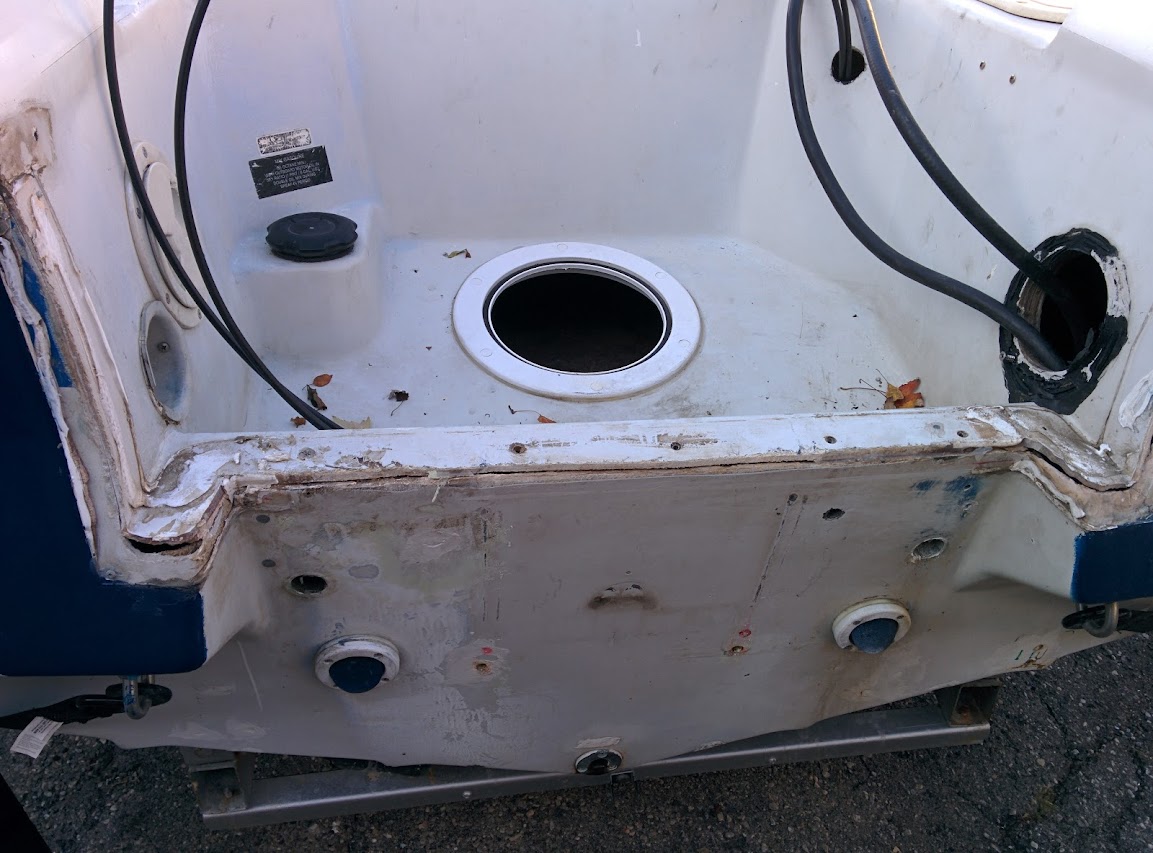
I am new to boats, and even newer to working on them. I recently acquired a 1989 Bayliner and long story short, it runs great, but takes on a pretty substantial amount of water. I originally thought it was just due to a couple loose tie-down D-rings and swim ladder bolts, but after looking inside the boat when running down the lake, I noticed the water was coming in from all around the transom. Upon closer examination once out of the lake, noticed some PO's horrid attempt at a repair, and covered it up with the shroud that covers the seam. The pics speak for themselves...


I've read and done plenty of research on transom, stringer, and floor replacement, but I can't find much on what to do about this!

I'm just wanting to fix this enough to last a season, and over next winter, I want to fully redo the floor, transom, and stringers.

Any and all advice is appreciated.

Best regards,

Caleb
 

jbcurt00

Moderator
Staff member
Joined
Oct 25, 2011
Messages
25,262
Caleb, unfortunately, from your description and pix, this isn't going to be an easy or quick fix to get thru this season. It is much more likely a park the boat until you can tear into it, and when you do it's likely to be a full tear down to do complete transom, stringers and deck replacements.

In use, underway, w/ little to no warning, bad stuff can happen. Quickly. When it does, you can't just pull over, stop and get out.

You've already dug in to the forum and seen what this typically entails, and theres a reason you couldn't find much info on a temp/quick fix. There really isn't one.
 

calebjcannon

Cadet
Joined
Apr 13, 2015
Messages
7
Caleb, unfortunately, from your description and pix, this isn't going to be an easy or quick fix to get thru this season. It is much more likely a park the boat until you can tear into it, and when you do it's likely to be a full tear down to do complete transom, stringers and deck replacements.

In use, underway, w/ little to no warning, bad stuff can happen. Quickly. When it does, you can't just pull over, stop and get out.

You've already dug in to the forum and seen what this typically entails, and theres a reason you couldn't find much info on a temp/quick fix. There really isn't one.


I was afraid of that. That's just the thing though...I really have no idea where to begin. The transom is pretty solid, as is the floor. I have no doubt there's some degree of rot lurking underneath, simply due to age. Even if I were to do a hull-up resto, I'm unsure what needs to be done about correcting the separation issue.

Would cleaning the seams up, then rebonding with poly/glass mat be the thing to do?
 

Bondo

Moderator
Staff member
Joined
Apr 17, 2002
Messages
71,418
The transom is pretty solid, as is the floor. I have no doubt there's some degree of rot lurking underneath, simply due to age. Even if I were to do a hull-up resto, I'm unsure what needs to be done about correcting the separation issue.

Would cleaning the seams up, then rebonding with poly/glass mat be the thing to do?

Ayuh,.... Welcome Aboard,..... What yer seein', is caused by the rotten transom, not just some bit of delamination,.....

The transom is Not Ok to run,...... It appears Bad enough, the motor could be lost on a hard launch,....
 

calebjcannon

Cadet
Joined
Apr 13, 2015
Messages
7
Ayuh,.... Welcome Aboard,..... What yer seein', is caused by the rotten transom, not just some bit of delamination,.....

The transom is Not Ok to run,...... It appears Bad enough, the motor could be lost on a hard launch,....


I gotcha. Ok, so is my thought process correct on this...

Transom has rot. Rot caused weight of motor to sag transom, pulling it down, and thus separating the seams?
 

Arawak

Chief Petty Officer
Joined
Aug 27, 2010
Messages
486
Your transom may very well be rotten, but most of what you are showing there is just poor Bayliner construction and someone's attempt to repair it. Except for the part where the top of the transom (where the engine sits) meets the cap, a rotten transom could not really cause those gaps. For comparison, have a look at my 88 17 footer before I started the rebuild:

IMG_20141009_172736.jpg


Not quite as pronounced, but the gaps are there and poorly repaired by PO (or possibly factory!).

Here's the thing... if you are taking on serious water from where the cap meets the hull, you a waaaay overweight in the stern. That alone indicates wet foam, and wet or rotten wood. Have a look at my project to see what you may be looking at.

The transoms on these models are pitifully small squarish pieces of plywood. Due to the hull shape they are not even as wide as the splash well.

I suspect the cause of your water ingress is elsewhere... the scuppers which due to hull design must be located below the waterline, or maybe the scupper hose. Or possibly the through hull for the livewell.

In any case I'd echo the caution that others have made above, that you'd probably not want to be putting her in the water until you have sorted out the problem.

Removing the cap/tub is not trivial, but it is do-able and you will need to do it in order to know what you've got going on.

See also fisheymikey's project which is very close to yours and mine.
 

calebjcannon

Cadet
Joined
Apr 13, 2015
Messages
7
Your transom may very well be rotten, but most of what you are showing there is just poor Bayliner construction and someone's attempt to repair it. Except for the part where the top of the transom (where the engine sits) meets the cap, a rotten transom could not really cause those gaps. For comparison, have a look at my 88 17 footer before I started the rebuild:

IMG_20141009_172736.jpg


Not quite as pronounced, but the gaps are there and poorly repaired by PO (or possibly factory!).

Here's the thing... if you are taking on serious water from where the cap meets the hull, you a waaaay overweight in the stern. That alone indicates wet foam, and wet or rotten wood. Have a look at my project to see what you may be looking at.

The transoms on these models are pitifully small squarish pieces of plywood. Due to the hull shape they are not even as wide as the splash well.

I suspect the cause of your water ingress is elsewhere... the scuppers which due to hull design must be located below the waterline, or maybe the scupper hose. Or possibly the through hull for the livewell.

In any case I'd echo the caution that others have made above, that you'd probably not want to be putting her in the water until you have sorted out the problem.

Removing the cap/tub is not trivial, but it is do-able and you will need to do it in order to know what you've got going on.

See also fisheymikey's project which is very close to yours and mine.


thanks for all the great info. What exactly is a scupper?

Here's an anecdote regarding water intake...I put the boat in, and took off for about 30 min. I then idled and stopped. I checked the bilge, and it was nearly full of water. I flipped the bilge pump on and drained a pretty substantial quantity of water out. Once the bilge quit spitting water out, I turned it off and floated for about an hour. I then checked the bilge area again and no water was present. A short burst of the pump to double check, and no water was present.

I then started heading down the river again, but this time I was under the doghouse looking and my friend driving. I observed water coming in all along the transom seam where it's cracked. I carefully checked everywhere else I could in the transom area didn't see anything coming any in anywhere else. I then pumped off the water taken on, and turned the boat off and let it float again for 30 min or so. Again, no water was taken on when idle. I also noticed the stern of the boat rooster tails water a lot when running at speed, and it splashes all over the splash well and transom area. The splashing must be where the water is coming from, as the crack area is above water line.
 

Bondo

Moderator
Staff member
Joined
Apr 17, 2002
Messages
71,418
I also noticed the stern of the boat rooster tails water a lot when running at speed, and it splashes all over the splash well and transom area. The splashing must be where the water is coming from, as the crack area is above water line.

Ayuh,.... Ya might have other issues,.... How deep below the keel is the prop,..??
 

Arawak

Chief Petty Officer
Joined
Aug 27, 2010
Messages
486
thanks for all the great info. What exactly is a scupper?

Well technically a scupper is any sort of drain at the bottom of an open structure, like a self bailing boat's deck. Just realised that your Capri doesn't have them.

I then started heading down the river again, but this time I was under the doghouse looking and my friend driving. I observed water coming in all along the transom seam where it's cracked.

You must not have been on plane. The bow was up in the air and and stern was buried?
 

calebjcannon

Cadet
Joined
Apr 13, 2015
Messages
7
Well technically a scupper is any sort of drain at the bottom of an open structure, like a self bailing boat's deck. Just realised that your Capri doesn't have them.


You must not have been on plane. The bow was up in the air and and stern was buried?


Ahhh, ok.

I was on plane. This was at around 35 mph.
 

calebjcannon

Cadet
Joined
Apr 13, 2015
Messages
7
Hmmmm.... if the water is that high on plane I think something is really bad.


What do you mean if water is that high? Like splashing that high? The transom seam wasn't submerged, but it kicked up a pretty impressive rooster tail.
 
Top