thanks for the insight...a few questions regarding your response...
1. why cedar? is there much of a difference with what type of wood used (except hard wood), especially if i plan to fully wrap it in glass and resin?
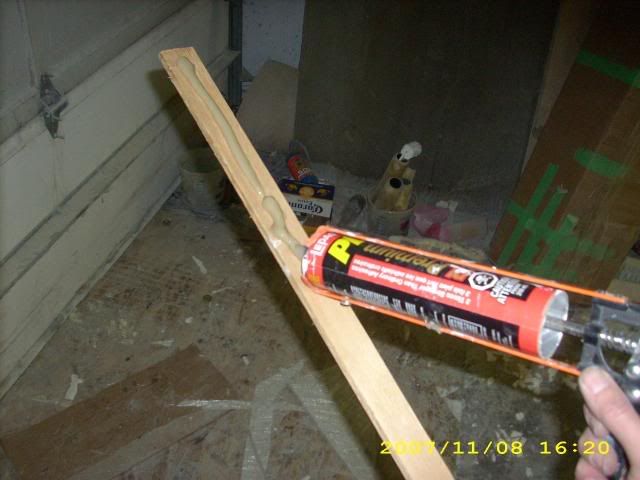
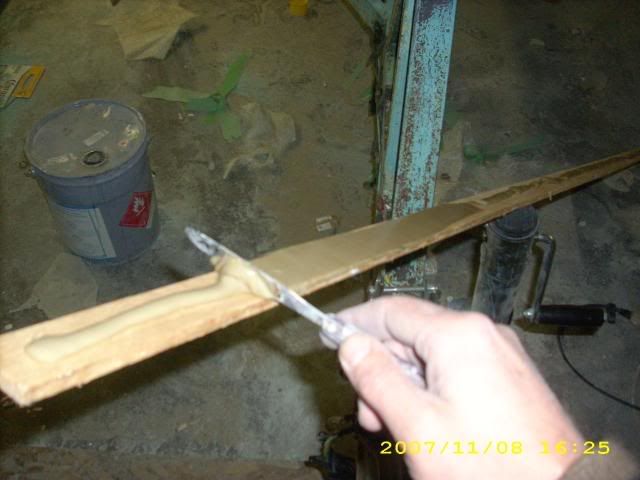
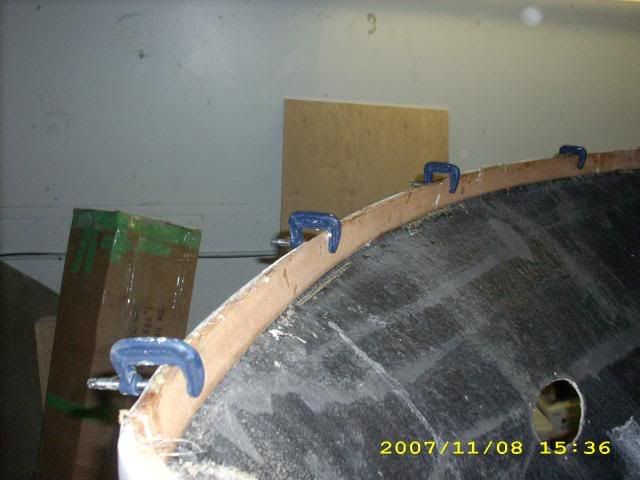
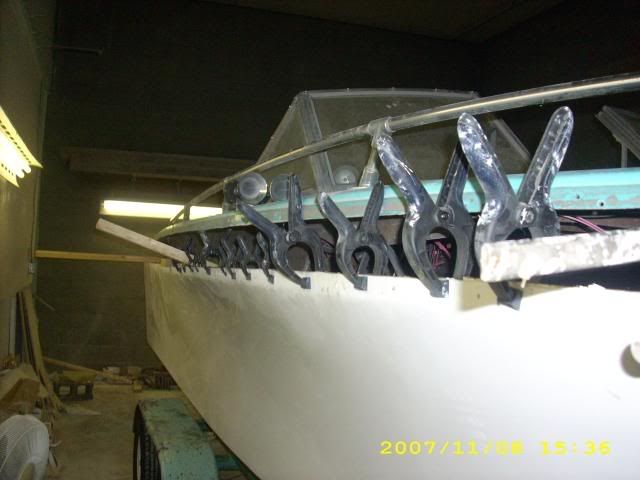
The cedar was pre cut, the perfect size, so i used it,,,,,it just needs to be a backing plate for the bolts I am using. glass ing the backing for the reevits or bolts is really over kill. It will also add rigidity to the cap. this will make it very difficult when fitting the cap back on.....it can be a real pain at the best of times, and with the extra rigidity, it might be near impossible.
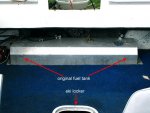
2. so i guess regarding the gas tank...6 of one / half dozen of the other...both have their pros and cons...just a preference choice....
Pretty much, except the fittings and tank well is the factor over having one custom made and buying a pre built one off iboats
3. wrapping hull - an additional 100 lbs is not that bad when considering the boat had all that extra water weight...approximately how much extra weight would the two layers of 1.5 csm add? which would be better 1 layer of 1708 or two layers of 1.5 csm?...and why...
Two layers of CSM is far lighter than a single layer and a full wrap of 1708 the 1708 is 25 oz per yard plus the weight of the 1.5 CSM.....that means you are at 26.5 oz per yard plus another 10 gals of resin that you will need to use for the big knitted fabric.
Two layers of csm will add rigidity to the hull in significant values to do what you want......the extra layers ...plus the foam will stiffen the hull great, plus it will keep some of the flex for a softer ride.
you can go with the single layer of CSM and 1708,,,,it will work...and work well.....but the hull will stiffen, and your ride will change a stiff hull is great.....but it will really bang down coming off a big wave.....if you plan on no foam.....i would do a full CSM and 1708 wrap.
either way......the wraps should come up to the deck line......then the tabbing of the deck will continue another 6 inches up the hull.
this subject actually leads into a discover i made today while grinding and sanding....i will try to explain as best i can, along with a few pics...
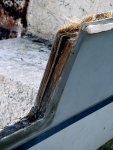
Today, while grinding, cutting and sanding the last little bit if the plywood from the transom (along the bottom edge of the transom and the hull), being so close to this area with my face, as i has to be really careful not to go thru the transom, i noticed a few things;
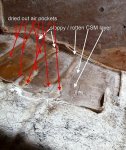
a). the white speckled hard surface is the top surface, then under this is a really bad / sloppy csm layer with tons of dry areas which look like old rotted air bubbles / pockets that were never taken care of when they installed this layer, then under this layer is another layer of what looks like nice thick glass...so there seems to be 3 layers of various types of glass work...the white layer is tough to grind, the second layer is pretty easy to grind, the third layer is what i want to get down to and this will be my starting point. Is this correct? from this layer, i will add a few layers of 1.5 csm or a nice layer of 1708...let me know your thoughts...
View attachment 125516
the white speceled layer is the flow coat over the glass....under it is a chopped strand and resin mix that came out of a chopper gun......the bubbled areas are where the manufacturers did not use resin rollers to roll out the hull properly......this is common on faster production lines. i would just grind off the flow coat over the glass, but not take off the chopped.....(except any loose strand areas) this will give you a solid surface to bond the new layer to.
If you do grind too deep, just add a single CSM and a 1708 over the area to re inforce the hull
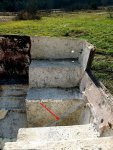
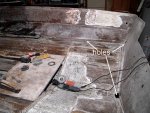
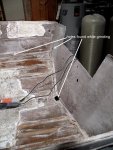
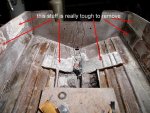
b) while grinding, i noticed what i would call "hull ribs". They are about 1" thick. There are three on both sides of the hull floor, running the full length of the hull. They are in pretty bad shape. they are under the really bad layer of CSM. i uncovered a few inches of two of these ribs, near the transom, and found that they are pretty wet and somewhat rotten. what is their purpose? they seem to be simply placed on the hull floor and then glassed over...are they actually needed? if so, i am assuming that i will have to remove and replace all of them...correct? if so, what type of wood should be used?
View attachment 125517
View attachment 125518
I like those ribs, or mock stringers ! those will stregnthen the hull tremendously,,,,,,any time you have glass in bulk like an ibeam.....the structural integrity is doubled or tripled.
I would cut out the rot, and replace them........remember .....the rule of thumb....is replace what was there !
thanks for any input!
i have a few more questions that i will post in a little while...