1978 Mercury 70hp Worth Messing With?

Berdink

Chief Petty Officer
Joined
Mar 5, 2020
Messages
522
Not a robust lower unit for a 70 HP.----And 2 carburetors for 3 cylinders.----Not on my list of favorite motors.
Yeah, my research is telling me this same lower unit is used all the way down to a 30hp. And the 70hp was the biggest motor they used this lower unit on.
It does look really small.
.
Google keeps giving me different answers for this motors weight.
Sometimes it says 250 or so, sometimes it says 190-200.
I don't think it weighs anywhere near 250.
 

racerone

Honorary Supreme Mariner
Joined
Dec 28, 2013
Messages
39,925
In my opinion it was designed ( in a hurry ) to compete with the hot selling OMC 3 cylinder motors of that era.
 

Mc Tool

Lieutenant Commander
Joined
Aug 7, 2024
Messages
1,904
In my opinion it was designed ( in a hurry ) to compete with the hot selling OMC 3 cylinder motors of that era.
Yeah ,Im thinkin the 2 carbs for 3 cylinders is a bit of a patch job using what was laying around at the time ....and probly same thing with the small-ish lower unit .šŸ™‚
 

jimmbo

Supreme Mariner
Joined
May 24, 2004
Messages
14,665
Yeah ,Im thinkin the 2 carbs for 3 cylinders is a bit of a patch job using what was laying around at the time ....and probly same thing with the small-ish lower unit .šŸ™‚
It was that way because of the Design of the Reeds, Mercury had on their Production Inlines. In 76, merc did make a 650XS which had the same Bore and Stroke, and thus displacement, but it used an entirely different induction System, with Reeds on V-Blocks, and it had 3 carbs. It was rated at 90hp with an WOT range of 6000-7000 rpm. Still used the modified Crossflow Induction Merc called Direct Charge. I'm sure the Port Timing and Exhaust Tuning were different.
 

Mc Tool

Lieutenant Commander
Joined
Aug 7, 2024
Messages
1,904
It was that way because of the Design of the Reeds, Mercury had on their Production Inlines. In 76, merc did make a 650XS which had the same Bore and Stroke, and thus displacement, but it used an entirely different induction System, with Reeds on V-Blocks, and it had 3 carbs. It was rated at 90hp with an WOT range of 6000-7000 rpm. Still used the modified Crossflow Induction Merc called Direct Charge. I'm sure the Port Timing and Exhaust Tuning were different.
Thanks jimmbo . Guess it what one is used to seeing , all the motorbikes I recall had one carb per pot , and then I saw some 2 strokes feeding multiple cylinders from a plenum with one carb ( I guess a bit like a V8 with a 2 or 4 barrel carb on a distribution manifold ) ....so why not 2 carbs if it gets you to the required cfm .
Im coming round to the outboard way of doing things ......I mean they are pretty lazy compared to other 2 strokes but an under stressed motor is going to be both more reliable and durable . There is little point in racing out to spot X in a highly strung 2 stroke if it munches a piston or a big end on the way and you have to paddle home :)
 

jimmbo

Supreme Mariner
Joined
May 24, 2004
Messages
14,665
The problem with the 2 carbs for 3 cylinders is that a 3 cylinder has 120 degrees between inhalations in the induction systems. With merc's usual 2 cylinders per carb, the flow was smooth and even as the cylinders combined, inhaled 180 degrees apart. With the 2 carb for 3 cylinders, each carb was feeding 1 1/2 cylinders, and sharing that 1/2 cylinder with another carb. That created some very uneven air flows through the carb, as sometimes it was only supplying to one Cylinder, but at some point it would be supplying for 1 1/2 Cylinders, then it would only be supplying for 1/2 of a Cylinder. The other Carb was facing the same thing. Calibrating the Fuel Delivery Curve of the Carbs was a real challenge for the Mercury Engineers.
It also made for some difficult Exhaust Tuning, as the resulting Mixtures to the Cylinders were different, which affected the Exhaust Pulse, and thereby the engine's power output.
These Engines had a very different Sound to them, than any of the other Mercury Engines of the Era.
Not the best engineering from Mercury
 

Mc Tool

Lieutenant Commander
Joined
Aug 7, 2024
Messages
1,904
the design of the plenum could have a bearing on the 120 deg intake pulses , being that one carb would be drawn on evenly its the physical location of two carbs in relation to the reeds that becomes an issue , however I suspect the Mercury probly didnt spend a lot of time or money worrying about that and just bunged em on where it was easiest :)
One could argue that 3 cylinders would have a more even flow thru a plenum than two, and get away with a smaller venturi sectional area for the same combined cylinder volume 😁😁
 

jimmbo

Supreme Mariner
Joined
May 24, 2004
Messages
14,665
Inline Merc of that lineage do not have a Plenum.
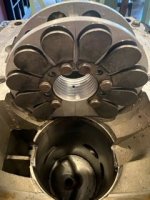
This pic is of the top two cylinders of a inline six. The above mention 3 would have another Reed block and Carb, between the 2nd and 3rd cylinder, not that main Bearing Block.
reeds.jpg
 

jimmbo

Supreme Mariner
Joined
May 24, 2004
Messages
14,665
Both Reed Blocks have reeds on both sides, which is how the center cylinder would draw from both carbs
 

Texasmark

Supreme Mariner
Joined
Dec 20, 2005
Messages
15,043
In my opinion it was designed ( in a hurry ) to compete with the hot selling OMC 3 cylinder motors of that era.
The OMC 3 was Loop Charged which made a BIG difference in fuel consumption plus a redesigned, streamlined, lower unit. In looking at later sales brochures I notice that the Merc. 75 has 3 carbs and is also Loop Charged.....don't know if the earlier model 70 with 2 carbs was a Looper or not.
 

Chris1956

Honorary Supreme Mariner
Joined
Mar 25, 2004
Messages
29,144
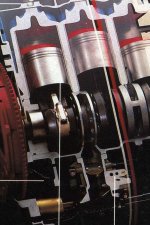
Reed blocks on the inline Mercs were placed between cylinders. The reed blocks had petals on each side allowing air/fuel to pass into each cylinder's crankcase. The reed blocks also had concentric rings of aluminum on the parts that ringed the crankshaft. These acted as seals between the cylinders, which is essential for multi cylinder 2 cycle motors. The reed blocks did not have bearings inside them. Main bearings were above and below cylinder pairs. That worked great for IL6, 4- and 2-cylinder motors.

In the case of a 3 cylinder IL motor with 2 carbs, there would need to be a different setup, both reed blocks would need main bearings inside them.
 

Mc Tool

Lieutenant Commander
Joined
Aug 7, 2024
Messages
1,904
Reed blocks on the inline Mercs were placed between cylinders. The reed blocks had petals on each side allowing air/fuel to pass into each cylinder's crankcase. The reed blocks also had concentric rings of aluminum on the parts that ringed the crankshaft. These acted as seals between the cylinders, which is essential for multi cylinder 2 cycle motors. The reed blocks did not have bearings inside them. Main bearings were above and below cylinder pairs. That worked great for IL6, 4- and 2-cylinder motors.

In the case of a 3 cylinder IL motor with 2 carbs, there would need to be a different setup, both reed blocks would need main bearings inside them.
on motorbike the concentric ally rings you mention are called labyrinth seals , and they dont actually contact the crankshaft , Im not sure of the clearance but it aint much .:)
 

Berdink

Chief Petty Officer
Joined
Mar 5, 2020
Messages
522
...
You might swap coils and see if spark returns to #2. If so, replace the coil. If not the stator or CDI unit is likely bad. There should be ohm specs for the stator.
Rather than taking the coils out to swap them, I could just temporarily move the green wire from #1 to #2 to verify if #2 coil is good, correct?
1000021034.jpg
 

Mc Tool

Lieutenant Commander
Joined
Aug 7, 2024
Messages
1,904
Yes but the spark would be in the wrong place but if you then get spark on #2 coil it would indicate that the cdi was crook
 

Berdink

Chief Petty Officer
Joined
Mar 5, 2020
Messages
522
Yeah, it just seems easier to temporarily move one wire than to move the coils.
I'd put things back of course.
But if when I do that, and #2 then has spark, I know it's not a bad coil.
 
Top