1973 Johnson 20hp

jpcurran

Cadet
Joined
Sep 30, 2011
Messages
8
I have a 1973 Johnson that is a friends and he wants me to try to bring it back to life after I got my 1959 johnson 10hp running. It is not seized which is a great start. I am starting out by replacing oil, water pump, fuel lines, coils,condensers, maybe points, some gaskets, spark plugs, and a few odd and end things as well. I know very little about motors but enjoy the DIY project. Any info on what I need to do to get this thing going would be appreciated! I may rebuild the carb, only after I get it running though. Please let me know if I need to replace anything else. Dumb it down for me since I don't know a lot about these motors or parts.
 

Will Bark

Lieutenant
Joined
Aug 1, 2010
Messages
1,470
Re: 1973 Johnson 20hp

Need to give the model # so the gurus can really give you the help. Good luck
 

eavega

Lieutenant
Joined
Apr 29, 2008
Messages
1,377
Re: 1973 Johnson 20hp

Start with the basics; fuel, compression, spark. If any of those are out, then you have a better starting point than just catching up with PM. Not that you shouldn't do any of that other stuff, but it would suck to replace an impeller, t-stat, seals, spark plugs, coils, condensers, points, fuel lines, etc, etc, and then find out that the top cylinder has no compression because there is a big ole hole in it.

Rgds
 

jpcurran

Cadet
Joined
Sep 30, 2011
Messages
8
Re: 1973 Johnson 20hp

Start with the basics; fuel, compression, spark. If any of those are out, then you have a better starting point than just catching up with PM. Not that you shouldn't do any of that other stuff, but it would suck to replace an impeller, t-stat, seals, spark plugs, coils, condensers, points, fuel lines, etc, etc, and then find out that the top cylinder has no compression because there is a big ole hole in it.

Rgds

Stupid question but I want to learn, how do I check compression? I have pulled on the rope and all but how do I actually check compression? Spark? Thanks!
 

AlTn

Commander
Joined
Mar 9, 2010
Messages
2,813
Re: 1973 Johnson 20hp

buy, rent, borrow a compression gauge and the procedure is listed in The Top Secret Files..youtube , no doubt, has vids of this
 

steelespike

Supreme Mariner
Joined
Apr 26, 2002
Messages
19,069
Re: 1973 Johnson 20hp

look in the secret files at the top of the page for title that fits your problem regarding awakening a sleeping outboard.
Any clarification feel free to ask we're here to help.
basic compression check remove the plugs,stick in or screw in the compression tester pull the rope 3 or 4 times
and read the pressure.release the reading and do the other cylinder.
100 psi would be wonderful ,within 10% between cylinders.
if readings are low a "decarb" may solve the problem.We can explain if the need arrises.
 

eavega

Lieutenant
Joined
Apr 29, 2008
Messages
1,377
Re: 1973 Johnson 20hp

how do I actually check compression?

Compression tester should be part of your tool case if you intend on running older motors. It is one of the basic checks you should make when something is not running right with the motor. You can get one at any auto parts store (pricey) or if you have a Harbor Freight nearby I think they go for like $20 or so. As AITn noted, there is a procedure in the Top Secret Files, but basically you take out the spark plugs, screw the compression gauge into the spark plug hole, give it about 5 good pulls, and read the gauge. Reading should be above 60 PSI or so, but more importantly is that the two cylinders read within 10% of each other. You may want to shoot some premix gas into the cylinder through the spark plug hole and turn the flywheel by hand a couple of time just to make sure it has adequate lubrication.

Spark? Thanks!

While at the auto parts store (or at Harbor Freight) get an inline adjustable gap spark tester. with the plugs out you clip one end of the tester to a ground, spark plug wire to the other end of the tester. Set the gap to the appropriate distance (I want to say its about a half inch) and give the motor a good pull on the pull-starter. You should get a bright blue spark with a good snap.


another tool you should have for diagnostic purposes if you are going to keep one of these old engines running; a good multimeter with a DVA adapter or a peak voltage setting.

Good luck.
 

cajuncook1

Chief Petty Officer
Joined
Sep 3, 2009
Messages
559
Re: 1973 Johnson 20hp

Read the information below, it will help you get organized. I posted this for another individual an it helped him out. I follow the same logic, reasoning and pattern when I get a new project motor. All of it may not apply directly to you will get the general idea.


Here is some guidance that will help you evaluate your motor and help us help you!


Now you want to use a systematic approach to assess your engine's problem. Sure, it maybe just needing a carb kit and cleaning and your on your way. But if you a systematic approach to evaluating a motor then you become more efficient than you just guessing and changing out parts.

You will see a lot of experience guys ask about compression, spark and fuel. (They are using a systematic approach to diagnosing an engine problem or problems....in this order)

C= compression ( if your compression is low are uneven between cylinders >10% then others checks don't matter until the that is resolved) Low compression will cause your motor not run or run very poorly.

S= Spark (if your have problems with your ignition then you can have the cleanest carb and great fuel delivery but it will run bad or not at all)

F= Fuel (if your carbs are not clean and fast/slow idle needle are not set right then it will run but like crap. If you have it set too lean then you run the risk of poor fuel/oil delivery and damage your pistons and cylinders then you run into the problem of C (poor compression from damage).

For your motor to run and run well (this a general statement) all three of above categories need to be fulfilled.

So it is advisable to get a manual for your motor. Excellent resource, specifications, and diagrams.


How to check compression: (remember to remove both spark plugs) You can get a compression guage for about $10 to 12 dollar at harbor freight or auto zone) auto zone will let you borrow one with a refundable deposit)

http://forums.iboats.com/showthread.php?t=391323

http://www.youtube.com/watch?v=PyCw4SiuT2I (gives you visual)

How to check for spark.(with a spark checker) about $6 at autozone (or similar store)...harbor freight store. You will also need a feeler guage to gap your spark plugs to 0.030 (feeler gauge is about $3 to 4 dollars)

- adjust the spark test to about 1/4 inches or so. It should be a good strong blue spark. (don't forget to ground the tester to the motor)

http://forums.iboats.com/showthread.php?t=294072

http://www.youtube.com/watch?v=lk70oyUEftY (general visual)

Here is link with some information regarding your ignition. (Your ignition will have a driver coil that will send spark to the 2 coils mounted on your cylinder head. It is a little different from the ignition information posted, but will give a good idea regarding cleaning and setting your points and testing your coils)

http://forums.iboats.com/showthread.php?t=531940


Carburetor adjustments

http://forums.iboats.com/showthread.php?t=167352

Carburetor cleaning instructions


http://forums.iboats.com/showthread.php?t=244013

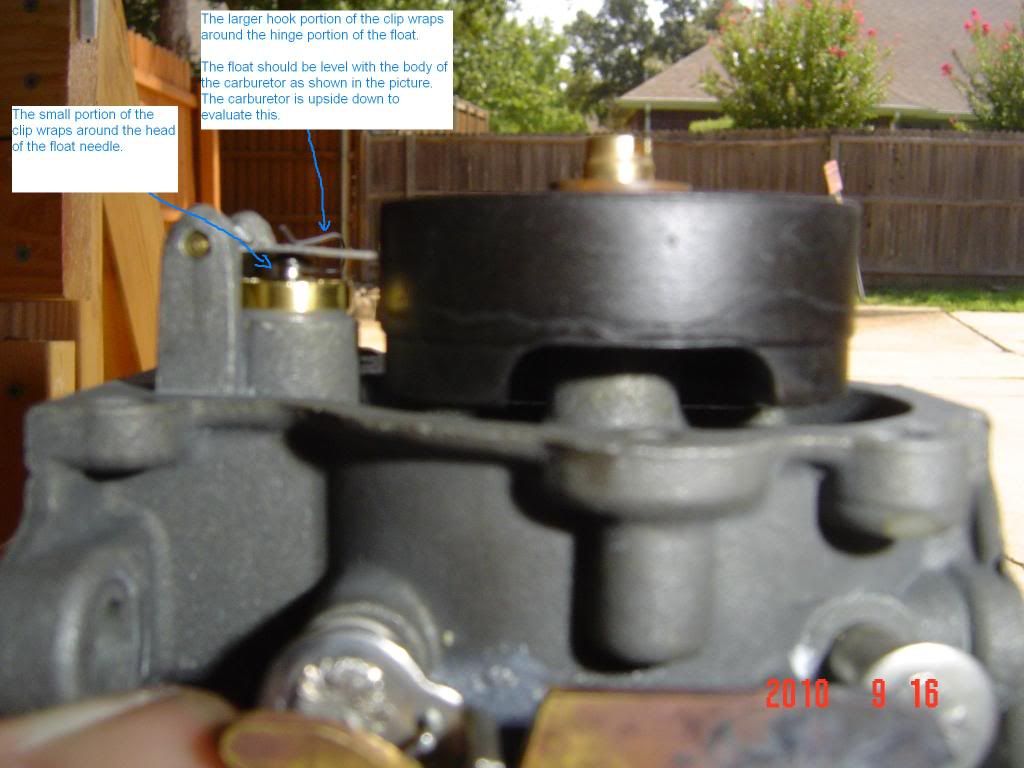
Here is a picture of how the float should lay.

levelfloatandclipinformation.jpg


Check to make sure the vent cap or plug on the tank is open. If it is not open then the motor will run ok for a little bit and die or run poorly. The vent cap or plug has to be open to allow air to enter the tank so fuel can easily be pumped out of the tank by the fuel pump. If the vent cap or plug is closed then the fuel pump has to work against a negative system created in the tank, and you may get low or no flow from the tank.**** Make a long story short, make sure the vent cap/plug is open and try to start your motor.

Also check to see if the fuel line bulb near the tank has the arrow pointing toward the motor and pumps up somewhat firm.


Here is a electronic parts diagram of your motor, so that will help you a bit.


http://www.marineengine.com/parts/johnson-evinrude-parts.php?year=1973&hp=20&model=20R73A


Get some compression numbers and check your spark with a tester and report back with your finding and a seasoned and experience member can assist you better. (Be sure to have your motor in water to run, if not you run the risk of damaging the water pump and not cooling the powerhead and burning it up.)

Proper fuel to oil ratio is 50:1

8oz TCW-3 oil with 3 gallons of gas(87 octane)....mixed well.


Good luck buddy! Hope you sort things out and get her running soon!
 

jpcurran

Cadet
Joined
Sep 30, 2011
Messages
8
Re: 1973 Johnson 20hp

Thanks for all the input. I rented a compression gauge for now and I followed the directions and did a "dry" test and got readings from each spark plug hole of 60. I was not at a great angle to pull the starter rope but it also pulled OK. I say OK because it definately does not pull as well as my 1959 Johnson does. Also, when I pull the starter rope I noticed that the prop turns too. Why does that turn because it doesn't do that on my 1959 Johnson. It's in neutral but I am not sure why it is doing that. Thanks for all the advice and input!
 

kfa4303

Banned
Joined
Sep 17, 2010
Messages
6,094
Re: 1973 Johnson 20hp

HI jp. For starters, the prop should definitely NOT be spinning when you try to start either motor! Turn the throttle all the way down, make sure the motor is in neutral, then turn throttle back to the START position and fire them up. Believe it or not, 60 psi isn't too bad. It's more important that the cylinders be within 10% psi of each other. The compression will probably go up once you start the motor properly in neutral and can get a better angle to pull from. Spraying a bit of PB blaster or WD-40 into the cylinders prior to checking the compression is also a good idea and should help the compression too. It may also go up once the motor has had a chance to warm up. I've had both the 10 hp and 20/18 hp motors. While the 20 hp isn't that bad to pull start, it makes the 10 hp seem like a piece of cake. My old '61 10 HP would start if I so much as touched the pull rope. I have to give my 20 hp a pretty stout tug, but she fires up on the first pull virtually every time. Hope that helps. Holler if you get stuck.
 

cajuncook1

Chief Petty Officer
Joined
Sep 3, 2009
Messages
559
Re: 1973 Johnson 20hp

Well, I have to say, that 60psi for a 1973 20hp is not good. Yes the values are even but in reality that year and model powerhead should have about 100psi or greater to idle and run smooth. 90 Psi would be bare minimum. The compression numbers are saying something wrong right off the bat.

Again, lets not jump to the worst conclusion until the motor can be taken out of gear and proper compression reading can be obtain. It is best to get compression number if the cylinder "dry and without extra lubrication that can falsely raise numbers.


- Did you snug the compressor guage fitting in well and did you have both spark plugs out?
- Second you will not be able to get a good compression reading with the gear case in in gear. Much harder to pull the rope in in gear.
- To get a good reading you pull the starter rope 4 to 6 times like your wanting to start it to get a accurate psi reading.
- bad compression gauge, so try another gauge to be sure.

***If you are moving the shift lever in neutral and it does not go in neutral, forward or reverse, then you will have to investigate why.

Couple of reasons:

- Your shift rod connector may be stripped or not connected. This will prevent you from adjust gear selection. Remove the exhaust housing plate cover ( #13 in the exhaust housing diagram) mid way down the exhaust housing to inspect your shift rod connector (#8 in the gearcase parts diagram)

- Your pivot pin screw(#46 gear case diagram) was removed and put back (thinking it was the drain plug). The pivot pin screw (phillips head looking screw) is located on the opposition side of the drain plug on the lower gear case. If this happens, then the shift lever, pin and cradle (parts # 22 and 23 in gear case diagram) may not engage the clutch dog and allow gear selection. This will require lower gear case dis-assembly. But don't worry about this now.....Important 1st to find out reason for low compression.

- Issues with gear case such as damage or corrosion.....various different reasons.

**** If Suggestion 1) regarding the shift rod connector is not the reason, then just drop your lower unit so you can properly check your compression in your power head.

GEARCASE Diagram:


42372.gif


EXHAUST housing diagram:

42369.gif


Remember: CSF (Resolve Compression issues 1st, then Spark, then Fuel)

Low compression:

- Blown head gasket (especially between cylinders will give you low even compression numbers) (the cylinder head would have to be removed to check this out.)

- Worn rings (the cylinder head would have to be removed to check this out and or bypass covers)

- Damage pistons and cylinders (the cylinder head would have to be removed to check this out and or bypass covers)


- Severely coked up rings that would not allow ring movement and good sealing of cylinder. (the cylinder head would have to be removed to check this out.)


Please let us know what you find.
 

kfa4303

Banned
Joined
Sep 17, 2010
Messages
6,094
Re: 1973 Johnson 20hp

actually, 60 psi really isn't that bad. it's probably a bit low anyway considering it's only being turned over manually. these old 2-stokes are relatively low compression motors without valves unlike modern, 4-stroke engines which require tightly sealed valves to help produce high compression in addition to using higher octane gas to delay detonation slightly as the pressure builds. in any event, if the motor starts and will idle, then the compression is sufficient. testing the compression is tricky at best due to all of the possible variables. you're primarily looking for a large discrepancy between the cylinders which might indicate a blow head gasket, etc... a proper decarb treatment with some good 'ol Sea Foam might also improve the compression and smooth out the idle. if the numbers are still low despite these simple treatments, you may have to tear into the power head per cajuncook1's previous post, but lets hope that's not necessary.
 

jpcurran

Cadet
Joined
Sep 30, 2011
Messages
8
Re: 1973 Johnson 20hp

So the shift rod connector was fine so I moved to the gear case and took it appart. There I found that the lower shift rod was not connected to ANYTHING. I was looking at it and something just looked missing so I pulled up the diagram of the gear case and found that the shift lever, pin, cradle and clutch dog were all missing. I informed my friend, the owner, about this and he has no idea where the pieces are or what happened to them. I am in the process of trying to get replacement parts which I found for around $112. Does anyone know of anyone with a 1971-1973 Johnson 20hp? Also, what is the best site to buy from with the best prices? I have compared 2 different sites but want the one with the best deals! Thanks all!
 

jpcurran

Cadet
Joined
Sep 30, 2011
Messages
8
Re: 1973 Johnson 20hp

So the shift rod connector was fine so I moved to the gear case and took it appart. There I found that the lower shift rod was not connected to ANYTHING. I was looking at it and something just looked missing so I pulled up the diagram of the gear case and found that the shift lever, pin, cradle and clutch dog were all missing. I informed my friend, the owner, about this and he has no idea where the pieces are or what happened to them. I am in the process of trying to get replacement parts which I found for around $112. Does anyone know of anyone with a 1971-1973 Johnson 20hp? Also, what is the best site to buy from with the best prices? I have compared 2 different sites but want the one with the best deals! Thanks all!

Meant to say a 1971-1973 johnson 20hp FOR SALE and at a GOOD price?
 
Top