Water in exhaust manifolds

chartersj

Petty Officer 1st Class
Thread starter
Joined
May 14, 2013
Messages
300
Intake manifold or the intake manifold gasket would be my next guess. The stem cleaning is evidence of water entering during the intake stroke. GM engine blocks have the front portion of the intake manifold act as the cooling water cross-over.
Ok thanks. I assume that could get water in both sides? What about head gaskets? But what are the odds both are bad,,,,
 

chartersj

Petty Officer 1st Class
Thread starter
Joined
May 14, 2013
Messages
300
compression and or leakdown test will reveal bad head gaskets
Just checked compression, all were between 172 and 190 psi.
I ordered an Amazon borescope this morning,
And I’m buying a good set of exhaust manifolds and risers from a buddy today…
 

Lou C

Supreme Mariner
Joined
Nov 10, 2002
Messages
14,510
If it were a leaky intake manifold, that would put water right in the oil since it would leak into the cam valley, I doubt that it would put water in the cylinders
Here's what you might do
If you can remove/install the manifolds and elbows as a unit, all assembled, you can remove the ones you have and prop each one level. Then hook up a garden hose to the manifold water inlet port, and turn on the hose about half way (don't need full pressure because these systems don't or shouldn't build that much pressure). Watch the ports that mate up with the cylinder heads for any sign of water. If there is a leak in a casting or the gaskets aren't sealing you should see it. If there is nothing at all, it could be condensation.
Or, when you get your borescope, run the boat on the water, get it good and warmed up, don't idle it too much and check them like I did. I used a fitting on the top of the OMC/Volvo exhaust elbow to slide the camera in. Small fitting but camera fit in perfect.
Last thing
what temp is your engine running at? If it never warms up when idling on the water hose (temp doesn't reach the rating of the thermostat) you will for sure get some condensation in the exhaust.
You should have a 160 stat if it's an EFI engine.
I have a 160 in mine, I tried a 140 stat because of all the blah blah about salt/calcium crystallizing in a raw water cooled engine (never really happened at all, I could see that with the heads off when I did my top end overhaul) and for sure I had condensation in the exhaust! So I went back to the 160 stat I always used.
Get a straight edge, and a set of feeler gauges, and measure the flatness even on new parts!
Run a thread chaser in the threads, make sure the bolts thread all the way in.
The condensation issue is such that Merc actually came out with the warm manifolds system where the manifolds do not get cooling water flow till the stat opens, the elbows always get it. Now what system does your engine have? Cold or warm?
OMC and Volvo always had the cold manifold system where one hose feeds the manifold and elbow, so their exhaust runs cooler but can get condensation.
If you have only one hose feeding the manifold/elbow it is the cold manifold system, if you have a separate hose for each one, it is the warm manifolds most likely. If you have the cold system then condensation is a definite possibility but if you have the warm, you should not see any water in there, unless the engine never warms up.
 

chartersj

Petty Officer 1st Class
Thread starter
Joined
May 14, 2013
Messages
300
If it were a leaky intake manifold, that would put water right in the oil since it would leak into the cam valley, I doubt that it would put water in the cylinders
Here's what you might do
If you can remove/install the manifolds and elbows as a unit, all assembled, you can remove the ones you have and prop each one level. Then hook up a garden hose to the manifold water inlet port, and turn on the hose about half way (don't need full pressure because these systems don't or shouldn't build that much pressure). Watch the ports that mate up with the cylinder heads for any sign of water. If there is a leak in a casting or the gaskets aren't sealing you should see it. If there is nothing at all, it could be condensation.
Or, when you get your borescope, run the boat on the water, get it good and warmed up, don't idle it too much and check them like I did. I used a fitting on the top of the OMC/Volvo exhaust elbow to slide the camera in. Small fitting but camera fit in perfect.
Last thing
what temp is your engine running at? If it never warms up when idling on the water hose (temp doesn't reach the rating of the thermostat) you will for sure get some condensation in the exhaust.
You should have a 160 stat if it's an EFI engine.
I have a 160 in mine, I tried a 140 stat because of all the blah blah about salt/calcium crystallizing in a raw water cooled engine (never really happened at all, I could see that with the heads off when I did my top end overhaul) and for sure I had condensation in the exhaust! So I went back to the 160 stat I always used.
Get a straight edge, and a set of feeler gauges, and measure the flatness even on new parts!
Run a thread chaser in the threads, make sure the bolts thread all the way in.
The condensation issue is such that Merc actually came out with the warm manifolds system where the manifolds do not get cooling water flow till the stat opens, the elbows always get it. Now what system does your engine have? Cold or warm?
OMC and Volvo always had the cold manifold system where one hose feeds the manifold and elbow, so their exhaust runs cooler but can get condensation.
If you have only one hose feeding the manifold/elbow it is the cold manifold system, if you have a separate hose for each one, it is the warm manifolds most likely. If you have the cold system then condensation is a definite possibility but if you have the warm, you should not see any water in there, unless the engine never warms up.
My engine has the cold manifolds. Only one hose goes to the bottom of each manifold, and 160 thermostat.
It is getting cool here now,, so I was idling the engine for the full 10-15 mins until I seen the thermostat open up then gave it only a couple small quick revs,,, maybe it is condensation,, I just want to be sure.
Can I put it back together, leave the hoses off the bottom of each manifold, start it up on the hose and let them drain into the bilge? Or is that telling me anything
 

Lou C

Supreme Mariner
Joined
Nov 10, 2002
Messages
14,510
If you start it that way, they won't get cooling as they should, that can overheat the exhaust rubber hoses and flappers. I don't think that will do anything to solving your concern.
I bet your exhaust system is only at about 90-100* under those conditions, idle, cool day, cold manifolds, because that is how mine is even with the 160* stat, the engine just doesn't make that much heat, idling on the hose.
I recall Mercruiser did tests of the hot and cold manifolds, they found that the exhaust temp had to be at least 120* to burn off condensation.
To deal with this I run the engine at about 1200 rpm so it builds a little more heat which helps, it warms up faster. In salt water you can have the issue of sand or rust flakes holding the 'stat open and then it never really warms up.
If you want to get to the bottom of it, see if you can test them off the boat like I described.
Some like to fill the manifold with acetone off the boat with the elbow off, that will find cracks that water might not, but it doesn't tell you if the joint is sealing.
just be careful those cast iron parts are dang heavy!
I got lucky with the Barr exhaust I installed, I haven't had any leaks with it so far and I've used it approx 7 seasons, so will probably have to change them soon. I'll check em again with the borescope and see how it looks inside.
 

chartersj

Petty Officer 1st Class
Thread starter
Joined
May 14, 2013
Messages
300
If you start it that way, they won't get cooling as they should, that can overheat the exhaust rubber hoses and flappers. I don't think that will do anything to solving your concern.
I bet your exhaust system is only at about 90-100* under those conditions, idle, cool day, cold manifolds, because that is how mine is even with the 160* stat, the engine just doesn't make that much heat, idling on the hose.
I recall Mercruiser did tests of the hot and cold manifolds, they found that the exhaust temp had to be at least 120* to burn off condensation.
To deal with this I run the engine at about 1200 rpm so it builds a little more heat which helps, it warms up faster. In salt water you can have the issue of sand or rust flakes holding the 'stat open and then it never really warms up.
If you want to get to the bottom of it, see if you can test them off the boat like I described.
Some like to fill the manifold with acetone off the boat with the elbow off, that will find cracks that water might not, but it doesn't tell you if the joint is sealing.
just be careful those cast iron parts are dang heavy!
I got lucky with the Barr exhaust I installed, I haven't had any leaks with it so far and I've used it approx 7 seasons, so will probably have to change them soon. I'll check em again with the borescope and see how it looks inside.
Yeah they are surprisingly heavy.
I got the exhaust from my buddy, but not sure they are usable. The mating surfaces are worse than mine.
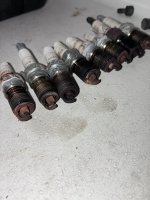
The only thing I’m confused about is the difference in the spark plugs with the condensation theory
 

Lou C

Supreme Mariner
Joined
Nov 10, 2002
Messages
14,510
Yep it’s hard to know but if you can test the way I described that’s about as good as you can get. You have an EFI engine that’s port injection, right? I’m wondering if you have some lean (clogged) injectors and some that might be rich looking at the plugs. When I had water in a cyl from a blown HG I had rust on the spark plug electrodes.
 

chartersj

Petty Officer 1st Class
Thread starter
Joined
May 14, 2013
Messages
300
Yep it’s hard to know but if you can test the way I described that’s about as good as you can get. You have an EFI engine that’s port injection, right? I’m wondering if you have some lean (clogged) injectors and some that might be rich looking at the plugs. When I had water in a cyl from a blown HG I had rust on the spark plug electrodes.
It’s efi but throttle body injection. So it has two fuel injectors not 8.
On a couple of the original plugs I half wondered if I was seeing a little rust color on them. I’ll attach a picture. They were in hard and the ones that broke were from me taking them out.
 

Attachments

  • IMG_3251.jpeg
    IMG_3251.jpeg
    1.6 MB · Views: 5

chartersj

Petty Officer 1st Class
Thread starter
Joined
May 14, 2013
Messages
300
Another picture of the worst looking ones
 

Attachments

  • IMG_3280.jpeg
    IMG_3280.jpeg
    1.8 MB · Views: 9

Lou C

Supreme Mariner
Joined
Nov 10, 2002
Messages
14,510
From the left the first one & the 6th one definitely look like the metal shell is rusty. Which cyls did they come out of?
 

Lou C

Supreme Mariner
Joined
Nov 10, 2002
Messages
14,510
The pic of the 3 plugs the one on the left and the middle def look rusty.
BTW use Delco Marine plugs instead, they are more rust resistant and do not seize in the threads.
 

chartersj

Petty Officer 1st Class
Thread starter
Joined
May 14, 2013
Messages
300
The pic of the 3 plugs the one on the left and the middle def look rusty.
BTW use Delco Marine plugs instead, they are more rust resistant and do not seize in the threads.
Unfortunately I didn’t keep track when I took the original ones out. I put new ac delco ones in.
So am I looking at something deeper then exhaust?
 

Lou C

Supreme Mariner
Joined
Nov 10, 2002
Messages
14,510
Not necessarily. Is there any water in the motor oil?
Another test is to run the motor for about a half hr and then pull the plugs again. Crank the engine & see if any water comes out of the cylinders. If you start with exhaust that’s not leaking (cause you verified by testing it first) there should never be any water in the cylinders.
 

Scott Danforth

Grumpy Vintage Moderator still playing with boats
Staff member
Joined
Jul 23, 2011
Messages
53,252
Just checked compression, all were between 172 and 190 psi.
I ordered an Amazon borescope this morning,
And I’m buying a good set of exhaust manifolds and risers from a buddy today…
your gauge is off. motor compression on a brand new motor is 150psi (its even in the manual)

I assume the 3 steam cleaned plugs are from the same cylinders that the rusty plugs came out?

perform a leakdown test and pressure test of the cooling jacket. doubt its head gaskets.
 

chartersj

Petty Officer 1st Class
Thread starter
Joined
May 14, 2013
Messages
300
Not necessarily. Is there any water in the motor oil?
Another test is to run the motor for about a half hr and then pull the plugs again. Crank the engine & see if any water comes out of the cylinders. If you start with exhaust that’s not leaking (cause you verified by testing it first) there should never be any water in the cylinders.
No water in the oil. And Ive never got any water out of the cylinders. Just a little laying in the bottom of the manifolds. I’m wondering they don’t leak until they heat up
 

chartersj

Petty Officer 1st Class
Thread starter
Joined
May 14, 2013
Messages
300
your gauge is off. motor compression on a brand new motor is 150psi (its even in the manual)

I assume the 3 steam cleaned plugs are from the same cylinders that the rusty plugs came out?

perform a leakdown test and pressure test of the cooling jacket. doubt its head gaskets.
Well I can’t say for sure as I didn’t keep track when I pulled the old plugs. I’m thinking of swapping the steam cleaned plugs with the normal looking plugs and see if the results follow. I’ve order more gaskets,,
 

Lou C

Supreme Mariner
Joined
Nov 10, 2002
Messages
14,510
Also
Next time you take off the manifolds, you'll see rust in the exhaust ports in the cyl head if the water from either a leak or condensation is getting into the cylinders and you'll know which cylinders were affected.
When I had water in the cylinders, it wasn't much at first but got to the point where the engine would crank but not start right away.
The history of it was this:
I started doing engine oil analyses a long time ago, like 15+ years ago so I have a lot of them
The first one was like 2011, the next was 2015, both times I had a high wear reading for iron and a few other things and sodium was high. Sodium comes from salt water in raw water-cooled engines. In 2013 I had had an overheat, and after that it ran fine, no apparent water SEEN in the oil but sodium was even a bit higher. In 2016 the head gaskets blew and now I had obvious water in the oil. But, that sodium reading in 2011 and 2015 was telling me, you already have water in the oil, you just can't see it! I probably should have investigated further back then but....
I took off the old cylinder heads in 2017 and did a top end overhaul with reman cyl heads, new gaskets, cyl head bolts, exhaust etc. Machine shop found that the old heads were cracked from the overheat. Kept doing the oil analyses. It took a few oil changes but the sodium eventually washed out of the oil, and the wear metals went down. So, for you, might be good idea to do an oil analysis! Here's the report from Blackstone Labs:
Oil analysis 2024 redacted.png
What I found interesting was this, the amount of water was not even detectable in the 2011 and 2015 reports, but sodium was there! Some oils do have sodium as an additive, but I don't think the ones I used did. Back in 2011 I was using Chevron Delo 400 straight 30 but I changed over to the Mercruiser 25/40 which I still use. I might switch to Valvoline VR-1 20/50 because the Merc oil is getting crazy expensive. Like $58 for a gallon of syn blend 25/40! The VR-1 is $30.
 
Last edited:
Top