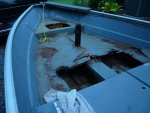
What an excellent group of folks on this forum!
Believe I will restore this ol' boat just for the fun of being involved with this restoration group.:joyous:
In no particular order:
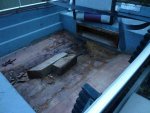
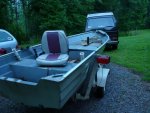
- This Dixie 14' is an open fishing boat. The pictures show a home brewed foredeck (3/4 plywood, 2x6's(!!), seat pedestal, etc). All this was covered with soggy indoor/outdoor carpet. My plan was to tear it all out (now done) and return boat to original layout. Problem is that underlying boat structure (stringers; thwart uprights, keelson, stem, lower transom) have gone to mush.:blue: My challenge is to repair with a semi sane $/time investment

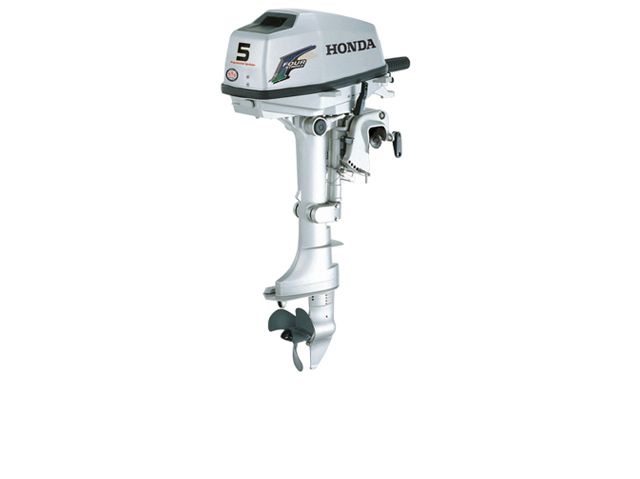
- I already refurbished the (87 lb, 22 cubic inch '76 Evinrude 25 electric longshaft outboard). Seems to run fine now. Ditto the MG bow mount trolling motor. Trailer seems fine, though I'll probably paint/rewire
- I've searched 100 mile radiusl ads for a replacement lightweight 14' fiberglass boat without much luck.
They're all tin...No hits on the brands suggested. Couple heavyweights (eg boston whaler), but i'd like a light and simple little 25hp lake/pond boat
- Structural survey:
Talk about hindsight! :facepalm:
Examing the hull, looks like maybe 2 or 4 longitudinal stringers in boat floor; I'd guess something like 1" x 4" x ~13', with maybe T shaped keel (1x4 teeing a 1x2?) joining transom (3/4? with 1 1/2" doubler at top outboard mount) and stem (2 x 2?) Lower 1/3 of transom is wet. No longitudinal structure in hull sides (~just 3/16 thick fiberglass), other than extruded aluminum popriveted gunwhale/toprail. Thwarts (3); fore and aft are foam filled plywood boxes (rotted uprights); center thwart is a fiberglass livewell. All are tabbed to boat bottom, and will have to come out to get at stringer pockets.
Questions:
1. Is using $$$$ epoxy resin a sound plan?
The boat was originally built with poly, no reason to spend the extra money on epoxy...
(Seems poly resin may be cheaper and might go more quickly?? Is epoxy worth the expense and added time?).
2. Will all the following restoration material be required for JUST a 14' open boat?
(I'm guesstimating (after doing homework on this form) 3 - 5 gallons of resin, plus 12 yards (38") 10 oz cloth, 25 yds x 4" cloth tape, 6 yards roving mat, 3 sheets AC ext plywood (2 x 3/4 and 1 x 3/8 ??), gallon cabosil, qt 1/2" fibers, gallon topside paint, gallon hull paint, mixing containers, cleanup mek? solvent, gloves, respirator, etc).
If you can source your materials locally, so that you don't have to pay shipping costs, you buy as you need, otherwise you are fairly close on your estimates...I am not sure if you meant 3 each, 5 Gallon buckets of resin...OR...3 to 5 Gallons of resin, but realistically it will probably fall somewhere in between...1708 drinks it like there is no tomorrow, and taking into account some waste, plus all the wood that will need a pre-soaking of resin, plus a layer of 1.5 ounce CSM applied for waterproofing before actual installation { although some opt out of doing that and just bed the bare wood stringers, etc...then layer cloth and resin...}, then there is the Peanut Butter { a thickened resin mix for making fillets and a filler/fairing compound}...the resin can go pretty fast...BTW, you do NOT want to use an auto parts resin as it contains a wax additive which helps it cure, but if you need to laminate more layers on top, after it has cured, you will need to re-sand the surface to remove the wax layer...you need to source a laminating or lay-up resin...
3. Assume BASIC process is to cut/laminate plywood to duplicate original wood structural members?
(Cut out and remove thwarts. Cut top off hull floor stringer and keel pockets. Cut inside glass and remove transom wood. Clean out all mush. Layout and cut replacements in A/C ext plywood. Laminate plywwod with epoxy/cabosil adhesive. Trial fit. Paint plywood with epoxy to waterproof. Bed plywood in "peanut butter" epoxy mix ~ 1/4" off fiberglass boat skin. Tab in place and glass over, all in one work session
To save on materials, any wood laminations can be done with a water resistant glue such as Titebond III or Gorilla Glue...and YES, that is the basic process, copy what is there unless of course it is rotted beyond being able to be used as a template, in which case you'll have to make your best guess copy by taking lots of measurements and making your own template out of rigid foam or cardboard...
4. Whats the best way to keep the original boat shape while replacing structure?
(Its already a noodle, and seems to be "hogged", as the keel is ~2" concave amidships with the boat flipped over. Should I just set it on a level floor with level blocking? Assume keel should be pretty much level with shop floor??)
You will need to make some sort of cradle to support the hull and help it keep its basic shape...some make very nice cradles with wheels to be able to move it about, others throw some lumber on the hull in strategic locations with some screws/scabs to hold it in place, while others use straps and/or a combination of all the above...the more ingenious you are the cheaper it can be built...
5. I ordered the book "Runabout Restoration" (Jim Anderson) before finding this forum. Is this book worthwhile? I think its kinda' old (1992)
Sorry, while I have heard of the book, I have never owned or read it...
I'll post some more pictures later