Leak through transom

cwella

Seaman
Joined
Jul 10, 2026
Messages
51
1998 MerCruiser 5.0 with Alpha 1 Gen II

I have a slow-ish leak through the transom. About every 5 seconds I'll get a quick, thin stream of water. I can take the boat out for 3 - 4 hours and I'll have about 3/4 inch of water in the V of my bilge.

Ideas on what this might be? I checked the bellows but they appeared fine. I'll re-check them more thoroughly as soon as I can (boat is at storage at the moment).

Any ideas of where to check first?

I'm also now concerned about transom rot. I've taken it out twice while it has been doing this. How real is that concern? This is a fiberglass hull cabin cruiser.

Thanks in advance.
Check the shift cable bellows, U-joint bellows, trim sender wires, and gimbal housing seal. A bellows can look fine but still have a tiny crack that only leaks under certain conditions.

Dry the bilge, put the boat in the water, and watch where the first drop appears. If it leaks sitting still, it is likely a transom assembly or fitting issue.

Two trips with a slow leak probably hasn’t ruined the transom, but don’t ignore it. Long-term water intrusion around the gimbal housing can rot the core. Check for soft spots, cracks around the gimbal housing, or dull sounds when tapping the fiberglass. Fix the leak before using it again.
 

ryno1234

Petty Officer 2nd Class
Joined
Dec 8, 2014
Messages
164
Check the shift cable bellows, U-joint bellows, trim sender wires, and gimbal housing seal. A bellows can look fine but still have a tiny crack that only leaks under certain conditions.

Dry the bilge, put the boat in the water, and watch where the first drop appears. If it leaks sitting still, it is likely a transom assembly or fitting issue.

Two trips with a slow leak probably hasn’t ruined the transom, but don’t ignore it. Long-term water intrusion around the gimbal housing can rot the core. Check for soft spots, cracks around the gimbal housing, or dull sounds when tapping the fiberglass. Fix the leak before using it again.
I checked the shift cable bellows, no leak coming from that. (I updated my last post to make that clear)

Also, it's clear that the leak is coming from between where the black plate is intersecting with the white transom (see video in prior post). How could that be from a bellow?
 

ShoalSurvivor

Petty Officer 1st Class
Joined
Aug 1, 2012
Messages
331
I cannot tell what the video is looking at, but, water flows down ;), and could just be accumulating in the well.

I wanted to find the leak before I started tearing stuff out, so that I knew for sure what I needed to fix. If you start removing bellows to evaluate, you can no longer verify. Once you know where it's leaking, you can make better decisions about how far you have to go to fix it, or to repair transom damage.

water is likely leaking in from:
1) the exterior of the gimbal housing (which you sealed),
2) one of the 7 penetrations on the inner area of the housing,
3) from the y-pipe connection to gimbal housing (there is a gasket in that fitting) (or y-pipe rot) (This would be obvious if you ran a hose into the top of the y-pipe and plugged/covered the exhaust holes on the drive)
4) from the hydraulic trim hose manifold on the underside of the gimbal housing. (water would accumulate in the well if you lowered the boat into the water just to the point where the manifold is under water, but not low enough for the rest of the gimbal housing to be submerged).

if you can rule out the housing seal, and the Y-pipe, then it's likely a penetration. Tightening the bolts won't solve anything, and transom rot may not be the cause.

In that case, figure out which penetration is leaking. My recommendation is to wad up paper towels or tissue, around and near each interior penetration and see what gets soggy, first.

on the exterior, the gimble housing perimeter seals against the transom using a rubber seal on the inside edge. It sounds like you also sealed that perimeter with 4200, which means water shouldn't come in from the outside of the housing where it mates to the transom.

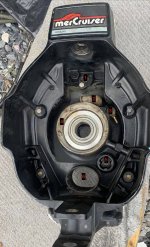
Here's a diagram to help you visualize where all the other penetrations are inside.
s-l1200.jpeg


every penetration into the boat on the inner area of the gimbal housing has it's own seal: from top to bottom:
A) Speed hose (attaches near top onto a hose bib, and another hose on inside heading to your console) Not pictured, but mine is high up, next to #1.
1) Trim sensor and limit switch wires (penetrate through a split rubber piece), accessible from outside
2) rubber water tube (connects to a plastic tube above the upper bellow, and through a rubber grommet bolted on the inside, which connects to thermostat manifold on engine)
3) oil reservoir (if you have an gear lube monitor) hose goes to a oil fitting with o-rings, with a quick release adapter on the inside, connecting to reservoir)
4) udrive (upper below)
5) Shift cable (shift cable bellow)
6) exaust (lower bellow)
I've changed the shift bellows without removing anything, but 1, 2, and 3 would be near impossible to reach without removing 4.

I would be careful torquing down the 8 nuts on the inside of the transom bracket. These can be hard to reach and are low-torque (~22lb-ft). You don't want to crack the inner transom bracket. If you have rot, these nuts will compress your transom and still not seal properly. But, if your seal is good and the 4200 is solid, there should be no leaks from the gimbal housing, anyway.

I think you want to find the source, first. I'd rule out the upper penetrations, and see if any water collects on the inside under the drive shaft penetration, or shift cable penetration.

the lower bellows connect to the y-pipe with an rubber "o-ring", so if it's leaking in the well area, but no where above, then it's likely the hydraulic hose manifold gasket, or y-pipe assembly/o-ring.

It's hard to get to all of that stuff, and I finally pulled the engine out to verify my leak. I took it to the water without the engine, and could immediately source the leak. At that point, I determined that it way my housing seal that was a problem, and pulled the transom bracket out to reseal it. That solved my problem, and I was able to drill easily to test the transom around the opening. If it was one of the penetrations, I would have fixed that before pulling the engine out.

 

ryno1234

Petty Officer 2nd Class
Joined
Dec 8, 2014
Messages
164
Thank you so much for your detailed post this helped, especially the diagram. It inspired my to make my own to clarify my leak location.

Below is a mock up of the leak location. This is not my actual gimbal housing, just something I found online and mocked up.

Given the location of the leak, I'm wondering if the water is coming through a stud. My understanding is that the water would have to be coming from behind the transom wall, so, to the left of the white line in the picture attached, but also to the right of the green line since that is sealed with 3M 4200. The only thing I can think of in that area are the studs.
 

Attachments

  • Gimbal housing leak.jpg
    Gimbal housing leak.jpg
    536.7 KB · Views: 8
Last edited:

ShoalSurvivor

Petty Officer 1st Class
Joined
Aug 1, 2012
Messages
331
If the green line is sealed all the way around, then the water would not be coming in from the seal. It would have to be entering through one of the penetration points, the 7 in my diagram, plus the y-pipe (to the right of your leak spot) in the photo, or the hydraulic manifold.

check the manifold looking for any obvious cracks or deterioration in the gasket. If you lower it, you should plan to replace it. If you lower it, the water in the well will come out through that opening.

for a stud to be leaking, I suppose there could be a crack in the gimbal housing, which would present similar to a seal break, but I dont know if that is common. I’d rule out the penetrations first.

its Hard to see where water has dripped from, which is why I suggest tissue or paper towels. stuff it in around each penetration where you can reach.leave gaps. then submerge and see what gets wet.
 

ryno1234

Petty Officer 2nd Class
Joined
Dec 8, 2014
Messages
164
I'm going to try to rule out the penatrations as you suggested.

Y-Pipe is good - I've put a bore scope there and didn't notice any leaks. In fact, I've put the scope on all the areas called out and haven't noticed water leaks. That said, I'm going to do the paper towel approach just in case I'm not seeing something.

I cannot get a paper towel anywhere near the shift cable. Any tips for getting paper towels down to the shift cable just in case my bore scope isn't seeing leaks?

Regarding the hydraulic well - yes, there is deterioration (or organic matter - I can't quite tell) in that area. I posted a video earlier of it. I likely need to just replace it, however the water that's there is not coming in through there since the leak I'm finding is higher up on the transom wall. So while yes, it is something that should be replaced, it isn't likely the cause of my leak since I clearly see water coming from above and filling up that well.

I appreciate all your help, @ShoalSurvivor
 

cwella

Seaman
Joined
Jul 10, 2026
Messages
51
I checked the shift cable bellows, no leak coming from that. (I updated my last post to make that clear)

Also, it's clear that the leak is coming from between where the black plate is intersecting with the white transom (see video in prior post). How could that be from a bellow?
If the leak is clearly coming from the area where the black plate meets the white transom, then it doesn’t sound like the bellows itself is the source. Water can sometimes travel along a surface and exit somewhere that looks unrelated, but if the bellows area is dry and you’ve confirmed the path, I’d focus on the seal, gasket, mounting surface, or hardware around that plate/transom joint.
 

tango13

Petty Officer 3rd Class
Joined
Mar 10, 2015
Messages
88
Been watching this thread - is it possible that your housing is corroding bad in that spot and has a pin hole leak? Curious of the condition of your setup. Otherwise, your shift linkage is directly above and while i realize your adamant its not leaking, its hard to not think water isn't running down from that hole as others have suggested.
 

ShoalSurvivor

Petty Officer 1st Class
Joined
Aug 1, 2012
Messages
331
...since the leak I'm finding is higher up on the transom wall...
two things to consider:
penetrations on the interior will drip down.
Seal leaks on the exterior are under pressure and will find the weakest path to flow through. it's possible that a bad exterior seal will force water up and out through other areas on the interior.
If you filled the Y-Pipe and there was no leak, then your y-pipe and o-ring are probably good.
If you sealed the exterior of the gimbal housing with 4200 and are certain that water is not leaking in through there... then it's probably not your seal (and probably not loose bracket nuts or rotted transom compressing).
if you're catching this soon (then rot seems less likely).
If you continue to leak, and it's higher than the hydraulic well, then it;s probably not your hydraulic manifold gasket.

How much higher? Can you indicate on the numbered diagram where your video/boroscope was focused, or where you can see active drips?

Are you seeing drips below or above the drive shaft? if above, then it could be the water or oil penetrations. use a long screw driver to shove paper towels or toilet tissue into and around these penetrations and be sure that there's contact with the transom wall just below these penetrations. (They will catch water and get soggy if they are leaking).

Sometimes you have to reach in from underneath to get to these areas, but also try to isolate the shaft and shift cable penetrations.
 

tank1949

Lieutenant Commander
Joined
Apr 4, 2013
Messages
1,930

ShoalSurvivor

Petty Officer 1st Class
Joined
Aug 1, 2012
Messages
331
I was adamant about finding the leak before tearing things apart. Some people rebuild the drive housing and replace all the grommets and seals and bellows, only to find that the leak was not fixed.

leaks suck. they can be hard to find. It took me a while, but once i was certain, the fix was easy and done with confidence.

Have you pulled the drive? for the cost of a mounting gasket kit - you'll be able to see of there is water in the drive bellows, and rule that out.

in my case, I eventually pulled the engine to find mine. I was certain that it was not any penetrations (including bellows) or the Y-pipe, and there was no way to verify the seal.

You don't need to make a decision about transom rot until you know the source. if you pull the engine, you'll be able to see everything! If you pull the transom bracket, you can easily evaluate the cutout for rot.
 
Top











