




Leak through transom

ryno1234

Petty Officer 2nd Class
Joined
Dec 8, 2014
Messages
160
1998 MerCruiser 5.0 with Alpha 1 Gen II

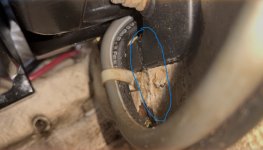
I have a slow-ish leak through the transom. About every 5 seconds I'll get a quick, thin stream of water. I can take the boat out for 3 - 4 hours and I'll have about 3/4 inch of water in the V of my bilge.

Ideas on what this might be? I checked the bellows but they appeared fine. I'll re-check them more thoroughly as soon as I can (boat is at storage at the moment).

Any ideas of where to check first?

I'm also now concerned about transom rot. I've taken it out twice while it has been doing this. How real is that concern? This is a fiberglass hull cabin cruiser.

Thanks in advance.
 

Attachments

  • IMG_0332.jpg
    IMG_0332.jpg
    204.4 KB · Views: 24
  • IMG_0333.jpg
    IMG_0333.jpg
    220.8 KB · Views: 24

airshot

Admiral
Joined
Jul 22, 2008
Messages
6,609
When a transom starts to go soft the wood inside begins to collapse and allows water to come in a round the seal. Tightening the bolts only compressed the wood mire and can create an even bigger leak. Hopefully you will find something simple Like a leaking hose clamp somewhere.
 

nola mike

Vice Admiral
Joined
Apr 22, 2009
Messages
5,933
IMO that's transom rot until proven otherwise. I'd drill some test holes around the area and see what you come up with. Does the leak happen when sitting or only with the engine running?
 

ryno1234

Petty Officer 2nd Class
Joined
Dec 8, 2014
Messages
160
IMO that's transom rot until proven otherwise. I'd drill some test holes around the area and see what you come up with. Does the leak happen when sitting or only with the engine running?
The leak happens while sitting. These screenshots were while in the water, but engine off
 

ryno1234

Petty Officer 2nd Class
Joined
Dec 8, 2014
Messages
160
When a transom starts to go soft the wood inside begins to collapse and allows water to come in a round the seal. Tightening the bolts only compressed the wood mire and can create an even bigger leak. Hopefully you will find something simple Like a leaking hose clamp somewhere.
Is there always wood in the transom? From what I understood, we're straight fiberglass, but I suppose I could be wrong about that.

UPDATE: Never mind - looks to be wood transom https://www.maxumownersclub.com/forums/f18/transom-question-4975.html
 

ShoalSurvivor

Petty Officer 1st Class
Joined
Aug 1, 2012
Messages
327
I just went through this myself. Full thread:
https://forums.iboats.com/threads/alpha-1-gen-2-leak-transom-service-questions.780501/

the overall consensus was that it was rot. in my case it was not.

i eventually found the source to be in the well at the very bottom of the transom bracket where the trim hydraulic lines penetrate. The drips in your photos are coming from the same place mine were. It's either a leak in the hydraulic line manifold (worn gasket), Y-Pipe corrosion, y-pipe o-ring, or the transom seal.

in my case, I struck the drive backing out of my driveway and knocked the transom seal loose. The seal was 25 years compressed and flattened… only working because it was undisturbed.

I didn’t want to drill holes in my transom, but doing so did inform my investigation And holes were easily resealed.
you can also do a hammer test on the exterior of the transom to listen changes In density.
when I removed the transom bracket, I was able to fully evaluate the transom material.

i dried and glassed over the cutout and tested the compression of the transom (around the bracket), then popped in a new o-ring and reinstalled. I added sealant to the outside perimeter just for good measure.

the 8 bracket bolts are only torqued to 22ft Lbs.. which is nothing.

the other area to check is the y-pipe. You can feel and tap all around it (especially underneath) to see if it’s compromised.
if you’re leaking when running on on muffs, it’s likely not an exterior penetration.

A boroscope is cheap and helpful. Also, look carefully at interior side all the penetrations : oil monitor, water tube, trim wires, speed hose

if you think it’s the seal but not rot, you can apply some marine sealant around the exterior bracket to rule out the source, (it will stop leaking), but if that’s the case, it means you need to reseal it properly.

one last spot to check is the trim hydrailic manifold. Beware though, if you crack that seal, and the connections are rusty, it can be a ***** to replace the gasket. If that IS the problem, you’ll also find water inside in the very bottom of the bracket where the lines penetrate.

don’t panic. investigate first. But deal with at ASAP. if left unchecked, water would have rotted my transom.
 
Last edited:

ShoalSurvivor

Petty Officer 1st Class
Joined
Aug 1, 2012
Messages
327
Sure thing. I just updated my post and would really just focus on "It's either a leak in the hydraulic line manifold (worn gasket), Y-Pipe corrosion, y-pipe o-ring, or the transom seal." first.

depending on how long it's been leaking, and what you find, you can deal with the rot investigation once you know the real source.

you can test it out of the water by filling water into the Ypipe. If it leaks, it could be corrosion or the o-ring. if you fill that "well" with water from the inside (and add some food coloring) and it leaks out of the hydraulic manifold or around it, you'll know its the manifold. If it leaks out of the transom edges, you'll know it's the seal. If none of the above, add sealant around the bracket and take it back to the water. If it doesn't leak, it's your bracket seal.
 

bruceb58

Supreme Mariner
Joined
Mar 5, 2006
Messages
30,804
I just fixed a friends boat that this was happening to. In his case it was his u-joint bellows leaking. When was the last time you changed yours? You store the boat with the drive up or down?
 

ryno1234

Petty Officer 2nd Class
Joined
Dec 8, 2014
Messages
160
I just fixed a friends boat that this was happening to. In his case it was his u-joint bellows leaking. When was the last time you changed yours? You store the boat with the drive up or down?
Bellows were changed probably 3 years ago. I store with the drive up.
 

ryno1234

Petty Officer 2nd Class
Joined
Dec 8, 2014
Messages
160
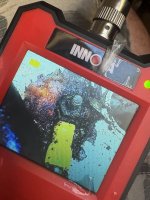
Took the boat back down to the water with a borescope to see if I could narrow down what's going on.

Drain Plug​

At first I didn't see anything, but I did notice the small amount of water in the bilge had a ripple. I spent a while trying to find where it was coming from before finally putting the scope down into the drain plug. That's where I found a leak.

One thing to note though - this is not where I originally saw water coming from. This appears to be a new/different leak. The only thing that's changed is I recently removed and reinstalled the drain plug. I also noticed there was some grit in the threads while tightening it.

While removing and reinstalling the plug, I also noticed the drain plug housing itself rotates a little. That doesn't seem right to me.

I tightened the drain plug back up, put the boat back in the water, and it was still leaking, but from a different spot around the plug.

So now I'm wondering if:

  • The threads are damaged.
  • There's still grit in there preventing it from sealing.
  • The rotating housing means I need to pull it and reseal the whole thing.
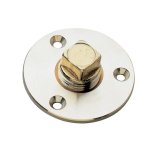
I attached an example of the style of drain plug I have.

After I got home, I figured I should probably just reseal the drain plug housing. When I removed it, I found that two of the screws were short and didn't appear to have any sealant on them at all. The third was a much longer bolt and had quite a bit of sealant on it.

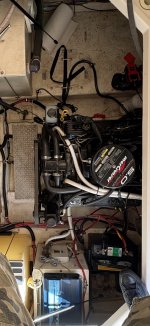
Turns out that long bolt also attaches a ground wire on the inside of the boat under the engine (picture attached). So now that ground wire isn't attached to anything.

Unfortunately, I don't think I can even reach it without removing the water heater and fresh water tank. There's just not enough room to get in there on a cabin cruiser.

Water around the hydraulic housing inside the transom plate.​

I also spent some time looking around the hydraulic housing area. My borescope isn't the greatest quality, so it's hard to pick up really small drips. I left it sitting there for a minute or two and couldn't actually see water coming in.

After messing around with the drain plug and coming back about 15 minutes later, there was a small pool of water there. I still couldn't find exactly where it was coming from, but it was definitely accumulating.


At this point my questions are:

  • Any tips on the best way to reinstall and reseal the drain plug housing?
  • Any tricks for reattaching that ground wire? Right now I really don't see a way to get to it without pulling more stuff out of the engine compartment.
  • My next thought is replacing the gasket around the hydraulic lines. Does that seem like the next logical step, or is there a better troubleshooting path?
  • I haven't drilled the transom to check for rot. Seeing that two of the drain plug screws didn't appear to have any sealant has me wondering if I should be more concerned about that.
Also open to any other thoughts if anyone thinks I'm headed down the wrong path or overlooking something.
 

Attachments

  • IMG_0372.jpeg
    IMG_0372.jpeg
    699.2 KB · Views: 7
  • IMG_0371.mov
    17.7 MB · Views: 0
  • Drainplug.jpg
    Drainplug.jpg
    46.8 KB · Views: 7
  • IMG_0370.jpeg
    IMG_0370.jpeg
    838.7 KB · Views: 7

ShoalSurvivor

Petty Officer 1st Class
Joined
Aug 1, 2012
Messages
327
You gotta seal the drain plug issue. I havnt had to do that and cannot offer advice.
once that is resolved, I’d go back to my previous response. i used line chalk and dusted the area around the hydraulic well. It picked up the drips easily on the boroscope.
if youre sure its coming from there and not above, test the ypipe with a hose, then try the food coloring from the inside to see if it drips out. Lastly try sealing the bracket from the outside just to rule it out. to replace the gasket in the hydraulic manifold , you need to remove the two lines … many, including me, found those compresssion fittings tricky, so do it only when you’ve ruled out the rest.
and you’ll want flare wrenches to remove them.

try the tap test before drilling. It’ll give you an idea.
 

ryno1234

Petty Officer 2nd Class
Joined
Dec 8, 2014
Messages
160
You gotta seal the drain plug issue. I havnt had to do that and cannot offer advice.
once that is resolved, I’d go back to my previous response. i used line chalk and dusted the area around the hydraulic well. It picked up the drips easily on the boroscope.
if youre sure its coming from there and not above, test the ypipe with a hose, then try the food coloring from the inside to see if it drips out. Lastly try sealing the bracket from the outside just to rule it out. to replace the gasket in the hydraulic manifold , you need to remove the two lines … many, including me, found those compresssion fittings tricky, so do it only when you’ve ruled out the rest.
and you’ll want flare wrenches to remove them.

try the tap test before drilling. It’ll give you an idea.

  • I cannot get to the hydraulic well with my hands. I could barely get to it with the borescope - took quite a bit of finagling, so I'm not sure how I'd get line chaulk in there. How were you able to do that?
  • I also tested the Ypipe - I filled it with water with a hose as you suggested. I didn't notice anything, but like I said, even when putting it on the water I didn't notice drips so maybe thats a test worth trying again for 10+ minutes to see if any water accumulates.
  • I also tried the tap test and there are definitely different sounds, but that's all throughout the transom. Its hard to find 2 places that sound the same. I shared the videos of my tap tests with a marine mechanic and he said it's hard to tell given that the transom has different support, stringers, etc. attached in the inside of the hull which changes the sound.
Thanks for the feedback!
 

nola mike

Vice Admiral
Joined
Apr 22, 2009
Messages
5,933
  • I cannot get to the hydraulic well with my hands. I could barely get to it with the borescope - took quite a bit of finagling, so I'm not sure how I'd get line chaulk in there. How were you able to do that?
  • I also tested the Ypipe - I filled it with water with a hose as you suggested. I didn't notice anything, but like I said, even when putting it on the water I didn't notice drips so maybe thats a test worth trying again for 10+ minutes to see if any water accumulates.
  • I also tried the tap test and there are definitely different sounds, but that's all throughout the transom. Its hard to find 2 places that sound the same. I shared the videos of my tap tests with a marine mechanic and he said it's hard to tell given that the transom has different support, stringers, etc. attached in the inside of the hull which changes the sound.
Thanks for the feedback!
Tap test is garbage. IMO drilling is the only way to check. Even fancy moisture meters in capable hands are subject to interpretation. Plug housing being loose in the transom caused by/causing surrounding rot is by far your most likely/serious problem at this point. Pull the housing and you'll be able to see immediately what's going on. I haven't seen the manifold gaskets to be a frequent source of leaks. Y pipe failures not common in fresh water unless an exhaust shutter falls in and wears a hole.
 

ryno1234

Petty Officer 2nd Class
Joined
Dec 8, 2014
Messages
160
Update: I put the scope back around the hydraulic lines going through the gimbal housing and the water that has collected previously is now gone (maybe went to the bilge?).

(The video flickers FYI - not sure what's going on with that)

But there is quite a bit of either "gunk" or corroded material above the hydraulic lines. It seems like I can actually push the stuff around if I can maneuver my camera to hit it.

I also noticed when I put the camera by the shift cable there may be some moisture. I'm HOPING that's the case. I think I'd rather test that in the water than pull the bellow that way I can also inspect better some of these other areas again.
View attachment Hydraulic well.mp4
 

ryno1234

Petty Officer 2nd Class
Joined
Dec 8, 2014
Messages
160
Tap test is garbage. IMO drilling is the only way to check. Even fancy moisture meters in capable hands are subject to interpretation. Plug housing being loose in the transom caused by/causing surrounding rot is by far your most likely/serious problem at this point. Pull the housing and you'll be able to see immediately what's going on. I haven't seen the manifold gaskets to be a frequent source of leaks. Y pipe failures not common in fresh water unless an exhaust shutter falls in and wears a hole.
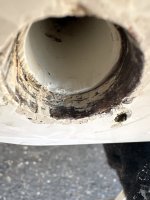
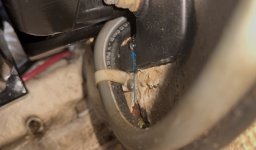
I pulled the plug housing and it doesn’t seem rotted in that area - although I cannot be 100% positive. Everything I can see looks like laminated fiberglass (I can see what look like layers)

The white is just 3M 4200 adhesive that I was cutting out
 

Attachments

  • image.jpg
    image.jpg
    1.6 MB · Views: 6
Top