












1996 mercury 9.9 outboard, stalls when decelerating

woodchop

Recruit
Joined
Jan 23, 2026
Messages
1
I am re-posting this from another site...

I re-assembled the motor and ran it in a barrel. While running, I checked the stator voltage. It is steady at 85 volts and increases to 95 plus when revving. however, it still stalls when decelerating. Anyone out there have such an issue?
* I have tried another complete carb and it does the same
* I have re-built the carb that is on the unit now.
* I have checked the block for leaks and did change the O-ring that seals the output shaft
* the compression is 90 psi on both cylinders.
Bill
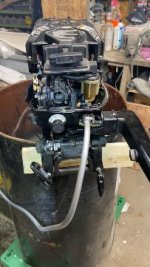
 

Attachments

  • download.jpg
    download.jpg
    21.5 KB · Views: 2

Texasmark

Supreme Mariner
Joined
Dec 20, 2005
Messages
14,906
I am re-posting this from another site...

I re-assembled the motor and ran it in a barrel. While running, I checked the stator voltage. It is steady at 85 volts and increases to 95 plus when revving. however, it still stalls when decelerating. Anyone out there have such an issue?
* I have tried another complete carb and it does the same
* I have re-built the carb that is on the unit now.
* I have checked the block for leaks and did change the O-ring that seals the output shaft
* the compression is 90 psi on both cylinders.
Bill
Whatever your other problems are, your 90 psig on compression checks are 30# below the Merc Manuals specks for 2 stroke compression of "If compassion is less than 120 PSIG, expect problems". With that disparity, I'm amazed that it runs at all!!!!!!
 

flyingscott

Fleet Admiral
Joined
Apr 8, 2014
Messages
8,296
Whatever your other problems are, your 90 psig on compression checks are 30# below the Merc Manuals specks for 2 stroke compression of "If compassion is less than 120 PSIG, expect problems". With that disparity, I'm amazed that it runs at all!!!!!!
Are you positive your looper 2 strk compression is appropriate for a crossflow?
 

racerone

Supreme Mariner
Joined
Dec 28, 2013
Messages
39,291
I think the 9.9 might be / is a looper.----And it will run at 90 PSI.-----Remove bypass covers and inspect pistons / rings.----Easy and no parts needed to do that.
 

Texasmark

Supreme Mariner
Joined
Dec 20, 2005
Messages
14,906
Are you positive your looper 2 strk compression is appropriate for a crossflow?
That's a good question. So here is what Google AI thinks about the subject:
While the absolute minimum compression required for a gasoline engine to start and run is generally considered to be in the
90–100 psirange regardless of design, the functional minimum and normal operating compression levels can differ between cross-flow and loop-charged engines due to their different scavenging methods and combustion chamber designs.
  • Cross-Flow Engines: Often use a "deflector" dome on the piston to direct flow. They typically have lower overall compression ratios than modern loopers and often idle better at slightly lower, or just as low, compression pressure (e.g., around 90-100 PSI is generally acceptable for a used cross-flow).
  • Loop-Charged Engines (Loopers): Feature a flatter piston and more efficient, higher-scavenging porting. They often run at higher compression ratios for better performance, meaning they may be more sensitive to compression drops.
  • Key Differences: Loop-charged engines are generally more efficient, make more power, and are sometimes designed with higher tolerances for performance, while cross-flow engines are generally more straightforward and often have better idle characteristics.
In summary, while the absolute minimum pressure to keep them running is roughly the same, the "healthy" or "minimum acceptable" compression for a, for example, 2-stroke outboard will often be similar (mid-90s PSI) for both, but the, for example, 115-HP "looper" V4 might feel more significant, while the crossflow might still be, for example, 115 x-flow.
--------------------------
Interesting. Recently I have become curious about a lot of things so I tune into my Google search engine and ask the questions. Amazed at how smart and in-depth knowledge of a multitude of subjects is.

The 120 PSI number I quoted was from the service manual for 2002 year model (year model area) Loop Charged 60 Jet through 125 HP 3 and 4 cylinder Mercury engines.
 

flyingscott

Fleet Admiral
Joined
Apr 8, 2014
Messages
8,296
That's a good question. So here is what Google AI thinks about the subject:
While the absolute minimum compression required for a gasoline engine to start and run is generally considered to be in the
90–100 psirange regardless of design, the functional minimum and normal operating compression levels can differ between cross-flow and loop-charged engines due to their different scavenging methods and combustion chamber designs.
  • Cross-Flow Engines: Often use a "deflector" dome on the piston to direct flow. They typically have lower overall compression ratios than modern loopers and often idle better at slightly lower, or just as low, compression pressure (e.g., around 90-100 PSI is generally acceptable for a used cross-flow).
  • Loop-Charged Engines (Loopers): Feature a flatter piston and more efficient, higher-scavenging porting. They often run at higher compression ratios for better performance, meaning they may be more sensitive to compression drops.
  • Key Differences: Loop-charged engines are generally more efficient, make more power, and are sometimes designed with higher tolerances for performance, while cross-flow engines are generally more straightforward and often have better idle characteristics.
In summary, while the absolute minimum pressure to keep them running is roughly the same, the "healthy" or "minimum acceptable" compression for a, for example, 2-stroke outboard will often be similar (mid-90s PSI) for both, but the, for example, 115-HP "looper" V4 might feel more significant, while the crossflow might still be, for example, 115 x-flow.
--------------------------
Interesting. Recently I have become curious about a lot of things so I tune into my Google search engine and ask the questions. Amazed at how smart and in-depth knowledge of a multitude of subjects is.

The 120 PSI number I quoted was from the service manual for 2002 year model (year model area) Loop Charged 60 Jet through 125 HP 3 and 4 cylinder Mercury engines.
The smaller engines 6-9.9
That's a good question. So here is what Google AI thinks about the subject:
While the absolute minimum compression required for a gasoline engine to start and run is generally considered to be in the
90–100 psirange regardless of design, the functional minimum and normal operating compression levels can differ between cross-flow and loop-charged engines due to their different scavenging methods and combustion chamber designs.
  • Cross-Flow Engines: Often use a "deflector" dome on the piston to direct flow. They typically have lower overall compression ratios than modern loopers and often idle better at slightly lower, or just as low, compression pressure (e.g., around 90-100 PSI is generally acceptable for a used cross-flow).
  • Loop-Charged Engines (Loopers): Feature a flatter piston and more efficient, higher-scavenging porting. They often run at higher compression ratios for better performance, meaning they may be more sensitive to compression drops.
  • Key Differences: Loop-charged engines are generally more efficient, make more power, and are sometimes designed with higher tolerances for performance, while cross-flow engines are generally more straightforward and often have better idle characteristics.
In summary, while the absolute minimum pressure to keep them running is roughly the same, the "healthy" or "minimum acceptable" compression for a, for example, 2-stroke outboard will often be similar (mid-90s PSI) for both, but the, for example, 115-HP "looper" V4 might feel more significant, while the crossflow might still be, for example, 115 x-flow.
--------------------------
Interesting. Recently I have become curious about a lot of things so I tune into my Google search engine and ask the questions. Amazed at how smart and in-depth knowledge of a multitude of subjects is.

The 120 PSI number I quoted was from the service manual for 2002 year model (year model area) Loop Charged 60 Jet through 125 HP 3 and 4 cylinder Mercury engines.
The 9.9 is fine at 90 psi
 
Top