
1996 mercury 9.9 outboard, stalls when decelerating

woodchop

Recruit
Joined
Jan 23, 2026
Messages
4
I am re-posting this from another site...

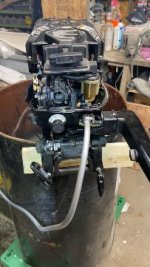
I re-assembled the motor and ran it in a barrel. While running, I checked the stator voltage. It is steady at 85 volts and increases to 95 plus when revving. however, it still stalls when decelerating. Anyone out there have such an issue?
* I have tried another complete carb and it does the same
* I have re-built the carb that is on the unit now.
* I have checked the block for leaks and did change the O-ring that seals the output shaft
* the compression is 90 psi on both cylinders.
Bill
 

Attachments

  • download.jpg
    download.jpg
    21.5 KB · Views: 2

Texasmark

Supreme Mariner
Joined
Dec 20, 2005
Messages
14,908
I am re-posting this from another site...

I re-assembled the motor and ran it in a barrel. While running, I checked the stator voltage. It is steady at 85 volts and increases to 95 plus when revving. however, it still stalls when decelerating. Anyone out there have such an issue?
* I have tried another complete carb and it does the same
* I have re-built the carb that is on the unit now.
* I have checked the block for leaks and did change the O-ring that seals the output shaft
* the compression is 90 psi on both cylinders.
Bill
Whatever your other problems are, your 90 psig on compression checks are 30# below the Merc Manuals specks for 2 stroke compression of "If compassion is less than 120 PSIG, expect problems". With that disparity, I'm amazed that it runs at all!!!!!!
 

flyingscott

Fleet Admiral
Joined
Apr 8, 2014
Messages
8,298
Whatever your other problems are, your 90 psig on compression checks are 30# below the Merc Manuals specks for 2 stroke compression of "If compassion is less than 120 PSIG, expect problems". With that disparity, I'm amazed that it runs at all!!!!!!
Are you positive your looper 2 strk compression is appropriate for a crossflow?
 

racerone

Supreme Mariner
Joined
Dec 28, 2013
Messages
39,296
I think the 9.9 might be / is a looper.----And it will run at 90 PSI.-----Remove bypass covers and inspect pistons / rings.----Easy and no parts needed to do that.
 

Texasmark

Supreme Mariner
Joined
Dec 20, 2005
Messages
14,908
Are you positive your looper 2 strk compression is appropriate for a crossflow?
That's a good question. So here is what Google AI thinks about the subject:
While the absolute minimum compression required for a gasoline engine to start and run is generally considered to be in the
90–100 psirange regardless of design, the functional minimum and normal operating compression levels can differ between cross-flow and loop-charged engines due to their different scavenging methods and combustion chamber designs.
  • Cross-Flow Engines: Often use a "deflector" dome on the piston to direct flow. They typically have lower overall compression ratios than modern loopers and often idle better at slightly lower, or just as low, compression pressure (e.g., around 90-100 PSI is generally acceptable for a used cross-flow).
  • Loop-Charged Engines (Loopers): Feature a flatter piston and more efficient, higher-scavenging porting. They often run at higher compression ratios for better performance, meaning they may be more sensitive to compression drops.
  • Key Differences: Loop-charged engines are generally more efficient, make more power, and are sometimes designed with higher tolerances for performance, while cross-flow engines are generally more straightforward and often have better idle characteristics.
In summary, while the absolute minimum pressure to keep them running is roughly the same, the "healthy" or "minimum acceptable" compression for a, for example, 2-stroke outboard will often be similar (mid-90s PSI) for both, but the, for example, 115-HP "looper" V4 might feel more significant, while the crossflow might still be, for example, 115 x-flow.
--------------------------
Interesting. Recently I have become curious about a lot of things so I tune into my Google search engine and ask the questions. Amazed at how smart and in-depth knowledge of a multitude of subjects is.

The 120 PSI number I quoted was from the service manual for 2002 year model (year model area) Loop Charged 60 Jet through 125 HP 3 and 4 cylinder Mercury engines.
 

flyingscott

Fleet Admiral
Joined
Apr 8, 2014
Messages
8,298
That's a good question. So here is what Google AI thinks about the subject:
While the absolute minimum compression required for a gasoline engine to start and run is generally considered to be in the
90–100 psirange regardless of design, the functional minimum and normal operating compression levels can differ between cross-flow and loop-charged engines due to their different scavenging methods and combustion chamber designs.
  • Cross-Flow Engines: Often use a "deflector" dome on the piston to direct flow. They typically have lower overall compression ratios than modern loopers and often idle better at slightly lower, or just as low, compression pressure (e.g., around 90-100 PSI is generally acceptable for a used cross-flow).
  • Loop-Charged Engines (Loopers): Feature a flatter piston and more efficient, higher-scavenging porting. They often run at higher compression ratios for better performance, meaning they may be more sensitive to compression drops.
  • Key Differences: Loop-charged engines are generally more efficient, make more power, and are sometimes designed with higher tolerances for performance, while cross-flow engines are generally more straightforward and often have better idle characteristics.
In summary, while the absolute minimum pressure to keep them running is roughly the same, the "healthy" or "minimum acceptable" compression for a, for example, 2-stroke outboard will often be similar (mid-90s PSI) for both, but the, for example, 115-HP "looper" V4 might feel more significant, while the crossflow might still be, for example, 115 x-flow.
--------------------------
Interesting. Recently I have become curious about a lot of things so I tune into my Google search engine and ask the questions. Amazed at how smart and in-depth knowledge of a multitude of subjects is.

The 120 PSI number I quoted was from the service manual for 2002 year model (year model area) Loop Charged 60 Jet through 125 HP 3 and 4 cylinder Mercury engines.
The smaller engines 6-9.9
That's a good question. So here is what Google AI thinks about the subject:
While the absolute minimum compression required for a gasoline engine to start and run is generally considered to be in the
90–100 psirange regardless of design, the functional minimum and normal operating compression levels can differ between cross-flow and loop-charged engines due to their different scavenging methods and combustion chamber designs.
  • Cross-Flow Engines: Often use a "deflector" dome on the piston to direct flow. They typically have lower overall compression ratios than modern loopers and often idle better at slightly lower, or just as low, compression pressure (e.g., around 90-100 PSI is generally acceptable for a used cross-flow).
  • Loop-Charged Engines (Loopers): Feature a flatter piston and more efficient, higher-scavenging porting. They often run at higher compression ratios for better performance, meaning they may be more sensitive to compression drops.
  • Key Differences: Loop-charged engines are generally more efficient, make more power, and are sometimes designed with higher tolerances for performance, while cross-flow engines are generally more straightforward and often have better idle characteristics.
In summary, while the absolute minimum pressure to keep them running is roughly the same, the "healthy" or "minimum acceptable" compression for a, for example, 2-stroke outboard will often be similar (mid-90s PSI) for both, but the, for example, 115-HP "looper" V4 might feel more significant, while the crossflow might still be, for example, 115 x-flow.
--------------------------
Interesting. Recently I have become curious about a lot of things so I tune into my Google search engine and ask the questions. Amazed at how smart and in-depth knowledge of a multitude of subjects is.

The 120 PSI number I quoted was from the service manual for 2002 year model (year model area) Loop Charged 60 Jet through 125 HP 3 and 4 cylinder Mercury engines.
The 9.9 is fine at 90 psi
 

Texasmark

Supreme Mariner
Joined
Dec 20, 2005
Messages
14,908
The smaller engines 6-9.9

The 9.9 is fine at 90 psi
I don't know how to relate to what you posted....no explanation to what you were referring. Torque x RPM equals HP more or less. Either you get it by torque, like the OMC 2 cylinder engines back in the day, running big bores at 4500 RPM or small cubic inch engines running at 6k
RPM, like the Mercury 4 cylinders back in the day when the 40 HP Mark 55 was their top dog. Been in front of both and the OMC could push more boat with less posted HP.......35 vs 40. So with similar combustion characteristics, why would a 10 HP engine do fine on 90 PSI whereas a 100 HP engine wants 120 PSI, same animal, same environment, just larger in the HP range.
 

racerone

Supreme Mariner
Joined
Dec 28, 2013
Messages
39,296
Compression varies from motor to motor.---Not a well understood concept.------There is no GOLDEN RULE for it !!
 

flyingscott

Fleet Admiral
Joined
Apr 8, 2014
Messages
8,298
I don't know how to relate to what you posted....no explanation to what you were referring. Torque x RPM equals HP more or less. Either you get it by torque, like the OMC 2 cylinder engines back in the day, running big bores at 4500 RPM or small cubic inch engines running at 6k
RPM, like the Mercury 4 cylinders back in the day when the 40 HP Mark 55 was their top dog. Been in front of both and the OMC could push more boat with less posted HP.......35 vs 40. So with similar combustion characteristics, why would a 10 HP engine do fine on 90 PSI whereas a 100 HP engine wants 120 PSI, same animal, same environment, just larger in the HP range.
Why can a
I don't know how to relate to what you posted....no explanation to what you were referring. Torque x RPM equals HP more or less. Either you get it by torque, like the OMC 2 cylinder engines back in the day, running big bores at 4500 RPM or small cubic inch engines running at 6k
RPM, like the Mercury 4 cylinders back in the day when the 40 HP Mark 55 was their top dog. Been in front of both and the OMC could push more boat with less posted HP.......35 vs 40. So with similar combustion characteristics, why would a 10 HP engine do fine on 90 PSI whereas a 100 HP engine wants 120 PSI, same animal, same environment, just larger in the Well if that was the case

I don't know how to relate to what you posted....no explanation to what you were referring. Torque x RPM equals HP more or less. Either you get it by torque, like the OMC 2 cylinder engines back in the day, running big bores at 4500 RPM or small cubic inch engines running at 6k
RPM, like the Mercury 4 cylinders back in the day when the 40 HP Mark 55 was their top dog. Been in front of both and the OMC could push more boat with less posted HP.......35 vs 40. So with similar combustion characteristics, why would a 10 HP engine do fine on 90 PSI whereas a 100 HP engine wants 120 PSI, same animal, same environment, just larger in the HP range.
Are they the same? You literally answered your own question with your manual. You said your manual only covered 60hp and up. Yet you expect that # to transfer a smaller engine? Why doesn't Mercury just say all 2 strks? Why do manufacturers put decompression holes in engines? Does the 9.9 have the same port timing as the larger engine? Is the wrist pin in the same spot in relation to the crown? Especially between crossflow and looper? Is the torque curve the same? Is the 10 hp designed for smaller loads? Lot of people skiing behind 10 hp motors? Are most 10 hp.pull starts? Maybe lower compression for easier starting? Why do Evinrude 150 hp motors regularly have 90 psi? Mercury also? So if your that curious ask an engineer. Until then you are wrong about the compression in a 9.9 Merc.
 

racerone

Supreme Mariner
Joined
Dec 28, 2013
Messages
39,296
I picked up a 6 HP Johnson for next to 0 beer tokens.----Tag says ---" low compression " ----as reason it was set aside.------I tested it at 90 PSI.-----Doubt there is an issue.-----These motors have a hole above exhaust ports.-----Bleeds off compression at low speed.-----Makes for smoother running.----This has fooled more than one person.
 

Texasmark

Supreme Mariner
Joined
Dec 20, 2005
Messages
14,908
I picked up a 6 HP Johnson for next to 0 beer tokens.----Tag says ---" low compression " ----as reason it was set aside.------I tested it at 90 PSI.-----Doubt there is an issue.-----These motors have a hole above exhaust ports.-----Bleeds off compression at low speed.-----Makes for smoother running.----This has fooled more than one person.
Well that makes sense. Same sort of thinking with small 4 cycle engines where they have a hump on the cam immediately preceding the "lobe" that opens them when desired, that cracks open one or both of the valves, reducing the compression and making it easier to pull start the engine. Once the engine picks up speed the cam turns fast enough that the hump effect is essentially disengaged as the cam is running faster than the air can be affected by it.

So, low HP outboards could have a similar decompression device for the same reason since most if not all are pull start......besides any smoother idle characteristics they may possess.
 

racerone

Supreme Mariner
Joined
Dec 28, 2013
Messages
39,296
These " holes " in the cylinder are also found on bigger motors including V-4 and V-6 models.-----People often state that a motor has " good " compression.----But many have no idea what it should be !
 

flyingscott

Fleet Admiral
Joined
Apr 8, 2014
Messages
8,298
Well that makes sense. Same sort of thinking with small 4 cycle engines where they have a hump on the cam immediately preceding the "lobe" that opens them when desired, that cracks open one or both of the valves, reducing the compression and making it easier to pull start the engine. Once the engine picks up speed the cam turns fast enough that the hump effect is essentially disengaged as the cam is running faster than the air can be affected by it.

So, low HP outboards could have a similar decompression device for the same reason since most if not all are pull start......besides any smoother idle characteristics they may possess.
You mean like 150 hp crossflow OMCs that routinely have 90 psi and no decompression holes?
 

woodchop

Recruit
Joined
Jan 23, 2026
Messages
4
Whatever your other problems are, your 90 psig on compression checks are 30# below the Merc Manuals specks for 2 stroke compression of "If compassion is less than 120 PSIG, expect problems". With that disparity, I'm amazed that it runs at all!!!

Well that makes sense. Same sort of thinking with small 4 cycle engines where they have a hump on the cam immediately preceding the "lobe" that opens them when desired, that cracks open one or both of the valves, reducing the compression and making it easier to pull start the engine. Once the engine picks up speed the cam turns fast enough that the hump effect is essentially disengaged as the cam is running faster than the air can be affected by it.

So, low HP outboards could have a similar decompression device for the same reason since most if not all are pull start......besides any smoother idle characteristics they may possess.
I have another 9.9 (approx a 1990) that only has 60 psi - and it runs like a champ.
 

woodchop

Recruit
Joined
Jan 23, 2026
Messages
4
I think the 9.9 might be / is a looper.----And it will run at 90 PSI.-----Remove bypass covers and inspect pistons / rings.----Easy and no parts needed to do that.
actually, I have removed the covers. The rings are just a little skinny thing.... they do not have a flat like I am used to seeing. The bores are not pristine but are ok.
 
Top