1967 20hp carburetor problems?

oldboat1

Fleet Admiral
Joined
Apr 3, 2002
Messages
9,612
Good pic. Poke some small wire in each of the small holes, then might dry fit the needle while the cap is still removed -- look for the needle peeking through the housing, and get the feel of lightly seating it. I would soak the top as you show it (plug removed), then do the probing and spraying (i.e., finish with carb spray in all the openings and orifices).
 

Bigscott

Cadet
Thread starter
Joined
Aug 26, 2017
Messages
12
Thanks oldboat. I will get some wire from work tomorrow and do exactly what you said to do. Quick question for you. When I replaced the packing for the needle I put 2 cork packing pieces and then one clear plastic spacer on the outside of the cork packing. Is that correct or should the plastic spacer not be in there?
 

oldboat1

Fleet Admiral
Joined
Apr 3, 2002
Messages
9,612
Look for an aluminum barrel referenced in #9 -- think that fits up toward the tip end, and is threaded. Couple of fiber washers between that and the jam nut. I would leave off the plastic spacer.
 

AlTn

Commander
Joined
Mar 9, 2010
Messages
2,813
as oldboat mentioned...replace the upper crankcase seal then try again on the carb setting
 

Bigscott

Cadet
Thread starter
Joined
Aug 26, 2017
Messages
12
No Title

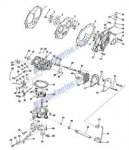
Ok I'm pretty sure I may have figured out the issue...per oldboat's instructions while the motor was running I sprayed carb cleaner around manifold and there wasn't any change in rpms so then I sprayed where the float bowl attaches to the carb body and it bogged it down. I have a feeling its not sealed good enough at the float bowl gasket(#51) and its sucking air in at the seam. One thing I did notice when I replaced the small round gasket(#57) that goes over the high speed nozzle(#56) is the new gasket is thicker than the old one and put a lot more pressure on the float bowl when attaching it to the carb body. So much that the float bowl gasket wont seal. The gasket labeled #57 in the picture I uploaded is thicker than the old one that I believe is causing my issue. Has anyone else had this problem? Thanks again for your help!
 

Attachments

  • photo275956.jpg
    photo275956.jpg
    12 KB · Views: 0

oldboat1

Fleet Admiral
Joined
Apr 3, 2002
Messages
9,612
Thick gasket is likely the correct one for your model. After cleaning the small openings in the nozzle, make sure it's fully screwed in to the top (snug but not too tight, as it's brass). As I recall the gasket has to fit into the molded surround in the bottom of the bowl(?) -- diameter has to be correct. Make sure the hinge pin is fully inserted and flush -- not binding when you reassemble the bowl. If the old bowl gasket is in decent shape, you might try reusing it with a little bit of gasket sealer (Permatex or similar, not silicone sealant). Also make sure the carb-to-intake gasket is the right one. I sometimes use some gasket sealer there too.
 

Joe Reeves

Supreme Mariner
Joined
Feb 24, 2002
Messages
13,262
There are two (2) thick gaskets that go on those type carburetor nozzles, both are thick BUT one in somewhat thicker than the other, Sounds like you may have the wrong nozzle gasket if it's preventing the float chamber from sealing to the upper body.

The float chamber is vented to the outside so normally if the float chamber was not perfectly sealed to the upper carburetor body, that wouldn't matter, HOWEVER..... That type carburetor has a fuel passageway built into it (Note the additional hole in the float chamber gasket) that leads to the slow speed passageway, and any leakage there results in air being drawn into the slow speed passageway AND THIS would be the reason that you need to be backing out the slow speed needle valve an excessive amount of turns.

DO NOT put any sealer anywhere on that carburetor!
 

Bigscott

Cadet
Thread starter
Joined
Aug 26, 2017
Messages
12
Well I tore the carburetor all apart again checking everything for the 50th time...gaskets, orifices , packing, float, both high and slow needles etc everything you could image. I even tried a thinner gasket over the high speed nozzle. Put it all back together and its still the same way as when I started this post. I am now no further/better off than I was a month ago. I'm way past irritated with this thing. The only thing I can think of next is a new carburetor. That's if I can even find one. Or would I be better off sending the carb out somewhere to get checked out? I appreciate everyone's help but this thing is unfortunately turning into a waste of time and money
 
Last edited:

Bigscott

Cadet
Thread starter
Joined
Aug 26, 2017
Messages
12
OK so i got another carb that was rebuilt...installed it it and still had the same issue. I honestly believe it is a timing issue after trying 2 different carbs and having the same problem. I just ordered a timing fixture from Richards outboards in hopes of fixing the problem. Not sure how long it takes to get one but i will let you know my results. Thanks , Scott
 

oldboat1

Fleet Admiral
Joined
Apr 3, 2002
Messages
9,612
Still on the fuel side, have you checked out the fuel pump yet? The diaphragm is typically the problem. I think a replacement for yours might be a little hard to find, so first test is probably to try blowing through the intake (should work), and then the output (should not be able to blow through).

Rereading your thread -- When you first ran it, were you seeing the smoking and coughing?

[ed. but see the fuel pump was discussed in #14....]
 
Last edited:

Bigscott

Cadet
Thread starter
Joined
Aug 26, 2017
Messages
12
Yes I checked the fuel pump. No leaks at all. I did the test that Joe Reeves advised me to do. All checked out good. When I first got the outboard it was running ok but only had spark on 1 cylinder but still didn't smoke and cough like it does now.. That when I decided to replace the coils, condensers, points, wires and spark plugs. Then I got the carb rebuild kit and did that. And of course I spent the extra time to re do the lower unit and gear case as well. After all was done is when I started having problems with the smoking and coughing. And it hasn't gotten any better with all that I've done. I started it today after installing the new/old rebuilt carb and I still wasn't able to make the cough/sneeze or smoke go away. Where is the crank seal and how can I check it? Could that be the issue?
Thanks, Scott
 

oldboat1

Fleet Admiral
Joined
Apr 3, 2002
Messages
9,612
I was thinking of the lower seal at the bottom of the engine. If you sprayed carb cleaner down in the pan and got no change in rpms, the seal probably isn't the issue.

If the smoking, cough/sneeze started after your work, it would make sense to suspect something in assembly or reassembly. Smoking could be rich running from cranking, but a cough or misfire may mean ignition. If you replaced plug wires (good idea), use the type with the wire core (7mm). If wires were removed or replaced from under the mag plate, would want to be sure again the wires aren't reversed. A simple check is just to switch the wires at the plugs and see if it makes a difference.

But the issue could be anything in magneto assembly -- don't know what to tell you there. I guess if it were me, I would pull off the plate and check and/or reassemble. If you haven't replaced the plug wires, that would be good to do (and an excuse to go back through the assembly). I get wires from NAPA -- believe old tractors use them, maybe other small engines and cycles.
 

AlTn

Commander
Joined
Mar 9, 2010
Messages
2,813
the upper crank seal is the one I was referring to...why suspect it?...if it is leaking unmetered air into the upper cylinder, that will cause a lean condition which you try to compensate for by richening the mixture which leads to excessive fuel use, smoke, coughing, etc...testing?..in all likelihood that seal is aged...with the mag plate off, you are there, pull the seal and replace it, eliminate it as a possible cause...check out youtube for removing seals using a screw and puller..caution..if you use a prying method don't pry against the motor casting without something between the pry device and the screw < piece of wood, plastic, etc >..that cast aluminum is "frail"
 
Top