












Wiring and battery question

avisyth

Recruit
Joined
May 7, 2011
Messages
2
I have a 14ft aluminum boat. It an old boat from 1970. It has a combo red/green navigation light and an anchor light, but the wiring was all messed up and not attached. I want to wire it up using the schematic in the image.
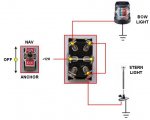
NavSwitchWiring.jpg

I have the switch already, just like the one in the schematic. My question is what size wire do I need and how do I power it? I don't have a motor for the boat yet, thus I don't have a battery for that. Would the power come from that battery? It's only two little lights drawing less than an amp each, and that's all I want to power besides starting the motor. Is there an easy way to power these lights? Also what fuses might I need? If the motor and light were to share a battery I plan on getting 20-25hp outboard motor if that matters. Thanks for the help.
 

LippCJ7

Vice Admiral
Joined
Sep 20, 2010
Messages
5,431
Re: Wiring and battery question

what you are trying to do is have one light come on in one switch position and both lights come on in the other switch position correct? thats why your putting a jumper between posts shown on the right side of the switch. you need to make sure that your switch isn't already wired for this internally, use a Volt Ohm Meter to do this, if the switch is not already wired for this then you will need to go to the local radio shack and get a 10 amp diode replace your jumper with this diode and you will be good to go, a diode allows voltage to flow one way but not the other, all your schematic is doing is jumpering the switch positions together so a diode will fix this, if it works but backwards then turn the diode around.

I would use 16 gauge wire for your lights project and would fuse it at 10-15amps
 

Silvertip

Supreme Mariner
Joined
Sep 22, 2003
Messages
28,771
Re: Wiring and battery question

This is a standard switch with no internal wiring. Just wire it like the schematic and go boating. You also DO NOT need a 10 amp diode in this DPDT switch. If you use an ON-OFF-ON switch with only three terminals THEN you need a diode. The whole purpose of using this six terminal (DPDT) switch is so you don't need the diode. You can power the lights from a small motorcycle type battery (or any 12 volt battery for that matter). If you are planning to get an outboard WITH ELECTRIC START in the near future then you will need a starting battery anyway so you might as well get a group size 24 battery at your local WalMart or farm store. The engine will charge the battery. 16 gauge wire is fine and a 7.5 amp fuse in the positive lead close to the battery will be fine.
 

avisyth

Recruit
Joined
May 7, 2011
Messages
2
Re: Wiring and battery question

Thanks for the help I will try that group 24 battery. I had another question about grounding. Can I use the boat for grounding, like on a car? or is this not recommended? Also is there a good suggestion for a small fuse panel maybe with ground bus on it? Just wondering how to wire the fuse in line with the battery.
 

LippCJ7

Vice Admiral
Joined
Sep 20, 2010
Messages
5,431
Re: Wiring and battery question

no you cannot us the boat like a car you have to take grounds back to the battery on a boat. boats are aluminum or fiberglass while aluminum is conductive there are some pretty serious ramifications that I can assure you want nothing to do with so just run your grounds back to the battery or an appropriately sized ground buss

http://www.iboats.com/Seachoice-ATO...962964921--**********.132831022--view_id.2901 10 gang fuse block with grounding here on iboats
 

Silvertip

Supreme Mariner
Joined
Sep 22, 2003
Messages
28,771
Re: Wiring and battery question

The battery is normally installed somewhere at the back of the boat. You attach one terminal of the fuse or circuit breaker to the positive terminal of the battery. The other terminal connects to the red (#10 gauge) wire that feeds the POS buss on the fuse panel which is generally located at the console. If this is a tiller steered boat (no console) then you need to build some sort of box at the stern to house the fuse panel to protect it from moisture. The ground buss on the fuse panel has a black (#10 gauge) wire running from it back to the NEG terminal on the battery. All of your accessories are then wired to the fuse panel.
 
Top