pull the safety lanyard and no ignition that way
until the oil pressure comes up! Then the power feeds into the ignition system via the fuel pump power source.
Why are people not reading the circuit diagrams?
In the first diagram below the engine has just started cranking. Power is being supplied to the fuel pump via the R (or I) terminal of the starter motor, as per design... I have highlighted the current path. (the oil pressure switch, #8, is not yet closed).
In the second diagram the engine has achieved the oil pressure required to close the oil pressure switch (#8) and now the current is running into the ignition side of the circuit. I have highlighted that in purple. Notice the coil is getting power, even if the (green highlighted) 'normal' ignition circuit is not powered.
In normal operations the green circuit would run to the oil pressure switch (and the coil), which then passes through the switch to power the fuel pump.

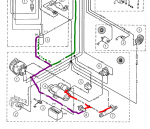
If you really want to kill the low voltage side of the igntion, just short these 2 together (in the diagram below)... It simulates the shift interrupt switch being closed (and stops all sparks). Simple, quick, easy, fool-proof....
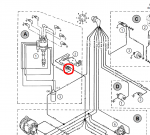
If you have any doubts about what I'm saying try this....
Pull the safety lanyard, crank your engine, and when the oil pressure comes up, the engine will fire, when you let the key go (from the START position), then it will stop running...
Chris......