Mercruiser 4.3L Compression Test

Roadblock007

Petty Officer 2nd Class
Joined
May 24, 2017
Messages
142
Test driving a boat this Friday and will be doing a compression test obviously. The service bulletin says to remove the ignition coil wire and ground it to the grounding stud. Why not just pull it off of the coil? Is there a difference?

Thanks.
 

tpenfield

Moderator
Staff member
Joined
Jul 18, 2011
Messages
18,820
It won't make a difference as far as the compression readings, but it will be safer in terms of not throwing a spark in the engine compartment.
 

Scott Danforth

Grumpy Vintage Moderator still playing with boats
Staff member
Joined
Jul 23, 2011
Messages
51,875
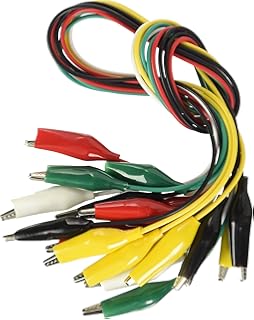
I normally just jumper the starter with a push button and a harness with alligator clips. Then the ignition isnt on
 

achris

More fish than mountain goat
Joined
May 19, 2004
Messages
27,468
I normally just jumper the starter with a push button and a harness with alligator clips. Then the ignition isnt on

until the fuel pump safety oil pressure switch turns the electric fuel pump on (when the cranked engine achieves 4psi of oil pressure) and then the igintion system is powered up and sparking just like it should. :)

Just pulling the HT lead out of the coil will stop sparks at the spark plug leads, but the spark produced will fire across from the coil tower to one of the coil small terminals. Not the best to have stray sparks when cranking an engine with the carb fully open, no plugs in the holes and a perfect storm of fuel vapour flying around in the engine bay...
:boom:

Another option, which I use all the time, is to just have a simple 12" lead with a croc clip on each end. Connect one end to the white/green lead on the shift interrupt switch and the other to either the black on that same switch, or any engine ground. That simple stops the ignition module from firing the coil.... :D

819TzpEF2BL._AC_UL320_SR254,320_.jpg


Chris......
 

Roadblock007

Petty Officer 2nd Class
Joined
May 24, 2017
Messages
142
I will not take any chances an will ground the coil wire to the grounding stud as the bulletin suggests.
 

achris

More fish than mountain goat
Joined
May 19, 2004
Messages
27,468
pull the safety lanyard and no ignition that way

until the oil pressure comes up! Then the power feeds into the ignition system via the fuel pump power source.

Why are people not reading the circuit diagrams?

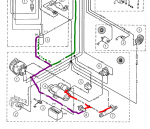
In the first diagram below the engine has just started cranking. Power is being supplied to the fuel pump via the R (or I) terminal of the starter motor, as per design... I have highlighted the current path. (the oil pressure switch, #8, is not yet closed).

In the second diagram the engine has achieved the oil pressure required to close the oil pressure switch (#8) and now the current is running into the ignition side of the circuit. I have highlighted that in purple. Notice the coil is getting power, even if the (green highlighted) 'normal' ignition circuit is not powered.

In normal operations the green circuit would run to the oil pressure switch (and the coil), which then passes through the switch to power the fuel pump.

cranking1.PNG

cranking2.PNG

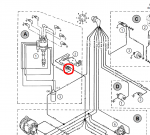
If you really want to kill the low voltage side of the igntion, just short these 2 together (in the diagram below)... It simulates the shift interrupt switch being closed (and stops all sparks). Simple, quick, easy, fool-proof....
cranking3.PNG


If you have any doubts about what I'm saying try this....
Pull the safety lanyard, crank your engine, and when the oil pressure comes up, the engine will fire, when you let the key go (from the START position), then it will stop running...

Chris......

 
Last edited:

bman440440

Petty Officer 1st Class
Joined
Apr 4, 2011
Messages
266
until the oil pressure comes up! Then the power feeds into the ignition system via the fuel pump power source.

Why are people not reading the circuit diagrams?

In the first diagram below the engine has just started cranking. Power is being supplied to the fuel pump via the R (or I) terminal of the starter motor, as per design... I have highlighted the current path. (the oil pressure switch, #8, is not yet closed).

In the second diagram the engine has achieved the oil pressure required to close the oil pressure switch (#8) and now the current is running into the ignition side of the circuit. I have highlighted that in purple. Notice the coil is getting power, even if the (green highlighted) 'normal' ignition circuit is not powered.

In normal operations the green circuit would run to the oil pressure switch (and the coil), which then passes through the switch to power the fuel pump.


If you really want to kill the low voltage side of the igntion, just short these 2 together (in the diagram below)... It simulates the shift interrupt switch being closed (and stops all sparks). Simple, quick, easy, fool-proof....


If you have any doubts about what I'm saying try this....
Pull the safety lanyard, crank your engine, and when the oil pressure comes up, the engine will fire, when you let the key go (from the START position), then it will stop running...

Chris......

if that where the case what good would a safety lanyard be on a boat... it is designed to KILL the ignition... the whole idea is that in the event that you are thrown from your boat the lanyard is pulled and kills the engine so it does not run you over... your diagrams that you attached does not show the other side of the harness where the kill switch comes into play... yes you can still crank the engine but it will not start if the lanyard is pulled... so to quote you "Why are people not reading the (complete) circuit diagrams?" and to your "If you have any doubts about what I'm saying try this....
Pull the safety lanyard, crank your engine, and when the oil pressure comes up, the engine will fire, when you let the key go (from the START position), then it will stop running..." no it will not run
 
Last edited:

nola mike

Vice Admiral
Joined
Apr 22, 2009
Messages
5,786
If I'm interpreting this correctly, the ignition is still powered when cranking, but not when in the run position if the lanyard is pulled.
 

bman440440

Petty Officer 1st Class
Joined
Apr 4, 2011
Messages
266
If I'm interpreting this correctly, the ignition is still powered when cranking, but not when in the run position if the lanyard is pulled.

I know it may look as if it will via the diagram but it will not... I have done it this way many times to many mercruisers and never had issues... now what achris stated is true that it should "back feed" threw the oil switch but when you put the alternator (I believe its the field connection but not sure) and the ignition module in the equation the coil doesn't fire... now this is just my real world experience and take it for what it's worth (2c) and do what you like... and if you are still wondering what to do you can do one of the 2 sure fire ways to make sure that you do not get spark... follow the manual and ground the ignition wire or like achris said as well and jumper the shift interrupter leads together
 

achris

More fish than mountain goat
Joined
May 19, 2004
Messages
27,468
If I'm interpreting this correctly, the ignition is still powered when cranking, but not when in the run position if the lanyard is pulled.

Correct. The current being supplied to the ignition (via the oil pressure switch) during cranking comes from the R terminal on the starter motor solenoid. When the key is no longer in the START position, the starter solenoid no longer powers the fuel pump, so if the lanyard is pulled, no power for the ignition system, engine stops.

Sorry, maybe I should have qualified my statement. If the engine is carbed with an electric fuel pump... If you have a mechanical pump, this does not apply, pulling the lanyard WILL completely kill spark...

If you have a carb with electric pump, go out and test what I am saying...

Chris......
 
Last edited:
Top