Re: Low Vacuum
Intake Manifold Vacuum Testing
Test Procedures
1. Install a vacuum gauge to a good intake manifold source (usually
at the PCV valve port), following the gauge manufacturer?s
instructions. Start and warm up the engine.
2. Observe the vacuum gauge while operating the engine over a
range of engine speeds.
Test Results
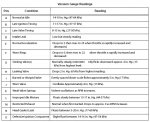
1. A steady vacuum reading between 14 and 19in. Hg. (47-64
kPa) at idle indicates an engine in good mechanical condition.
2. A vacuum reading below 14 in. Hg. (47 kPa) at idle, indicates
an engine that is not developing enough vacuum. Further testing
for base mechanical problems is needed.
3. Possible causes of low intake manifold vacuum are late ignition
timing, low compression, poor engine sealing, leaks at vacuum
lines and connections or bad MAP sensor.
4. If the gauge fluctuates at idle, possible causes are sticking or
leaking valves, or an ignition miss.
5. If the gauge fluctuates at idle but smooths out as engine RPM
increases, check for bad valves or camshaft.
6. If the gauge fluctuates more with increases engine RPM, check
for weak or broken valve springs, bad valves, ignition miss, or a
leaking head gasket.
7. If the vacuum gauge fluctuates regularly with each engine
cycle, check for a bad valve.
8. If the vacuum reading drops steadily as engine RPM increases,
check the exhaust system between the engine and vertical
drive for restrictions.
9. See table and chart below for more information.