Although you may be overlooking something in cleaning/rebuilding the carburetors... that area is not anything I'd be looking into right now as you state that once the engine starts, it runs fine... my reasoning is that carburetors do not come and go... if they're bad, they stay that way.
The proper starting method of a cold engine is to.... Pump the fuel primer bulb up hard.... Apply a slight bit of throttle..... Turn the key to the START position and PUSH the key in at the same time to engage the Fuel Primer Solenoid (There is NO choke on that engine!).
You state that the engine starts fine on a flushette BUT not in the water... and you mention exhaust back pressure when in the water probably being the cause. Well, you've sort of hit on the cause but didn't think it further through enough. The exhaust back pressure results in having the engine crank over slower and that affects the ignition system.
That engine must crank over at least 300 rpm in order for the stator to supply the needed "AC" voltage to the powerpack capacitor (approximately 300v AC) which is needed to energize the powerpack/ignition/spark.
Remove, clean, all terminals of the wires and cables that pertain to the starting system, including the battery, solenoid, starter, ground cable at the powerhead, etc.... also clean the components they attach to. A tight but dirty cable will result in a "DC" voltage drop that will cause the cranking power to drop.
Also.... carefully inspect the stator under the flywheel. The stator is the beginning of both the charging and ignition system. Look for cracks and any portion of it to be dripping a sticky looking substance down on the powerhead area.
********************
(Fuel Primer Solenoid Function)
(J. Reeves)
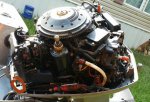
The RED lever...... The normal operating/running position is to have that red lever positioned over top of the solenoid and aimed at the other end of the solenoid, gently turned to its stop. This is the normal/automatic mode position. Pushing the key in opens the valve within the solenoid allowing fuel to pa$$ thru it in order to prime and start the engine. Looking upon this solenoid as a electric choke results in a better understanding of it.
Having that red lever turned in the opposite direction, facing away from the solenoid, allows fuel to flow thru it to the crankcase area. One would only turn the red lever to this position in a case where the battery might go dead and the engine had to be started via the rope pull method. Look upon putting the red lever in this position as moving a choke lever on a choke equipped engine to the full closed position. Either one would supply fuel to the crankcase/engine for starting purposes BUT if left in that position while running would flood the engine.
The later model primer solenoids are equipped with a schrader valve, used for attaching a pressurized can of fogging oil etc, available at your local dealership with complete instructions.
Pumping the fuel primer bulb up hard fills the carburetor float chambers of course, but that process also applies fuel pressure to the primer solenoid.
The two small hoses leading from the primer solenoid branch off via tees to each fuel manifold section that would feed fuel to the individual cylinders.
Pushing the key in activates the primer solenoid to allow fuel to flow thru it to the intake manifold pa$$ageways. Cranking the engine over causes the fuel pump to engage which in turn sends fuel pulses to the primer solenoid via the 3/8" fuel hose.
Some engines incorporates the "Fast Start" feature which automatically advances the spark electronically so no advance of the throttle is required for starting.
Engines that do not have the "Fast Start" feature will be required to have the throttle advanced slightly.
Starting procedure: pump fuel bulb up hard, crank engine and push the key in at the same time. When the engine fires/starts, release the key so that it falls back to the run position.
Bottom line..... Look upon the primer solenoid as an electric choke.
Let us know what you find.