Hi,
I am just beginning to restore this motor. I purchased it (along with a pressurized gas tank) from an elderly couple who had it in their garage (untouched) since the mid 1970's. It is a model 15024 (a 1958 from my research). Let me qualify myself as mechanically inclined with small engine experience (both 4 and 2 stroke) but zero experience with outboards. So please excuse any mis-naming of parts, etc.
Right off the bat I have run into two snags.
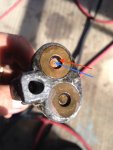
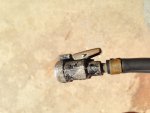
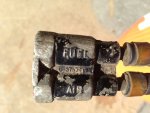
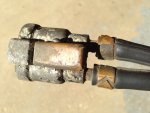
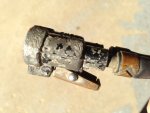
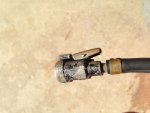
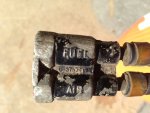
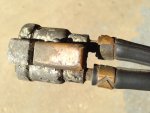
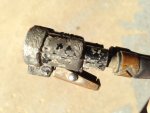
1) When attempting to attach the female end of the fuel line from the tank to the male receptor on the engine, the coupling will no go in all the way. I turned it upside down to see if it was the locking pin, but that in fact does go in all the way. I discovered that while the brass centers (both the air and the fuel ports) on the female end will fully depress, there appears to be a gasket (metal?) around the center that will only depress part way. That appears to be why the male ends will not go all the way in. In the photo I've attached, the blue arrow is pointing to the center brass pin and the red arrow is pointing to what I assume to be the gasket.
Any thoughts on why the gasket(s) will only depress half-way down? Is there some cleaning I should attempt?
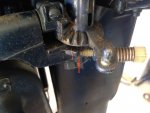
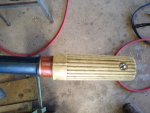
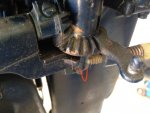
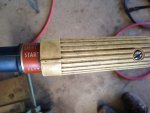
2) The throttle grip has limited movement. It is set at the 'start' position and will will only move half-way towards the 'fast' position. It will not move at all towards the 'shift' or 'stop' positions (the gear shifter is in the neutral position). The other pics I posted show the throttle grip in it's two allowable positions and a corresponding picture for each of the idle stop screw on the speed control vertical shaft gear. When in the 'start' position, the screw is hitting the stop. When half-way to the 'fast' position, there is a gap (as indicate by the red annotation).
I'm confused about many things but the main one is understanding how the throttle will ever be able to move to the 'shift' or 'stop' positions if the idle screw stop won't let it go any further???
Any thoughts on this will be greatly appreciated.
Thanks,
Tim