







Check/Fix/Replace Starter Motor 1996 50hp

Chris1956

Supreme Mariner
Joined
Mar 25, 2004
Messages
28,614
You can usually test the spark timing with all but one of the spark plugs removed, and a timing light on the remaining spark plug, in the top cylinder.

Joe Reeves was an iBoats member who worked at OMC for a long time and published a timing procedure for OMC products that doesn't require their specialized equipment. You might search for it here under "Joe Reeves method".
 

saltchuckmatt

Captain
Joined
Jul 19, 2019
Messages
3,129
Thanks. It cranks when the spark is off (I wouldn't say well). Voltage drops about 3.5V. Cannot crank when circuit is set to spark. I'd like to test the spark timing, can I do this without cranking using the starter motor. Is it time to do electrical tests on the wiring, from ignition switch to solenoid?
Without going back through the posts, and assuming this is a remote motor, have you removed the control box plug from the motor and then try testing the starting stuff back at the motor. Usually I jump the solenoid and at that point the kill circuit will somewhat be removed from the system. At least it'll tell you if it's in the control box or back at the motor. Racer one and Chris know a lot so maybe it's just what they suggest but kill circuit is a known problem.
 

janul15

Petty Officer 2nd Class
Joined
Feb 15, 2020
Messages
104
Before doing other things, I want to check the current draw when powering up the starter motor on the bench. I'm taking delivery of a clamp on ammeter tomorrow. Chris 1956 suggests the current draw should be less than 200 Amps. Does that value sound right for a bench test? I can post my findings tomorrow night, or Saturday, if the test should only be done on the boat.
 

Crosbyman

Vice Admiral
Joined
Nov 5, 2006
Messages
5,994
I don't really know where you are at here but rightly or wrongly I can't see how the ignition /kill circuitry would contribute to the starter problem unless somehow it contributes such a high amperage drain worthhy of smoking up the place being low drain elements to begin with.

That said and not to oversimplify as an occasional greenlighter.... if it seems there are no mechanical issues with the engine innards, soexternally your left with few possibilities
  • bad starter
  • bad power circuitry
  • bad battery
Bad power circuitry seems the likely suspect, ohms law and and an inexpensive IR gun are is your friends...incl your fingers ! .

Before doing a series of cranking test and after cleaning all electrical junction points incl. cable crimps..... properly install a voltmeter at subsequent points and note the voltage before (up to the solenoid) and during while cranking.

Each point showing lesser and lesser volts indicates a resistance to current flow and is likely to generate heat (P=VxI across the resistive junction) which your fingers or an IR gun can sense.
main points to check...
  1. across battery posts to establish a referrence value before/ while cranking
  2. across solenoid "IN" post and battery B- (before and during cranking)
  3. across solenoid "OUT" post and battery B- (before and during cranking)
  4. across starter "IN" post and battery B- (during cranking)
tell us what you found
 

dingbat

Supreme Mariner
Joined
Nov 20, 2001
Messages
17,005
Continuity test only tells you if the motor is shorted to ground. Tells you absolutely nothing about the integrity of the windings themselves.
 

janul15

Petty Officer 2nd Class
Joined
Feb 15, 2020
Messages
104
I'll update you, although I've unwittingly left some things unanswered. Bench test on starter proves it is spinning, and a voltage drop here is about 1V. At the boat, the boat will crank (starter motor turns, engages flywheel, flywheel rotates) from the ignition switch when the key is turned to start. Voltage readings; across solenoid IN post and B- (I used an engine ground point) - 0.0V before cranking, 8V when cranking; across solenoid OUT post and ground- 0.0V before cranking, 0.9V when cranking. Across battery posts, 12.8V before, then, ( I think I made an error here) when +ve lead attached directly to starter motor, 11.9V. Anything from the above results to help us?
Can't do any more until late next week.
 

dingbat

Supreme Mariner
Joined
Nov 20, 2001
Messages
17,005
I'll update you, although I've unwittingly left some things unanswered. Bench test on starter proves it is spinning, and a voltage drop here is about 1V. At the boat, the boat will crank (starter motor turns, engages flywheel, flywheel rotates) from the ignition switch when the key is turned to start. Voltage readings; across solenoid IN post and B- (I used an engine ground point) - 0.0V before cranking, 8V when cranking; across solenoid OUT post and ground- 0.0V before cranking, 0.9V when cranking. Across battery posts, 12.8V before, then, ( I think I made an error here) when +ve lead attached directly to starter motor, 11.9V. Anything from the above results to help us?
Can't do any more until late next week.
Bench testing starter performance is useless as a diagnostic tool.

Once the windings are proven to be good (growler) the unit must be load (amp) tested to determine condition

You either have a bad starter, battery and or battery cable

Have you load tested the battery?
“New” means nothing.

Have you run an ohm tested on both the positive and ground battery cables?
 

Chris1956

Supreme Mariner
Joined
Mar 25, 2004
Messages
28,614
Generally speaking, when cranking an outboard, the battery voltage should not go below 8.5VDC. It is not a hard and fast rule, but if your battery shows 7VDC when cranking, it is likely failing.

In your case, 8VDC when cranking does not prove the battery is good or bad.

If I were you, I would check the timing as I suggested in post #21. If the spark plug fires too soon, it will slow or stop the starter from cranking, and that will cause the amperage draw of the starter to spike.

Concurrent to that I would ohm out the battery cables and inspect them for corrosion "lumps" under the insulation.

I once had a battery cable that rotted down to a few strands of conductor, under the insulation. The lump in the insulation, gave it away, but it passed the ohm test.
 

Crosbyman

Vice Admiral
Joined
Nov 5, 2006
Messages
5,994
Across solenoid IN post and B- (I used an engine ground point) - 0.0V before cranking,
MAIN IN post on solenoid should always have 12v..! in fact its is suppose to equal the same as reading the voltage across the battery posts since the engine frame ground is the same referrence as the battery B- post. This measurement point is directly linked to the the 2 battery posts with heavy cables !! if not equal find out why!... possible bad connections, bad crimps etc... certainly should not be 0 volts at solenoid IN !

8V when cranking; across solenoid OUT post and ground-
over the first reading descrepancy above.... which needs clarification.... reading 8v across the solenoid OUT post during cranking indicates major loss of voltage .(possible cabling problem, connections oxydized, bad battery bad solenoid internal contacts)
If such is the case 8v should also show up at the starter main IN post since a very short piece of cabel links the two. If you do see 8v at solenoid IN and OUT during cranking...and if battery posts reading is at or above 10.5V problem is on the battery side of solenoid IN ...

again recheck all connections, crimps cable resistance etc...

Voltage losses from battery B+ to starter IN are proportionnal to the resistance of each section of the the circuitry (by ohms law).

If the 10.5v battery volts while cranking drops to 8v at the solenoid OUT those volts got lost on the way and souldn't.

see utubes on testing volate drops on starter circuitry.
 

janul15

Petty Officer 2nd Class
Joined
Feb 15, 2020
Messages
104
I'll recheck things when I can, including voltage drops on starter circuitry, and ignition timing.
 

Crosbyman

Vice Admiral
Joined
Nov 5, 2006
Messages
5,994
suggest one rabbit at a time... leave key to OFF and don't involve timing issues...

you can activate the starter cuircuit and do voltage drop testing by simply manually applying 12v on the solenoid control post which the key START position normally activates.

have you shiny cleaned / inspect ALL connection points ??
 

janul15

Petty Officer 2nd Class
Joined
Feb 15, 2020
Messages
104
Also, I must go back to check all the terminology, (terminal labels) on solenoids, I think I have got badly confused.
 

Crosbyman

Vice Admiral
Joined
Nov 5, 2006
Messages
5,994
starter circuitry is generally straight forward..
1772911088986.png

battery B- GROUND is bolted to the engine frame and serves everybody.
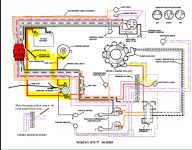
Red B+ from the battery FIRST goes to the solenoid main IN post
some B+ is sent off usually via a fuse to serve for ignition Tilt and Trim rely controls etc...
the same B+ on the solenoid IN post shares amp power to the t&T motor via the control relays for up- down movement.
the post is also the receipient of charge amps from the rectifier-regulator to replenish the battery.

the solenoid is just a electromagnet and needs B+ to close a contact and feed the starter with raw high power battery amps. The solenoid kicks in when the key S post sends it B+ power.

Assuming good GROUND connections anything impeding high amp flow from the battery to the starter will make the starter look weak or dead. Voltage readings are indicative of bad junction points to be investigated and more than likely... cleaned up or replaced as in corroded cable cores. Bad oxidized crimps can be cleaned up and resoldered..

remember that good voltage readings are not a garantee that high amps can flow in a junction point. Volt meters are sensive to VOLTs and are not Ampmeters !!
 
Last edited:
Top