Another Multiple Battery Setup from a newbie that read much of posts on the issue

Captain Zach

Recruit
Thread starter
Joined
May 13, 2013
Messages
5
Got a few questions about the new battery setup I want. I got a deal on a couple batteries and want to add both to the system as aux batteries in their own separate bank from the start batt. I want to use a BlueSea Mini Add a battery system with the switch and 65Amp ACR. I got a 2011 F90 Outboard with a 25amp alternator. My total load is somewhere between 10-70Amps probly right around 30 average. See diagram for more info on questions.

1. Does this wiring look correct?
2. Is it ok to use 2 batteries in the second bank and only 1 battery 1st bank with this ACR?
3. Will this 65Amp ACR get fried if I use the dual battery start feature on the switch to start my motor?
4. In real life the 2 Aux Batt's which make up the 2nd bank are a 19ft wire run apartfrom back of boat to box in front of boat, what size wire should this run be? Should I size for the accessory load or the start load in the event I used the double start feature?
5. Being that the Aux Batt's are so far apart is it ok to not use the +Bus Bar or comm on the switch and just wire things in the general area of each battery directly to that battery?
6. What size should the main ground be coming off the -Bus Bar? Should it run to the motor?
7. what size wires should I use in this system based on what you know from the info Ive given you? :)

As you can see I have much less on the alternator in terms of max output compared to what my max load is. This is another reason I want to add 2 batteries instead of just one. I plan on bringing the batteries home at the end of each weekend and charge from the garage to bring back to 100%. Any suggestions, comments, or answers welcome. Thanks guys.
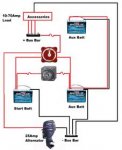
 

Attachments

  • Boat wiring system.jpg
    Boat wiring system.jpg
    10.7 KB · Views: 1
Joined
Feb 17, 2012
Messages
2,906
Re: Another Multiple Battery Setup from a newbie that read much of posts on the issue

a few questions.

Are you leaving the boat and just bringing the batteries home? If so skip the acr as 25 amps is not worth the effort and you will be recharging at home any way. If you are bringing the boat home skip the acr and get a 3 bank charger

All batteries that are capable of being wired to start the motor must have wire that is equal or better than the original wire being used on the motor this includes all negative cables as well (the wire must also be upgraded to account for voltage loss over distance) So if the motor leads are 4awg then the leads to the batteries up front is 4awg plus voltage loss which will be a few sizes bigger maybe 2awg (as i do not know the original wire size this is all guess work and will need to be calculated. 19 feet away is 38 feet of voltage loss)

what is the main amp draw on the boat that requires the 70 amp load and 2 additional batteries (trolling motor or stereo) If its a trolling motor what voltage is the trolling motor?
 

Captain Zach

Recruit
Thread starter
Joined
May 13, 2013
Messages
5
Re: Another Multiple Battery Setup from a newbie that read much of posts on the issue

a few questions.

Are you leaving the boat and just bringing the batteries home? If so skip the acr as 25 amps is not worth the effort and you will be recharging at home any way. If you are bringing the boat home skip the acr and get a 3 bank charger

All batteries that are capable of being wired to start the motor must have wire that is equal or better than the original wire being used on the motor this includes all negative cables as well (the wire must also be upgraded to account for voltage loss over distance) So if the motor leads are 4awg then the leads to the batteries up front is 4awg plus voltage loss which will be a few sizes bigger maybe 2awg (as i do not know the original wire size this is all guess work and will need to be calculated. 19 feet away is 38 feet of voltage loss)

what is the main amp draw on the boat that requires the 70 amp load and 2 additional batteries (trolling motor or stereo) If its a trolling motor what voltage is the trolling motor?

The boat and batteries will be coming home. I had planned on just rollingback the cover and hooking up charger in the boat with an extension cord. The load is stereo, electric downriggers, Spotlights and all the usual other gear all 12v. Though most of the time I wont be running all the lights etc. Its on the hour ride home in the dark that will be full draw and only with the engine running.
 
Joined
Feb 17, 2012
Messages
2,906
Re: Another Multiple Battery Setup from a newbie that read much of posts on the issue

you will have way more battery power than you realy require but thats never a bad thing. The lights will be running off the starter battery on the way home and the engine will keep up with what they are using so the other batteries will only be used while the engine is turned off. I would consider only adding one battery if adding 2 means one is up front but thats just a surgestion. I still wouldnt worry about the acr if i had to choose between that and a onboard charger. Instead of a second extra battery i would consider a jump pack as the back up.
 

jhebert

Ensign
Joined
Jul 24, 2005
Messages
903
Re: Another Multiple Battery Setup from a newbie that read much of posts on the issue

Got a few questions about the new battery setup I want. I got a deal on a couple batteries and want to add both to the system as aux batteries in their own separate bank from the start batt. I want to use a BlueSea Mini Add a battery system with the switch and 65Amp ACR. I got a 2011 F90 Outboard with a 25amp alternator. My total load is somewhere between 10-70Amps probly right around 30 average. See diagram for more info on questions.

1. Does this wiring look correct?

Yes.

2. Is it ok to use [two] batteries in the second bank and only [one] battery [first] bank with this ACR?

Yes.

3. Will this 65Amp ACR get fried if I use the dual battery start feature on the switch to start my motor?

No. The current passes through the switch contacts in the EMERGENCY position of the switch; it does not pass through the ACR. If too much current tries to flow through the ACR, the fuses you have shown in the circuit will protect the ACR.

4. In real life the [two auxiliary batteries] which make up the [second] bank are a 19ft wire run apart from back of boat to box in front of boat. [W]hat size wire should this run be? Should I size for the accessory load or the start load in the event I used the double start feature?

To properly distribute 12-Volt power, the size of the conductor must be selected to prevent too much voltage drop. If you want the auxiliary batteries to be able to deliver full voltage for starting the engine, you must select the conductor size for that load. Typically for engine starting with a (one-way) distance of 19-feet the conductors will need to be extremely large, about 1-AWG. I base this recommendation on having a V6 outboard engine and following the manufacturer's recommendation. Note that you must also increase the size of the conductors to the starter motor on the engine, because they are presently sized for a battery that is much closer. The resistance of the original conductors is already near the limit for engine starting. When you move the batteries 19-feet away you will have to replace the smaller conductors in the engine starting circuit with the new 1-AWG conductors so that the engine circuit is 1-AWG.

In general, it is very difficult to get good engine starting performance from the battery distribution when the battery is so far away.

If you want the auxiliary batteries to deliver full voltage for auxiliary loads, you still have to base the wire size on the voltage drop. You mention a load of 70-Amperes on the auxiliary batteries. You need to also include the distance from the switch to the secondary power distribution panel or other loads connected to the switch. If there is another 20-feet of wire from the batteries to their loads, this means the total (one-way) length is almost 40-feet. To distribute 70-Amperes over 40-feet you will need extremely large conductors, again. Probably a 2-AWG conductor will be suitable.

As you see, the long distance between the battery and the loads has caused the conductor size to become very large in either case.

5. Being that the Aux Batt's are so far apart is it ok to not use the +Bus Bar or comm on the switch and just wire things in the general area of each battery directly to that battery?

It would be much better to avoid running all the power from the batteries to that one switch and then back. Use three individual switches. One switch at each batteries to switch the loads ON-OFF to the battery, and a third switch to tie the auxiliary batteries to the starting battery when needed. Also, you must tie all three battery negative terminals together with a conductor that can handle the engine starting current.


6. What size should the main ground be coming off the -Bus Bar? Should it run to the motor?

The conductors in the negative circuit have to be the same size as the positive circuit, so they will also be extremely large, as described above, 1-AWG.

7. what size wires should I use in this system based on what you know from the info Ive given you? :)

All power distribution in a 12-Volt system that has a one way distance of more than 12-feet must be sized larger than the current handling capacity of the wire. Voltage drop is the greater concern. You must size all conductors to maintain a minimum voltage drop. Usually a maximum voltage drop tolerance is 3-percent.

As you can see I have much less on the alternator in terms of max output compared to what my max load is. This is another reason I want to add 2 batteries instead of just one. I plan on bringing the batteries home at the end of each weekend and charge from the garage to bring back to 100%.

It will soon become much too cumbrous to haul the batteries around every weekend. If there is AC power available, install an AC powered three-bank battery charger permanently in the boat.

Any suggestions, comments, or answers welcome. Thanks guys.

I believe I have commented on all your questions.

My suggestion: consider locating the auxiliary batteries closer to the engine in order to reduce the size of the conductors that will be needed to properly provide voltage to the engine when using them for starting.
 

Captain Zach

Recruit
Thread starter
Joined
May 13, 2013
Messages
5
Re: Another Multiple Battery Setup from a newbie that read much of posts on the issue

Yes.


Yes.


No. The current passes through the switch contacts in the EMERGENCY position of the switch; it does not pass through the ACR. If too much current tries to flow through the ACR, the fuses you have shown in the circuit will protect the ACR.


To properly distribute 12-Volt power, the size of the conductor must be selected to prevent too much voltage drop. If you want the auxiliary batteries to be able to deliver full voltage for starting the engine, you must select the conductor size for that load. Typically for engine starting with a (one-way) distance of 19-feet the conductors will need to be extremely large, about 1-AWG. I base this recommendation on having a V6 outboard engine and following the manufacturer's recommendation. Note that you must also increase the size of the conductors to the starter motor on the engine, because they are presently sized for a battery that is much closer. The resistance of the original conductors is already near the limit for engine starting. When you move the batteries 19-feet away you will have to replace the smaller conductors in the engine starting circuit with the new 1-AWG conductors so that the engine circuit is 1-AWG.

In general, it is very difficult to get good engine starting performance from the battery distribution when the battery is so far away.

If you want the auxiliary batteries to deliver full voltage for auxiliary loads, you still have to base the wire size on the voltage drop. You mention a load of 70-Amperes on the auxiliary batteries. You need to also include the distance from the switch to the secondary power distribution panel or other loads connected to the switch. If there is another 20-feet of wire from the batteries to their loads, this means the total (one-way) length is almost 40-feet. To distribute 70-Amperes over 40-feet you will need extremely large conductors, again. Probably a 2-AWG conductor will be suitable.

As you see, the long distance between the battery and the loads has caused the conductor size to become very large in either case.


It would be much better to avoid running all the power from the batteries to that one switch and then back. Use three individual switches. One switch at each batteries to switch the loads ON-OFF to the battery, and a third switch to tie the auxiliary batteries to the starting battery when needed. Also, you must tie all three battery negative terminals together with a conductor that can handle the engine starting current.


The conductors in the negative circuit have to be the same size as the positive circuit, so they will also be extremely large, as described above, 1-AWG.


All power distribution in a 12-Volt system that has a one way distance of more than 12-feet must be sized larger than the current handling capacity of the wire. Voltage drop is the greater concern. You must size all conductors to maintain a minimum voltage drop. Usually a maximum voltage drop tolerance is 3-percent.


It will soon become much too cumbrous to haul the batteries around every weekend. If there is AC power available, install an AC powered three-bank battery charger permanently in the boat.


I believe I have commented on all your questions.

My suggestion: consider locating the auxiliary batteries closer to the engine in order to reduce the size of the conductors that will be needed to properly provide voltage to the engine when using them for starting.

Thanks for the replies guys I appriciate the help. I should have been more clear I am not going to remove the batteries from the boat every weekend, when I said bring them home I meant bring the whole boat home as I never spend 2 weekends at the same lake. Only the one auxillary battery is a 19FT run to the motor. The first of the 2 aux batts is probably a 4ft run to the motor. So my new idea based on your comments is to put a switch between the 2 aux batts to isolate the further battery in the event I use the double start feature. This way I dont need as big a wire at the starter or to run to the second aux batt. I can just size that for the load. But just to be clear the main ground that connects all the batteries from the negative bus in the diagram would be attached to the ob starter?
 

UncleWillie

Captain
Joined
Oct 18, 2011
Messages
3,995
Re: Another Multiple Battery Setup from a newbie that read much of posts on the issue

Don't discount that ACR so fast!
With the ACR you will not need a three bank Charger.
The ACR works 24/7.
Any single bank charger will charge all three batteries at the same time.
Only two will need charging and any 15 amp charger and 20 hours would have all three topped up.
That eliminates the need to remember to switch to Both with the engine running and Off when stopped or on the AC Charger.
A lot can be said for Idiot Proofing the system.
 

Auger01

Petty Officer 1st Class
Joined
Aug 15, 2009
Messages
201
Re: Another Multiple Battery Setup from a newbie that read much of posts on the issue

Thanks for the replies guys I appriciate the help. I should have been more clear I am not going to remove the batteries from the boat every weekend, when I said bring them home I meant bring the whole boat home as I never spend 2 weekends at the same lake. Only the one auxillary battery is a 19FT run to the motor. The first of the 2 aux batts is probably a 4ft run to the motor. So my new idea based on your comments is to put a switch between the 2 aux batts to isolate the further battery in the event I use the double start feature. This way I dont need as big a wire at the starter or to run to the second aux batt. I can just size that for the load. But just to be clear the main ground that connects all the batteries from the negative bus in the diagram would be attached to the ob starter?

If you do put a switch and smaller gauge wire between the two aux (house) batteries, bue sure to put a fuse (or CB) on it. That way if you forget to to open the switch when using them to start, you wont melt the wire and start a fire.

Jhebert response was very good and I agree with the wire sizes that he reccomended for you. The only thing in his respone that I would quibble with is the part about repacing ALL the wiring between the stern aux battery and the starter. IMO, connecting the two aux batterys with the 1 gauge wire would be sufficient if the motor has no problems starting with the existing wires.

If you havent priced boat cable lalely, you are in for a shock. 1 gauge is $4 a foot! :faint2:
 

Don S

Honorary Moderator Emeritus
Joined
Aug 31, 2004
Messages
62,321
Re: Another Multiple Battery Setup from a newbie that read much of posts on the issue

Don't discount that ACR so fast!
With the ACR you will not need a three bank Charger.
The ACR works 24/7.
Any single bank charger will charge all three batteries at the same time.
Only two will need charging and any 15 amp charger and 20 hours would have all three topped up.
That eliminates the need to remember to switch to Both with the engine running and Off when stopped or on the AC Charger.
A lot can be said for Idiot Proofing the system.

My only problem with that is you DO run the ACR all the time. Granted it's a continuous duty relay, but why make it work all the time.
I would hope the start battery would be remain fully charged.
Hooking a single bank battery charger to the two house batteries should be fine for topping up the house batteries, but no need to do the start battery too.
If the start battery looses charge, then it probably needs replaced, not charged.
 

Captain Zach

Recruit
Thread starter
Joined
May 13, 2013
Messages
5
Re: Another Multiple Battery Setup from a newbie that read much of posts on the issue

My only problem with that is you DO run the ACR all the time. Granted it's a continuous duty relay, but why make it work all the time.
I would hope the start battery would be remain fully charged.
Hooking a single bank battery charger to the two house batteries should be fine for topping up the house batteries, but no need to do the start battery too.
If the start battery looses charge, then it probably needs replaced, not charged.

I do still like the idea of the ACR. The main reason I want this is to not have to remember to switch batteries. I live in a highly remote area and quite often am 100's of kilometers down a lake or river with no support to help in the event of the dead batt. This is why I also would like to have a larger amount of stored power on the boat so that if I am using more of my batteries than my alternator can replace I have a lot to use before they are completely dead. I do see the fact though that it makes the system more complex and pricey. Wow 4 bucks a foot for wire! So what if I just bought automotive wire and tinned the ends with solder? Or used dielectric grease over the ends before the conntector goes on and then heat shrink over the end of the connector so no air can get to it? This should be good enough for lakes and rivers eh? I do not use the boat in the ocean.
 

UncleWillie

Captain
Joined
Oct 18, 2011
Messages
3,995
Re: Another Multiple Battery Setup from a newbie that read much of posts on the issue

Consider this option;

The Start and House Batteries in the rear could be wired with 2 gauge as they probably already are.
The Forward House Battery could be wired with 4 or even 6 gauge wire and a 50 Amp Auto Reset Breaker.
The 50 amp circuit between the house batteries will be plenty for the normal house electronics.

On the rare event when the Starter Battery became marginal, you would switch to BOTH to bridge all three batteries.
This would be the only reason to ever use the switch in operation.

The rear house battery would assist in starting the engine.
The forward battery would also contribute to the start,
But if the contribution exceeded the 50 amp breaker; the Breaker would open to protect the lighter wires.

Once the engine started you would switch out of BOTH, back to ON to begin charging the batteries.
The Breaker would reset without your assistance or knowledge.
Once the Start battery charged above the 13 volt ACR Threshold, the ACR would close and charge the House Batteries also.

A properly wired ACR will Open its circuit during engine start. (Start Isolation Circuit)
Start current will pass through the Battery Switch if it was set to BOTH.
Otherwise the ACR will only ever see charging currents, never staring current.

The ACR will only be closed when the engine alternator is charging or the external charger is attached.
If your end of the day run takes some time; the external charger will have an easy job that night.
By all means make sure you get a smart charger that goes into maintenace mode once the batteries are charged.
There is no reason to boil the batteries to death overnight.
 

Captain Zach

Recruit
Thread starter
Joined
May 13, 2013
Messages
5
Re: Another Multiple Battery Setup from a newbie that read much of posts on the issue

Consider this option;

The Start and House Batteries in the rear could be wired with 2 gauge as they probably already are.
The Forward House Battery could be wired with 4 or even 6 gauge wire and a 50 Amp Auto Reset Breaker.
The 50 amp circuit between the house batteries will be plenty for the normal house electronics.

On the rare event when the Starter Battery became marginal, you would switch to BOTH to bridge all three batteries.
This would be the only reason to ever use the switch in operation.

The rear house battery would assist in starting the engine.
The forward battery would also contribute to the start,
But if the contribution exceeded the 50 amp breaker; the Breaker would open to protect the lighter wires.

Once the engine started you would switch out of BOTH, back to ON to begin charging the batteries.
The Breaker would reset without your assistance or knowledge.
Once the Start battery charged above the 13 volt ACR Threshold, the ACR would close and charge the House Batteries also.

A properly wired ACR will Open its circuit during engine start. (Start Isolation Circuit)
Start current will pass through the Battery Switch if it was set to BOTH.
Otherwise the ACR will only ever see charging currents, never staring current.

The ACR will only be closed when the engine alternator is charging or the external charger is attached.
If your end of the day run takes some time; the external charger will have an easy job that night.
By all means make sure you get a smart charger that goes into maintenace mode once the batteries are charged.
There is no reason to boil the batteries to death overnight.

This is good stuff. I had decided to go with the smaller wire to the front aux battery but was thinking use a fuse as buddy said previous. The auto breaker is an awesome idea! Definitely the way im gonna go. As well earlier today got a deal on an intelligent charger for half price. Think I pretty much got it all figured out now. Thanks for the help! :)
 
Top