Anchors

mssunnyone

Recruit
Joined
Nov 8, 2010
Messages
1
I have a question. We just bought a Bruce Claw anchor for our boat. My question is, why are there 2 holes in the anchor. 1. hole of course is on the end for the chain, rope (rode), the 2nd hole is located at the angle of the anchor near the working end of the anchor, i have looked online and couldn't find an answer, i noticed that most anchors have 2 holes in them 1 on the top and the other on the lower end. thanks.
 

Fireman431

Rear Admiral
Joined
Sep 17, 2007
Messages
4,292
Re: Anchors

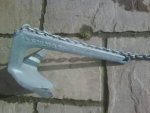
Actually, that second hole (near the flukes) is where you can attach the anchor rode if you anchor in rocky areas or some place with a lot of underwater obstructions where the anchor tends to get fouled.

Run the anchor rode up to the place where you would normally attach the clevis/shackle and secure the rode with a couple of wire ties.

When the anchor gets fouled, the wire ties break and then the anchor can be retrieved from the fluke/claw end. Works like a champ. I have been using that set up for years. See the attached pic for an example.
 

Attachments

  • an.jpg
    an.jpg
    8.1 KB · Views: 0

barbosam

Petty Officer 2nd Class
Joined
Aug 25, 2009
Messages
153
Re: Anchors

well put fireman, I couldn't have said it any better.
 

markernineteen

Seaman Apprentice
Joined
Feb 21, 2007
Messages
48
Re: Anchors

Very wise of you to ask this question ! Always think before you go out , ask questions , you might have to put up with some smarty pants , but there are people who care on this forum and give good advice .
 

Shrike

Petty Officer 2nd Class
Joined
Jul 17, 2009
Messages
112
Re: Anchors

Very wise of you to ask this question ! Always think before you go out , ask questions , you might have to put up with some smarty pants , but there are people who care on this forum and give good advice .
There ain't no smarty pants on here!:D
 

JoLin

Vice Admiral
Joined
Aug 18, 2007
Messages
5,146
Re: Anchors

When the anchor gets fouled, the wire ties break and then the anchor can be retrieved from the fluke/claw end. Works like a champ. I have been using that set up for years. See the attached pic for an example.

So, under normal anchoring and retieving loads, the wire ties hold up okay? My concern would be having them break as I'm retrieving with an electric winch. Could get interesting if the anchor comes up fluke end first.

Just thinking out loud here...
 

Bondo

Moderator
Staff member
Joined
Apr 17, 2002
Messages
71,453
Re: Anchors

Could get interesting if the anchor comes up fluke end first.

Ayuh,... Not as Interesting as when it won't come up, at All...
 

Dick Sorensen

Petty Officer 2nd Class
Joined
Feb 5, 2008
Messages
189
Re: Anchors

Another approach. Attach a 2nd line rigged to the anchoring depth your in and tied off with a float (piece of wood or a milk bottle.) If your anchor does become fouled and you can't retrieve it....motor over to the float and pull the anchor out backwards. This method should be considered when anchoring in all areas with questionable bottoms. For a more detailed explanation look to "Chapman Piloting Seamanship and Small Boat Handling Pg. 248 'clearing a fouled anchor.' Hope this helps.
 

Dick Sorensen

Petty Officer 2nd Class
Joined
Feb 5, 2008
Messages
189
Re: Anchors

Oh the wonders of a morning shower and how it inspires this human's brain. With all due respect to Fireman431 his approach to anchoring is wrong. Sorry. The whole design theory (and hundreds of years of practical experience) behind an achors design is for anchor shank to be held as close as possible to the bottom....so your drag is pulling on the end of the shank driving the flukes deeper into the holding ground. By following Fireman method the first time a big 'force' was put on your anchor line the 'tie' at the top (shackle) hole would release and all the effort would go directly to the throat of the anchor pulling the anchor out and up! The last thing you want to have happen. Secure your anchor to the top hole of the shank. It is recommended that you then attach a length of chain and then transition to your rope anchor line. The chain helps hold the shank to the bottom and directs your pull along the bottom.....another view on this is the concept of having an anchor line 7 times the water depth in really rough weather ( so if you're anchoring in 10 feet of water your need 70 feet of anchor line)....you want your 'effort' to be a very shallow angle to the end of the anchor....In the days of large wooden ships they would even take a cannon and secure it to the anchor line and lower it halfway down the cable so that the effort of the pull was more horizontal than vertical. Got to thinking about this...due some research on your own...but anchoring correctly is really important because when all else fails the last line of defense is the anchor.
 

Fireman431

Rear Admiral
Joined
Sep 17, 2007
Messages
4,292
Re: Anchors

****,

I understand your concern regarding the proper anchoring technique, and you are correct in most regards. However, the retrieval method that I wrote about was assuming that (and I should have stated it) the anchor rode has the proper amount of chain on the line (roughly the same length as the boat & never less than 15') to assure that the anchoe shank stays flat. Having the proper lenght/size of chain rode assures that the chain remains on the sea bottom, even during heavy seas or storm conditions, as long as the proper 7:1 scope is maintained.

I personally have utilized the aforementioned anchoring and been in heavy seas/storm conditions with it and it held just great. Of course, you have to have the proper anchor for your sea bottom, the proper size anchor for your vessel, the proper chain/rode and the correct scope to adequately hold any vessel securely.
 

Dick Sorensen

Petty Officer 2nd Class
Joined
Feb 5, 2008
Messages
189
Re: Anchors

Fireman, all the other points you mention are correct. My difference of opinion is where your anchor-line is finally attached to the anchor. I content that the safest place to have your anchor cable attached is at the farthest away from the 'flukes' at the end of the anchor's shaft. That way when your boat really puts a strain on the cable it will be transmitted to the shank (crown?) and not to the 'throat' where the anchor could actually be popped out! And you know that that situation would only occur when it' blowing like stink at 2 am! So we can agree to disagree?
 

Home Cookin'

Fleet Admiral
Joined
May 26, 2009
Messages
9,715
Re: Anchors

this discussion, where opposite methods are each correct, shows that there is no "simple" rule for anchoring; the rules have to include circumstances to have meaning. For example, the 7:1 rule is senseless when a boater wants to sit still in calm water while fishing. I can break all the rules, using a 10# mushroom on 15' of line to anchor my 21' boat. But it works great, in the right conditions.

The way to assess the best anchoring for the circumstances is to assess risk. For example, the method where you can "pop lose" the chain from the shank in case it gets stuck does, in fact, put the whole rig (boat) at risk, but that risk only arises in extreme conditions, and the risk is softened if the captain is aboard, as opposed to a boat moored remotely and unattended. But not doing that, puts your anchor rig at risk of being stuck and having to be abandoned. And, when you are over a sandy bottom with virtually no risk of getting stuck, you may decide the risk to the boat is greater.
Almost all of the boating "rules" are like this: kill switches, PFD's, VHF radios, extra bilge pumps. The only universal rule is, put the hull plug in before launching!

 
Top