24v wiring questions... almost blew something up!!1

Pbguy420

Cadet
Joined
Jan 15, 2012
Messages
22
hey guys i just came close to making a big mistake!!

my minn kota sp80 instructions say to wire it in series (its a 2 wire system, not three).... my old charger built into the boat was used in an application that the trolling motor used three wires, which may affect how im supposed to wire it.

so i wired the batteries for trolling motor in series, then without thinking began attaching the connections for the existing on board charger... (it has a pos and neg connection for both batteries) well with a series setup when i touched the final of the four lines from the battery charger to the battery i got sparks/hissing and instantly removed. then i thought about it and with the battery wired the way it does this would create a short wouldnt it? how do i wire this properly?

heres a 2 min diagram of how it is with the charger cables not connected.
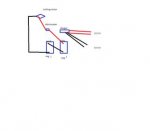
Untitled.jpg
 

dwparker99

Petty Officer 3rd Class
Joined
May 9, 2010
Messages
98
Re: 24v wiring questions... almost blew something up!!1

Should not have been a problem. Wire jumper to positive terminal of battery 1 and negative terminal of the battery 2. Wire the TM positive wire to positive terminal of battery 2 and TM negative wire to negative terminal battery 1. Wire positive & negative of charger bank 1 to one battery and positive & negative of charger bank 2 to other battery. Should work fine.
 

Don S

Honorary Moderator Emeritus
Joined
Aug 31, 2004
Messages
62,321
Re: 24v wiring questions... almost blew something up!!1

It would help if you posted the picture, and not the thumbnail of it.
 

Silvertip

Supreme Mariner
Joined
Sep 22, 2003
Messages
28,771
Re: 24v wiring questions... almost blew something up!!1

Depending on how old the charger is, even though it has two separate pairs of outputs, the grounds for those two pairs may be common which means you cannot use the charger in a 24 volt system. We need to know the make and model number of the charger. The way you can check this is to use an ohm meter and measure between the two ground wires. If it shows continuity, they are NOT isolated grounds and cannot be used in a 24 volt series system. If the grounds are isolated (showing infinity) then there should be no problem with the installation and you apparently did something wrong. As Don says, we need more info. But here is how a 24 volts system should look with a dual bank charger attached.

24VChargingSystem.jpg
 

Pbguy420

Cadet
Joined
Jan 15, 2012
Messages
22
Re: 24v wiring questions... almost blew something up!!1

turns out the grounds show continuity.... so i dont understand how this system worked in the boat before? when i bought the boat there were two battery trays, this charger (charge pro 2611) with two sets of outputs, and a 3 WIRE trolling motor plug (one grd two pos leads).... so this worked with the three wire system previously in place... im confused, this charger will work with a three wire system? ive got only two wires coming out of my trolling motor.... but i do have a lot of left over 10 ga, so if i could rewire the batteries to the trolling motor to make this setup work so i dont have to spend a bunch of money on a new charger it would be helpful...
 

Silvertip

Supreme Mariner
Joined
Sep 22, 2003
Messages
28,771
Re: 24v wiring questions... almost blew something up!!1

Continuity is one thing? Just how much resistance are you reading? Does this boat have a 12/24/RUN?CHARGE switch on a panel at the bow? Does it have a two, three, or four wire system running from the batteries to the bow? There are lots of 24 volt wiring systems in older boats that tried to accommodate 12 volt, 24 volt, and combination 12/24 volt motors. How the wiring was determined how the batteries could be charged and what type of charger could be used. The fact remains, you cannot use a dual bank chartger on a 24 volt system unless 1) there is ground isolation between the two outputs, or 2) you break the series connection between the two batteries and then disconnect the charger when reconnecting the jumper. Go back to the diagram I posted and look at it carefully. If there is continuity between the two charger ground wires you essentially place a direct short across the battery on the left because with the jumper in place the ground for the battery on the right is connected via the jumper to the POSITIVE terminal on the left battery. Two grounds that are common therefore is the short and things go up in smoke. If grounds are isolated this is not a problem.
 

Pbguy420

Cadet
Joined
Jan 15, 2012
Messages
22
Re: 24v wiring questions... almost blew something up!!1

there is 0 resistance (my terminology with electrical systems is lacking, but the grounds are not isolated). there is no switch, there used to be a three wire system going from batteries but my new trolling motor requires a 2 wire system....

so basically if i throw some wing nuts on there and simply disconnect the jumper (going from batt 1 pos to batt 2 neg this charger will work?

if i decide thats too much a pain and want a new charger what makes it easier i cannot use dual bank? what should i buy then?
 

Silvertip

Supreme Mariner
Joined
Sep 22, 2003
Messages
28,771
Re: 24v wiring questions... almost blew something up!!1

What kind of meter are you using? Digital or Analog? What setting is the meter on? (Rx1, Rx10, etc if analog, or 200, 20K, etc if digital). Are you measuiring between the two ground leads with the charger unplugged and the outputs disconnected from the batteries.
Then give us the actual reading. If an analog meter needle does not move at all on any Resistance setting you don't have zero resistance -- you have infinite resistance and that's what we are looking for. If the meter needle moves, then there is some resistance and that would indicate a common ground. If using a digital meter set it to the lowest resistance setting. Without the test leads connected the meter will typically read 1. Now measure across the two outputs. If the reading doesn't change, you again have infinite resistance. If the reading changes then there is some resistance. Remember that your body has resistance so you cannot be touching both probes with your fingers when you make these mesurements

If the outputs are NOT isolated, you can still use the charger you have but you would need to remove the jumper and then connect the charger to each battery. When charged you would need to disconnect the charger FIRST. then install the jumper again. If you didn't disconnect the charger first, the moment you connected the jumper between the two batteries you create the short and likely fry the leads. Do you have any idea how old this charger is and do you have a name and model number.
 

fishrdan

Admiral
Joined
Jan 25, 2008
Messages
6,989
Re: 24v wiring questions... almost blew something up!!1

I'm not sure how that was wired previously since there wasn't a run/charge switch. If the charger has common ground outputs, you can't leave the charger connected when the batteries are placed in series. Some plugs "create" the series connection, so the batteries are only in series when the TM is plugged into the receptacle, but it doesn't sound like you have this since you are now running a 2 wire system.

Before changing anything to accommodate the old charger I would make sure it still works, break the series connection and make sure it still charges the batts. Sparks and hissing isn't good and that 24V could have blown the charger. If it's in the budget, replace that old dinosaur charger and get one with independent outputs. I have a MinnKota MK330 (3 bank) that works well, though there are other good ones available. Make sure you get one with enough output current, 5amps/bank minimum, I would go for 10amps/bank.

Off subject, how long are the wire runs from the batts to the TM, or TM receptacle? 10GA wire is kind of small for a 24V system as your TM probably draws 50-60amps at 24V max. While 10ga might handle that voltage/current, it might have too much voltage loss. The wire coming out of the TM could be be 10ga, but the boat's wiring could need to be thicker, depends on wire length. (I'm running 6ga because of long wire runs) This isn't the problem with your charger, but something to look into.
 
Top