1993 Alumacraft Rivet Replacement... arghhhh

djang

Cadet
Joined
Aug 19, 2011
Messages
7
Just bought a used boat and it has a leak under the keel near the bow. Everything I have read says that it is best to repair from the inside. The original deck is still on the boat. How do I remove the rivets and then how do I replace the decking when I am done with the repairs? Are the stringers metal? Can I use screws? Tried searching the archives but could not find anything specific to this. If I choose not to mess with removing the decking; would a syringe filled with gluvit be a reasonable way to attempt to stop the leakage from the outside of the hull?

Thank you!
 

jigngrub

Fleet Admiral
Joined
Mar 19, 2011
Messages
8,155
Re: 1993 Alumacraft Backtroller Deck Replacement

Re: 1993 Alumacraft Backtroller Deck Replacement

If your rivets are leaking and you know which ones they are there's a pretty easy one man fix you can do from the outside without removing the decking.

You'll need to drill the bad rivets out and replace them like in this video.

http://www.youtube.com/watch?v=L0MA1-5NXjs&feature=related

If you'll post pics of your boat I may be able to explain how to remove your decking if you need/want to do that to apply the Gluvit, but the new rivets should stop the leak.
 

djang

Cadet
Joined
Aug 19, 2011
Messages
7
Re: 1993 Alumacraft Backtroller Deck Replacement

Re: 1993 Alumacraft Backtroller Deck Replacement

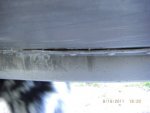
I might not have been too clear in the original post. I believe the leak is in the center seam of the boat and the water comes out around the keel where it has pulled away (maybe 1/32") from the hull. I am a bit intimidated about removing the wood decking to get at the inside of the hull; but I do want this fixed right. any suggestions would be greatly appreciated.

the pic on the right shows the keel and the left pick shows the (shiny) heads of the rivets used to hold the interior wood deck down.

deck.JPGkeel.JPG
 

Bob_VT

Moderator & Unofficial iBoats Historian
Staff member
Joined
May 19, 2001
Messages
26,099
Re: 1993 Alumacraft Backtroller Deck Replacement

Re: 1993 Alumacraft Backtroller Deck Replacement

Your keel rivets are not tight. The underside of the aluminum hull is all one sheet w/o seams. Water is probably leaking through at the rivets. You need to tighten the rives and use gluvit. There are no shortcuts.

The deck rivets need to be drilled to remove the heads and then remove the deck.
 

djang

Cadet
Joined
Aug 19, 2011
Messages
7
Re: 1993 Alumacraft Backtroller Deck Replacement

Re: 1993 Alumacraft Backtroller Deck Replacement

I appreciate the assistance. The video I was referred to by jigngrub suggested to drill out the old (hull) rivets with a 1/4" drill bit. That sounds awful large, but what do I know. Specifically what sized rivet would I use to fit in the new holes? Obviously 1/4" diameter, but is the length important? Since the drilling would be through the hull and the keel (which is much thicker) that would need to be taken into account. Can I be sure that "popping" the rivet will pull the hull and the keel together? If you could refer me to a source for rivets I would appreciate that too.

If I chose to tighten the rivets; that would entail removing the interior would decking and the tapping them with a hammer while someone else held a mall to the rivet head on the outside; right? Would this be likely to pull the keel and the hull back together? I would hate to remove all the decking, try this repair and not have it work and then end up drilling out the old rivets and replacing them anyway

What is that larger 2-handed rivet fastener called that is used in that video?
 

jigngrub

Fleet Admiral
Joined
Mar 19, 2011
Messages
8,155
Re: 1993 Alumacraft Backtroller Deck Replacement

Re: 1993 Alumacraft Backtroller Deck Replacement

The large rivet setting tool in the vid is a heavy duty blind rivet setter, they range in price from $20- $130.It is used for setting the large 1/4" dia. rivets.

This is the best place to get the closed end blind rivets:

http://www.rivetsonline.com/blind-rivets-en/closed-end-blind-rivets.html

The thickness of the 2 metals will determine what length rivet you buy, you want to select the proper "grip range" on the chart. The .126-.250 is a 1/8"-1/4" grip range. If the combined thickness of the 2 metals is 1/4" or less these are the ones you want, if it's thicker than 1/4" you want the .256-.375 (1/4"-3/8"). Be sure to use the dab of epoxy on the rivet like in the vid for extra insurance. I recommend the aluminum rivet with the steel mandrel because it is stronger, just smear a dab of epoxy over the mandrel hole to prevent rusting.

You deck is an easy removal job, just drill out the rivets and lift up the panels. Then use you heavy duty rivet to to install them back, you'll need a different rsize rivet for that though... depending on the thickness of your decking.

As far as rebucking the old rivets goes, I personally would remove them because they're already weakened and install new ones... you're going to have to buck them anyway.

 

djang

Cadet
Joined
Aug 19, 2011
Messages
7
Re: 1993 Alumacraft Backtroller Deck Replacement

Re: 1993 Alumacraft Backtroller Deck Replacement

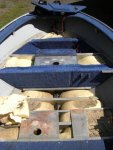
I removed 2 deck panels; the bow casting deck and the one immediately astern of that. The bow deck was fastened to the metal stringers with screws; the other deck piece was riveted down. Is there a reason for that? Could the one that was riveted in place, be re-installed using screws?

My project is not to deal with the deck, but to replace some loose rivets in the very forward end of the keel. Unfortunately, those rivets are under the battery box portion viewable in the very top of the photo. For now, I do not think I will dismantle anymore. To drill out the keel rivets, I can do that from the underside. The only rationale I could think of for further deck dismantling, is to enable the inside of the new keel rivets to be coated with Gluvit. If I put Gluvit on the rivet prior to setting it (as in the video cited in an earlier reply) would that be sufficient?

thanks again for the support and assistance

I re-named the post to more accurately reflect the project.

Deck_Gone.jpg
 

jigngrub

Fleet Admiral
Joined
Mar 19, 2011
Messages
8,155
Re: 1993 Alumacraft Backtroller Deck Replacement

Re: 1993 Alumacraft Backtroller Deck Replacement

Screws or rivets work, just be sure to use stainless steel.I'd say there were screws and rivets because someone else has worked on that boat before and just used what they had.

In the rivet installation vid that is epoxy that guy is applying to the rivet. Epoxy the rivet in and then use the Gluvit on the inside. Gluvit breaks down when exposed to sunlight so it either has to be where the sun doesn't shine or painted over.
 

djang

Cadet
Joined
Aug 19, 2011
Messages
7
Re: 1993 Alumacraft Backtroller Deck Replacement

Re: 1993 Alumacraft Backtroller Deck Replacement

Thanks for the clarification on epoxy vs. Gluvit; I thought Gluvit was an epoxy. Any specific brand of epoxy that I should use when setting the rivets?

I went ahead and removed the bow battery box. I am glad I did; it is directly below that point where the most suspect rivets are located. The hull is actually made of 2 longitudinal halves that are riveted together in the centerline. For most of the length these 2 halves actually overlap, but in the section under the battery box where the worst leaking is, there is actually a 1/4" gap between the 2 halves (this is clearly by design) and the only thing preventing the boat from going to the bottom is the rubber/foam packing that is inside the keel and pressed up into this joint. The keel is pulled away here, the packing can't do its job and voila, leaks.
 

djang

Cadet
Joined
Aug 19, 2011
Messages
7
Re: 1993 Alumacraft Backtroller Deck Replacement

Re: 1993 Alumacraft Backtroller Deck Replacement

Argh...

So I followed all the advice, drilled out the old rivets with a 1/4" bit, seated new 1/4" blind rivets (grip range of 0.126 - 0.250) and they did not pull the keel and hull together tightly. The resulting gap is even worse than before. I have removed all the new rivets (didn't want the epoxy to set) and now am at a loss as what to do...
 

djang

Cadet
Joined
Aug 19, 2011
Messages
7
Re: 1993 Alumacraft Backtroller Deck Replacement

Re: 1993 Alumacraft Backtroller Deck Replacement

Anything wrong with putting bolts in all those holes? Or placing in bolts to pull everything tight and then seating rivets one at a time as I remove each bolt...?
 

orlandoclippertim

Petty Officer 2nd Class
Joined
Jun 2, 2011
Messages
106
Re: 1993 Alumacraft Backtroller Deck Replacement

Re: 1993 Alumacraft Backtroller Deck Replacement

Djang... I am a part time aircraft mechanic and aluminum boat restorer. Here is waht I think if you want to try it. The rivet doesn't have a lot of power to pull the joint together by its self. It will hold very tight once the sheets are firmly in contact and THEN the rivet is set (or "bucked" as it is called) Once the back side of the rivet is swelled by bucking it will hold a lot and may be watertight if done properly (or may leak a little so coating with something won't hurt and is probably good insurance.) The pulling or bucking process won't pull the sheets together. You have to cause that to happen before you swell the rivet. I would drill out one or two on either side of the suspect rivet. Then use a # 10 bolt and nut in all the holes except the suspect rivet. That will bring the sheets together
into firm contact. Set the suspect rivet. Next take one of the bolts out.... set a rivet there. Take another bolt out and set another rivet. The aircraft mechanics have little spring loaded clamps which go into the open holes to squeeze the sheets together. These are called "cleco's". Nuts and bolts will do the same thing .. just slower. By the way... when drilling out a rivet standard practice is to center punch a small divit with a sharp punch to get the bit to be in center. Then use a drill bit the exact size the rivet shank was before it was bucked... the same size as the hole in the sheet metal was. Drill down the head untill the bottom of the hole is about levle with the surface of the sheet. try to make the hole no larger than the bit and not tapered. Once you get the hole in the head
take a pin punch nd put it in the drilled hole - it should just fit one of the punch sizes. push it to the bottom of the hole and then rock it in a circular motion a little . this rocking will make the head peel right off onto the punch. This breaks the shank off flush with the skin. Then take your punch and lightly tap the shank and drive it inward where it will leave the skin and be loose inside the hull.
Be carefull to center punch the initial dent in the rivet exactly in the center and stop drilling at the right depth and this works great.
This process is for removing solid rivets. Removing a blind rivet ( like a common "pop" type ) is different.
Solid rivets come in two hardnesses. dead soft (no marks on head) or hard heat treated ones ( dimple on head or other mark )
I think for boat work soft is the way to go. much easier to set and they don't get harder as you set them. Most boats I have seen use
a head style called "brazier" which is broader and maybe thinner than a standard aircraft style (which would work OK) There is an on-line mail order companny which sells brazier style in hard or soft. Google "brazier aluminum rivet"

How to set them is another message but its not hard but a 2 man job.
you don't want to use a drill bigger than the oregional hole because you don't want to accidently make the hole any bigger.
You want to keep your holes exactly the same size as the new rivet shank. this insures a tight fit when done and maximum
strength. (and probably best chance of a watertight joint)

If there are any aircraft home builders in your area they might install your rivets when you get ready.

Tim
 
Top