1974 Johnson 85 Melted Charge Coils

balthasar

Cadet
Joined
Jun 1, 2010
Messages
16
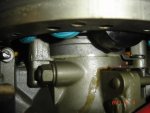
Hi, i have a 1974 Johnson 85 HP Model 85ESL74. I took the boat out for the first time in 11 years the other day and it ran fine for about 15 mins, then stopped working. The carbs were recently rebuilt, so its definitely an electrical issue. There are several corroded wires and some that are actually exposed in the system. Now no cylinders are getting spark.

Underneath the flywheel, i noticed that something dark green had melted, and upon inspection of the service manual, i think its the charge coils that have melted. However, i want to do a full overhaul on the ignition and electrical system. Does anyone have any recommendations, or a list of parts that i should update/buy? Any help would be greatly appreciated.

Also, what should be the order of chasing down a NO SPARK issue?
 

Bob427

Petty Officer 2nd Class
Joined
Jun 20, 2010
Messages
155
Re: 1974 Johnson 85 Melted Charge Coils

if it looks like this one from my 74 70hp
its time to change it

Bob
 

Attachments

  • 203.jpg
    203.jpg
    37.2 KB · Views: 2

Joe Reeves

Supreme Mariner
Joined
Feb 24, 2002
Messages
13,262
Re: 1974 Johnson 85 Melted Charge Coils

The stator is a two fold component.... the beginning of the charging and ignition system. If it's melting down, save yourself a lot of trouble..... just replace it.

Possibly the rectifier shorted out and caused a voltage backup there. Be sure to check the rectifier as follows.

(Small Rectifier Description & Location)
(J. Reeves)

On most 2,3,4,6 cylinder engines, the small rectifier is located on the starboard (right) side of the engine just in front of the engines electrical wiring strip. There are a few older V4 engines that have the wiring strip on the rear portion of the engine and the rectifier would be located just under that terminal strip. The smaller horsepower engines usually have the rectifier located on the starboard side of the powerhead close to the carburetor area.

The rectifier appears to be a round object approximately one inch (1") in diameter and also about one inch (1") high. The base of it is sort of triangular in appearance and is attached to the engine with two (2) screws/bolts..... usually one screw/bolt is larger than the other. The rectifier, depending on which one your engine uses, will have either:

One Red wire, one Yellow wire, and one Yellow/Gray wire, or One Red wire, and two Yellow wires.

Note that either of the above rectifiers could have a fourth wire which would be Yellow/Blue

********************
(Small Rectifier Test)
(J. Reeves)

Remove the rectifier wires from the terminal block. Using a ohm meter, connect the black lead of the ohm meter to the rectifier base (ground), then one by one, connect the red lead of the ohm meter to the yellow, yellow/gray, then the red wire (some rectifiers may also have a fourth yellow/blue wire. If so connect to that also). Now, reverse the ohm meter leads and check those same wires again. You should get a reading in one direction, and none at all in the other direction.

Now, connect the black lead of the ohm meter to the red wire. One by one, connect the red lead of the ohm meter to the yellow, yellow/gray, and if present, the yellow/blue wire. Then reverse the leads, checking the wires again. Once more, you should get a reading in one direction and none in the other.

Note that the reading obtained from the red rectifier wire will be lower then what is obtained from the other wires.

Any deviation from the "Reading", "No Reading" as above indicates a faulty rectifier. Note that a rectifier will not tolerate reverse polarity. Simply touching the battery with the cables in the reverse order or hooking up a battery charger backwards will blow the diodes in the rectifier assy immediately.

 

balthasar

Cadet
Joined
Jun 1, 2010
Messages
16
Re: 1974 Johnson 85 Melted Charge Coils

Mine looks just like that.

So are the charge coils and the stator in the same part? Am i right that this part is $400 to replace? Could this be a thermostat issue? What is causing them to melt other than the rectifier?
 

Joe Reeves

Supreme Mariner
Joined
Feb 24, 2002
Messages
13,262
Re: 1974 Johnson 85 Melted Charge Coils

The new stator will be encased in epoxy.... unlikely you'll encounter this condition again.

The series of small coils are the alternator charge coils, the larger black coils are the ignition charge coils.

Heat causes the meltdown but this heat is caused by magnetic friction of the flywheel magnets whirling around the stator alternator and powerpack charge coils to produce voltage. This heat has nothing to do with the thermostat or the water cooling portion of the engine. A shorted rectifier would hasten this meltdown due to a voltage backup.

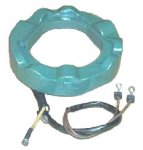
The stator is part number 581225, superseded up to 0763772 $403.30 as of July 2010. I have no idea what it sells for at the present time. You should be able to find a good used one at the various outboard repair shops, eBay, etc..... BUT you want the later model stator that is fully enclosed in Green epoxy, NOT another one that has all of the coils exposed.
 

balthasar

Cadet
Joined
Jun 1, 2010
Messages
16
Re: 1974 Johnson 85 Melted Charge Coils

$400 ouch! i guess i should replace the rectifier too while i'm at it. Also, some of the coil and yoke assemblies are cracked... should i replace these too? The wiring on the engine looks like a saltwater nightmare!
 

Joe Reeves

Supreme Mariner
Joined
Feb 24, 2002
Messages
13,262
Re: 1974 Johnson 85 Melted Charge Coils

I've seen many coils that are cracked but still in perfect working order. On a dark night, pull the leads off of the spark plugs, then have someone crank the engine over while you observe the coil areas. If you see any sparking around them, best to replace.... but if no sparking, coat them with liquid neopreme and don't be concerned.

The main concern about coils that appear to be fine is continuity. A break within the coil wiring results in inner sparking which leads to other problems.

(Magneto Capacitance Discharge Coils - Continuity Test))
(J. Reeves)

Check the continuity of the ignition coils. Remove the primary orange wire from whatever it's connected to. It may be connected to a powerpack screw type terminal, a rubber plug connector, or it may simply plug onto a small boss terminal of the coil itself.

Connect the black lead of a ohm meter to the spark plug boot terminal, then with the red ohm meter lead, touch the ground of the coil or the powerhead itself if the coil is still installed.

Then touch (still with the red lead) the orange wire if it's attached to the coil, or if it's not attached, touch the primary stud of the coil. You should get a reading on both touches (contacts). If not, check the spring terminal inside the rubber boots of the spark plug wire. Poor or no continuity of a coil is one reason for s/plug fouling.
 

balthasar

Cadet
Joined
Jun 1, 2010
Messages
16
Re: 1974 Johnson 85 Melted Charge Coils

does anyone have any experience with www.outboardignition.com?

http://www.outboardignition.com/jandesearch.asp?cat=itemname&cval=4&hval=30&val=8


they have a stator for $236

however, their info says:

Several tests have been conducted which show that there is excessive heat generated in the stator circuitry. This heat can be damaging if it not controlled. By removing the nylon (black epoxy) overcoat from the stator frame and coils, the heat can dissipate away from the stator windings. Also, the charge coils on some stators have been positioned differently in order to protect the sensitive capacitor charge coils which can be heat affected. All this means longer life and dependability, not to mention a generous 2 year warranty.

which leads me to think that maybe their stators don't have the green epoxy on it that protects the charge coils....

what do you guys think? Their parts are manufactured by CDI Electronics
 

Joe Reeves

Supreme Mariner
Joined
Feb 24, 2002
Messages
13,262
Re: 1974 Johnson 85 Melted Charge Coils

You mention: "which leads me to think that maybe their stators don't have the green epoxy on it that protects the charge coils."

Yes, that's what it sounds like to me also. If it's not a completely sealed unit, avoid it.
 

balthasar

Cadet
Joined
Jun 1, 2010
Messages
16
Re: 1974 Johnson 85 Melted Charge Coils

Joe, i have discovered that the part number for this model (1974 85ESL 74) is actually 0581046, and is a 6 amp, and does not appear to have any supersecession number (at least when it is added to my cart on shop.evinrude.com).

Please also comment on this thread: http://forums.iboats.com/showthread.php?t=470374
 

Joe Reeves

Supreme Mariner
Joined
Feb 24, 2002
Messages
13,262
Re: 1974 Johnson 85 Melted Charge Coils

0581046 supersedes up to 581225, which as of 2010 supersedes up to 0763772 .

Be sure to get the completely sealed epoxy unit, similar to the three cylinder stator I picture here.
 

Attachments

  • 581235_STATOR.JPG
    581235_STATOR.JPG
    11.8 KB · Views: 0

McGR

Senior Chief Petty Officer
Joined
Jun 19, 2004
Messages
667
Re: 1974 Johnson 85 Melted Charge Coils

Regarding the ignition coils... On the type of coil on your motor, as Joe mentioned, visible cracks don't necessarily mean the coils are defective (as it usually did on earlier OMC coils). Most of the visible area of the coils on your motor are basically plastic potting cases. The actual encapsulating/insulating compound (the stuff that matters) is within these potting cases. Cracks on these cases are generally of little consequence. Though, as Joe mentioned a coating with an insulating compound is a good idea. When I brought a 85hp back from the dead several years back, I did almost exactly as Joe described the only difference being that I coated the cracked cases in an electrical grade epoxy compound rather than liquid neoprene. I ran the motor for about 6 years after coating the coils without any ignition problems whatsoever.
 

balthasar

Cadet
Joined
Jun 1, 2010
Messages
16
Re: 1974 Johnson 85 Melted Charge Coils

Here's some pics of the damage. Does this look like the original stator? Notice the exposed wire on the rectifier:


333ihcy.jpg


sypeef.jpg


se7llz.jpg


xfyftd.jpg


Does the timer base look good?


2v1kkt2.jpg


124g4rs.jpg
 

Joe Reeves

Supreme Mariner
Joined
Feb 24, 2002
Messages
13,262
Re: 1974 Johnson 85 Melted Charge Coils

Yes, that's either the original stator or a stator replacement of original design..... the design you do not want to install again. Be sure to clean away that goop from the timer base. You want that timer base to move very freely... no binding.
 

balthasar

Cadet
Joined
Jun 1, 2010
Messages
16
Re: 1974 Johnson 85 Melted Charge Coils

ok, so the OEM parts finally came in. The new stator was exposed, with a light clear coat of epoxy on it. I replaced the rectifier and the stator, but still am not getting any spark on any cylinders. What do i try next?
 

Joe Reeves

Supreme Mariner
Joined
Feb 24, 2002
Messages
13,262
Re: 1974 Johnson 85 Melted Charge Coils

The stator was exposed.... such as your original stator?

Spark test..... Remove all spark plugs so that you obtain the highest cranking rpm available. The engine must crank over at least 300 rpm in order for the stator to energize the powerpack. The spark should jump a 7/16" gap on all cylinders. Have the key in the ON position when testing for spark.

If no spark, unplug the RED connector at the engine, then retest for spark. If you now have spark, the usual problem is a shorted ignition switch, in which case, replace the switch.

If still no spark, the usual cause is a failed powerpack.
 

balthasar

Cadet
Joined
Jun 1, 2010
Messages
16
Re: 1974 Johnson 85 Melted Charge Coils

Joe, The stator looked identical to the ones that CDI manufactures, which makes me think that CDI is supplying OEM Johnson stators now. There was very little epoxy on there. My old stator was covered in the green epoxy, however the coils were not. The new stator had very little epoxy, and some of the copper coils were not covered at all. The fabric around the charge coils had a very thin coat of clear epoxy on it.

The new stator had 2 yellow wires coming out of it, and there was no way to tell which went where.

A question about the procedure you have listed above:

If i disconnect the RED connector at the engine, wont that disable the key and i wont be able to turn over the engine?


Also, i checked the power pack as follows:

I connected the battery and turned the key to the ON position

I disconnected the brown and brown/yellow wires from the power pack (stator wires), and checked the Ohms. I then reconnected them to the power pack, and switched my voltmeter to ACV, and tested the brown and brown/yellow, and there was no reading. I then cranked the engine and got a reading of 70 AC volts. This makes me think that the powerpack is bad. I will do your process as well. I already eliminated the kill switch, i know that is not the problem.
 

Joe Reeves

Supreme Mariner
Joined
Feb 24, 2002
Messages
13,262
Re: 1974 Johnson 85 Melted Charge Coils

With the RED plug disconnected, crank the engine by using a small jumper "from" the positive battery cable terminal at the starter solenoid "to" the small 3/8" nut terminal of the solenoid that engages the solenoid (not the 3/8" ground nut terminal).

Where did you purchase that stator from?
 

balthasar

Cadet
Joined
Jun 1, 2010
Messages
16
Re: 1974 Johnson 85 Melted Charge Coils

Joe, the stator was purchased from boats.net The part number was 0763772

The stator is identical to the picture on the CDI website. Some copper wires seemed to be completely exposed, others had a light coat of clear epoxy on them. The charge coils seemed to be not coated in anything at all. The part was on backorder for about 3 days, and then shipped. The new stator had 2 yellow wires. so there was no way of figuring out which wire went where. That was confusing (still is). The old stators wires were so faded, they both looked brown.


When jumping, do i need to have the key in the ON position?
 
Top