






1973 14' floor restoration

johnbuczek51

Seaman Apprentice
Joined
May 27, 2012
Messages
34
I had this over at Starcraft but noticed I probably should have posted it here instead. If I'm wrong I apologize.

Been reading the restores for months now and find a lot of good info, however, some confusing info also.

Let's start with "floatation" the foam, insulation what ever. I've seen articles where some used spray foam, some using what appears to be 1/2" blue soft foam others swear by a pink foam. Some of the applications do not appear to have enough "whatever" to keep a boat afloat.

We removed from our (Grandson and I) boat a white solid approximately 3" thick chunks that were so water logged that they added maybe another 300lbs to the boat. This material could not possibly help in floatation in my opinion.

Second....wood for the deck...some say plywood others talk of another wood AND thickness from 1/8" to 3/4" all of which are painted with...paint, epoxy or some other type of application (fiberglass). From our boat we removed 1/8" plain plywood with no paint covered by an indoor-outdoor carpet. It was not rotted but it was soft and bounced when we walked on it.

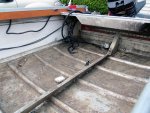
SO... the big question. Is there a standard by which you guys go by or is it a matter of what you honestly believe to be right because I'm about to embark on a new venture..............see pictures

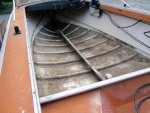
Resto 1 052813.jpgResto 6 052813.jpgResto 5 052813.jpg
 

johnbuczek51

Seaman Apprentice
Joined
May 27, 2012
Messages
34
Re: 1973 14' floor restoration

So I got a couple of replies, one I assumed was meant in humour "the foam is to keep it from going to the bottom, so it can be recovered, it wont keep it "afloat" though. even if just the tip of the bow is at the surface to be hooked to a towline".

So I did some research which still left me up in the air:

From the AeroMarine Products

AeroMarine Polyurethane Pour Foam
for Insulation and Flotation

"Boat Foam"
"Closed Cell Foam"
U.S. Coast Guard Approvable Liquid Foam

Q. Is this flotation foam compatible with styrofoam?

A. Yes. It will not "eat" or dissolve styrofoam. If you have a large cavity to fill, you can put some chunks of styrofoam in the cavity to save foam.

Q. How do I know how much foam I need to float my boat?

A. Get your calculator ready, you will need it. A cubic foot of polyurethane will float about 60 pounds of "dead weight". The wood parts of your boat will probably float, so you don't need flotation foam to offset that weight. The fiberglass parts of your boat will barely sink, so you really don't need much foam to offset the fiberglass- maybe one cubic foot of foam per two hundred pounds (or more) of fiberglass hull. The metal parts of your boat are what you really need to account for. A small (4-6hp) outboard may weigh 45-55 pounds. A 50hp outboard will weigh about 200 pounds.

So a 16 foot fiberglass skiff with a 50 horse outboard will need about six cubic feet of urethane foam to keep it afloat. A 12 foot plastic kayak will only need one cubic foot. A 30 foot fiberglass sailing sloop with a diesel engine and lead keel would need about 150 cubic feet of foam. Actually, very few 30 foot keelboats have positive foam flotation, but it's not out of the question- especially when you consider all of the air pockets that would exist, as well as all of the wood interior components that provide some positive flotation.

Q. Do I need to paint or fiberglass over the floatation foam?

A. You probably should. Polyurethane will absorb a small amount of water, because some of the the cells are open (95%+ are closed, though). Painting or glassing will seal the foam and prevent any water absorption. However, it really shouldn't be necessary unless the foam is constantly immersed in water, such as in a boat with bilges that are always wet. The foam is not UV resistant, so it must be painted if exposed to sunlight.

Q. Is the polyurethane foam resistant to fuel, oil, and solvents?

A. Mostly yes. It is resistant to splashes of gasoline and diesel fuel, although it will absorb a small amount because no pourable foam can be guaranteed to be 100% closed cell. A strong solvent such as acetone or toluene would eventually break the foam down, but it would take a long time.
 

jigngrub

Fleet Admiral
Joined
Mar 19, 2011
Messages
8,155
Re: 1973 14' floor restoration

The manufacturing standard for the majority of boats of today and yesterday is 1/2" plywood decking supported by 2 part expanding urethane floatation foam. It's what we see the most of on this forum when someone takes a boat apart. This is true for both fiberglass and aluminum boats.

If you don't plan to support your decking with expanding foam or add additional framing I suggest 3/4" decking.

The pink and blue rigid sheet foam are both the same, extruded polystyrene... it doesn't matter about the thickness, it's all the same.

Sealing your decking with epoxy resin, exterior grade spar urethane, spar varnish, or paint will extend the life of it. Out of the 4 choices epoxy resin is the strongest and longest lasting.
 

johnbuczek51

Seaman Apprentice
Joined
May 27, 2012
Messages
34
Re: 1973 14' floor restoration

So? I said to myself, who would know better about floatation

http://www. uscgboating.org/regulations/boatbuilder_s_handbook/flotation_part1_e.aspx

Flotation - Basic Flotation - FEDERAL LAW

Sect. 183.105 - Quantity of flotation required

(a) Each boat must have enough flotation to keep any portion of the boat above the surface of the water when the boat has been submerged in calm, fresh water for at least 18 hours and loaded with:

(1) A weight that, when submerged, equals two-fifteenths of the persons capacity marked on the boat;
(2) A weight that, when submerged, equals 25 percent of the dead weight; and
(3) A weight in pounds that, when submerged, equals 62.4 times the volume in cubic feet of the two largest air chambers, if air chambers are used for flotation.
(b) For the purpose of this section, "dead weight" means the maximum weight capacity marked on the boat minus the persons capacity marked on the boat.

The Coast Guard has been given authority to randomly check boats for compliance with the flotation requirements. When this check is conducted, simulated outboard engine weights are used rather than an actual outboard engine. The weight used during this check is obtained from the outboard engine weight table included in Subpart H (Flotation) of the CFR (see Table 4). Due to changing technology, outboard engines heavier than those listed in Table 4 are available. This is particularly true in the case of 4 stroke engines. The reader is encouraged to refer to ABYC Standard S-30, Outboard Engines and Related Equipment Weights, for the latest outboard engine weight table.

Distribute this material symmetrically within 36 inches (30 inches for boats of less than 15 feet in length) of the outside of the transom top at the motor-mounting area or around the propulsion system if engines are not stern mounted.
In small boats, sometimes it is difficult to pack the flotation material in the compartments prescribed here. Use the space on the deck aft, but stay within the 36-inch area (30 for boats under 15 ft.).

Assume an outboard engine-powered runabout with the following specifications:
Length Overall 18?- 6"
Beam 7?- 3"
Propulsion 140 HP Outboard engine
Engine weight 457 lb. (including controls and battery)
Fuel Portable fuel tank
Maximum weight capacity 1,400 lb.
Maximum persons capacity 1,100 lb. or 8 persons
Dry Hull weight 800 lb. (fiberglass 650 lb. + plywood 150 lb.)
Dry deck weight 300 lb. (fiberglass 245 lb. + plywood 55 lb.)
Deck hardware 228 lb. (Mostly aluminum)
Hull hardware 110 lb. (Aluminum 80 lb. + stainless steel 30 lb.)
Total weight 1,895 lb.

From the Applicability section, we determine that this boat must comply with the Level Flotation requirements. It is an outboard powered, more than 2 HP, mono-hull boat under 20 feet in length, and the requirements include a Level Flotation system and some tests to determine its compliance.

GUESS WHAT I'm not an engineer and all I wanted was an idea....................so maybe "coolbri70" is right "the foam is to keep it from going to the bottom, so it can be recovered, it wont keep it "afloat" though. even if just the tip of the bow is at the surface to be hooked to a towline"

I've spent 50hr+ on this and still do not know..........shoulda bought wood... I know wood.

Small-Motor-Boats.jpg
 

johnbuczek51

Seaman Apprentice
Joined
May 27, 2012
Messages
34
Re: 1973 14' floor restoration

WOW.... I was still posting and you gave me an answer and I really appreciate it.

I had planned on 1/2" but will use 3/4', I will coat with something but not epoxy and I will use the "pink and blue rigid sheet foam are both the same, extruded polystyrene... it doesn't matter about the thickness, it's all the same".

I do have a question. No matter the thickness, are you saying it has the same float capability? 1/4" vs 1/2" (using 2 layers)
 

jigngrub

Fleet Admiral
Joined
Mar 19, 2011
Messages
8,155
Re: 1973 14' floor restoration

I do have a question. No matter the thickness, are you saying it has the same float capability? 1/4" vs 1/2" (using 2 layers)

No, 1/4" will only float half as much as 1/2" per 4'x8' sheet. It doesn't matter what thickness you use, you just have to use more sheets of the thinner material.

The floatation value of foam is measured in number of pounds of weight floated by a cubic foot of foam... which is about 60 lbs. per cubic foot of foam... so if your boat weighs 600 lbs. you'll need 10 cubic feet of foam to keep it afloat.
You have to use a lot of foam if you want your boat to float when it fills with water, You'll need to pack your below deck bilge full.

This video is a good example of how well foam can float a boat if you use enough of it:
Lund Boat Floatation Video - YouTube

This picture shows what happens when you use just barely enough foam to float your boat:


Which boat would you rather be in?


Not using enough foam in your boat is like not having any foam, it will sink.


If you plan on using the sheet foam, buy the thickest sheets you can find. I'll be cheaper per cubic foot and less cutting and work to install. Here's a guide you can use to help you figure out how many sheets you'll need and how much weight a sheet will float:

1 sheet 2" thick x4'x8'= 5.31 cubic feet of foam and will float 319 lbs.

1 sheet 1" thick x4'x8'= 2.56 cubic feet of foam and will float 154 lbs.

1 sheet 1/2" thick x4'x8'= 1.28 cubic feet of foam and will float 77 lbs.


When in doubt about how much foam to use, use too much (you can't, but try). Put it everywhere you can think of, pack it in your boat.


If you would like to discuss the advantages of expanding urethane foam over the sheet foam I'd be happy to explain them to you.
 

johnbuczek51

Seaman Apprentice
Joined
May 27, 2012
Messages
34
Re: 1973 14' floor restoration

No, 1/4" will only float half as much as 1/2" per 4'x8' sheet. It doesn't matter what thickness you use, you just have to use more sheets of the thinner material.

The floatation value of foam is measured in number of pounds of weight floated by a cubic foot of foam... which is about 60 lbs. per cubic foot of foam... so if your boat weighs 600 lbs. you'll need 10 cubic feet of foam to keep it afloat.
You have to use a lot of foam if you want your boat to float when it fills with water, You'll need to pack your below deck bilge full.

This video is a good example of how well foam can float a boat if you use enough of it:
Lund Boat Floatation Video - YouTube

This picture shows what happens when you use just barely enough foam to float your boat:


Which boat would you rather be in?


Not using enough foam in your boat is like not having any foam, it will sink.


If you plan on using the sheet foam, buy the thickest sheets you can find. I'll be cheaper per cubic foot and less cutting and work to install. Here's a guide you can use to help you figure out how many sheets you'll need and how much weight a sheet will float:

1 sheet 2" thick x4'x8'= 5.31 cubic feet of foam and will float 319 lbs.

1 sheet 1" thick x4'x8'= 2.56 cubic feet of foam and will float 154 lbs.

1 sheet 1/2" thick x4'x8'= 1.28 cubic feet of foam and will float 77 lbs.


When in doubt about how much foam to use, use too much (you can't, but try). Put it everywhere you can think of, pack it in your boat.


If you would like to discuss the advantages of expanding urethane foam over the sheet foam I'd be happy to explain them to you.

Thanks for the explanation and thanks for the offer to explain expanding foam but I will be using sheet. Now where does one get 2" sheet stock?

OBTW. Popcorn foam, does it work?
 

jigngrub

Fleet Admiral
Joined
Mar 19, 2011
Messages
8,155
Re: 1973 14' floor restoration

Thanks for the explanation and thanks for the offer to explain expanding foam but I will be using sheet. Now where does one get 2" sheet stock?

OBTW. Popcorn foam, does it work?

You can get the 2" thick at Home Depot, if they don't have it in stock they'll order it and have it in a couple of days.

Don't waste your time with popcorn/peanut foam.
 

jbcurt00

Moderator
Staff member
Joined
Oct 25, 2011
Messages
25,289
Re: 1973 14' floor restoration

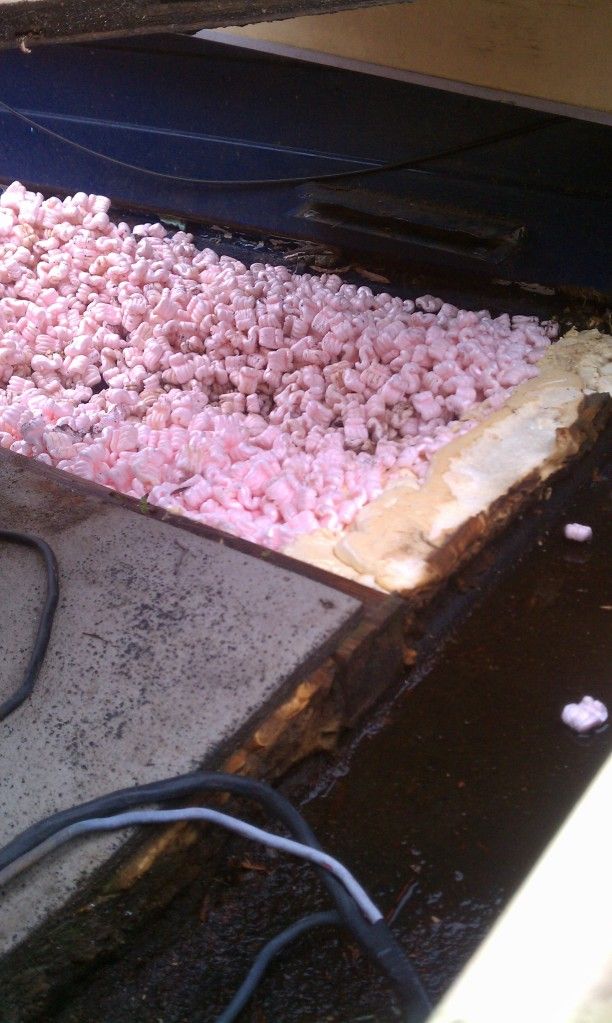
Don't waste your time with popcorn/peanut foam.

Makes for less then satisfactory results:
IMAG0459.jpg
:puke:
 

johnbuczek51

Seaman Apprentice
Joined
May 27, 2012
Messages
34
Re: 1973 14' floor restoration

You can get the 2" thick at Home Depot, if they don't have it in stock they'll order it and have it in a couple of days.

Don't waste your time with popcorn/peanut foam.


Thanks once again for the advice....sheet stock it is.....................john
 

Gbakman53

Cadet
Joined
Jun 30, 2022
Messages
12
Re: 1973 14' floor restoration


Thanks once again for the advice....sheet stock it is.....................john
I have been rehabbing a 1979 StarCraft Marine Fishmaster 160 for a few years but cancer and heart stents side lined me for a good while. It’s my first boat and I am 72 years young! I purchased the boat and it had been gutted and primer painted. So I am going at it again and I totally forgot about floatation requirements. So I panicked because I was in the final steps, wiring hookups and other stuff like that. When I came across an article about floatation! So I started looking at the requirements for my boat and I realized that I would have to disassemble some of my work to add floatation. At first, I thought I would have to meet current requirements. But after consulting with other people, my boat only has to meet the requirements at least at the level that was required in 1979. That requirement was 12 or 13 cf of 2 lbs closed cell foam. Today’s requirements are 28 or 30 cf of 2 lbs closed cell foam. I have NO IDEA how they could expect my 16’ boat to hold 28 or even 30 cf. Because just getting to the old requirement of 12 or 13 will be very difficult. I don’t have bench seats or storage space. But the Good News is, my boat is grandfathered to the old requirements, which I believe with some good plans, I can get it to the 13 cf requirement or more.
Here’s my plan -I am using HD purchased XPS 2” 4x8 sheets of foam board. I will install a single, 2” x 6” x 96” closed cell sheetfoam under the gunnel wall from top down then install a second piece which is 2” x 16” x 96”. This is done on both sides of the boat. So that provides 4224 cu inches or 2.44 cu feet each side. Then install in the bow nose 6” x 40” x 16” that narrows down to 36”, about 5040 cu inches or 2.92 cu feet. In the transom area, where I have 3 fuel tanks, 25 gallon capacity. I built 3 metal boxes and sealed them with marine grade caulk on all seams. The they are 12” x12” x 16” or 2304 cu inches or 1.3333 cu feet. Which will provide floatation for about 80 lbs of weight, since you get 60 lbs of floatation per each 1 cu ft of floatation material. I have 2 of these boxes, 160 lbs of floatation. The weight at the transom from the motor and fuel is 450 lbs. I have also added a third box, 4“ x 8“ x 36” or 1152 cu inches or 0.6667 cu feet so with these 3 boxes I have about 200 lbs of floatation. That’s still short of what I need to support the weight in my transom area. I have added some additional floatation to the gunnel walls in the same area, both sides are covered with the same amount of material, 4” x 16” x 36” or 1536 cu inches or 0.8889 cf so with both sides providing 1.778 cf. So as you can see, finding space for floatation is very difficult. I will have to remove the floor and flooring cover to access the area where I can get more space. I believe that I can get just over 8 cu feet of floatation in the floor area. I have been able to get almost 21 cu feet which I feel comfortable with. At 20.904 cf, that provides 1254.24 lbs of weight displacement. I estimate that my boat, with current build out, motor, fishing equipment and passengers (4), estimated weight is 1700 lbs. I believe that since I will always have everyone on my boat wearing a life jacket and I don’t plan to fish in the open ocean, my boat with the floatation I have installed, even though it is not at the Current USCG requirement, it does have sufficient floatation to prevent it from sinking and it will provide enough floatation that all passengers will have enough floatation to be able to survive a swamping or capsize vessel. If you read the USCG rules and regulations concerning floatation, they are wanting your boat to have enough floatation that in the event of a disaster and your boat is capsized or swamped, it will not Sink! So I was able to get my boat to a very good position with the floatation. Sorry for the lengthy post but if this post will assist someone else and it provides information to guide them to make their boat safe, then every word is worth the time and effort to help, because it may save a life and that in itself is worth everything!
Thanks once again for the advice....sheet stock it is.....................john
 
Top