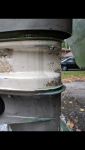
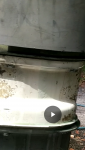
1958 four fifty leaking gas like crazy

CaptainObvious

Recruit
Thread starter
Joined
Jul 22, 2018
Messages
5
I recently bought a vintage 1958 Evinrude four fifty and have everything fixed (I think) except while it's running it leaks the gas/oil mixture down the drive shaft badly. The motor sounds beautiful while running but gas is pouring out. Thought it may be a hole in the fuel pump diaphragm so I replaced that but it made no difference. The carburetor float needle works (I think) after bench testing it....the fuel richness needs to be adjusted for sure but I can't imagine that much unburned fuel getting past the carburetor and the engine still running. Running out of ideas. Any advice appreciated. Can't see any visible fuel leak until you go down to the top of the mid unit....
 
Last edited:

Chinewalker

Fleet Admiral
Joined
Aug 19, 2001
Messages
8,902
Those motors did pass a whole lot of unburned fuel through them. It goes right out the exhaust, so if you don't have the gasket between the upper gear case and the exhaust housing, it'll weep out there. That said, you may be able to adjust the rich/lean a bit to mitigate it somewhat.
 

CaptainObvious

Recruit
Thread starter
Joined
Jul 22, 2018
Messages
5
I saw this as a possibility when reading other posts here but it just seems like so much gas to be leaking that it would get me a ticket or something if I took it out to the river. I'll try to dial in the fuel richness settings and see if it helps. There is a low and a high richness setting and I've only touched one of them. Thanks for your comment!
 

F_R

Honorary Supreme Mariner
Joined
Jul 7, 2006
Messages
28,226
I think they made a change on the '59 models to hide that drainage better. It's still there but not as obvious. Going by memory, not infallible. They did make some changes to the '58 carburetors also. They were famous gas guzzlers.
 

Joe Reeves

Supreme Mariner
Joined
Feb 24, 2002
Messages
13,262
(Carburetor Adjustments - Older V/4 Downdraft Carb)
(J. Reeves)

NOTE: The early model downdraft carburetors incorporated "Adjustable High Speed Jets". The later model downdraft carburetors used "Fixed High Speed Jets". The high speed jets would be located in back of the two bottom drain screws. Follow the below instructions accordingly.

NOTE: If you do not have adjustable high speed jets, ignore those paragraphs pertaining to same...... BUT do make sure that you manually inspect and clean the two brass fixed high speed jets which would be located in back of the two 7/16" slotted hex head bolts in the bottom front portion of the float chamber.

Lift the center High Speed Control lever and turn it so that the point faces forward, resting on the high ridge. This will disengage the lever control gear from the individual high speed jets (slots). Have the slow speed needle valve knobs installed upside down so that they can be turned without encountering any obstruction.

Gently seat each of the High Speed needle valves, then back each one out one (1) turn. Gently seat each of the Slow Speed needle valves, then back each one out one and one half (1-1/2) turns. NOTE... have the jam nut on the s/speed needles snug so that vibration won't have any effect on them, but loose enough so that you can turn them without a great amount of effort.

(High Speed)
With a reliable person at the wheel, and one kneeling in front of the engine, start the engine (yes, it will run lousy with the above initial needle valve settings), put it into forward gear, and apply full throttle. Start with the High Speed adjustment on the left using a screwdriver that properly fits the slot.

(High Speed Adjustments)
At full throttle, with the proper size screwdriver, slowly start turning one of the H/S needles in segments of 1/8 turn, waiting momentarily for the engine to respond, then repeat turning. You will reach a point where the engine will start to die out. At that point, back that needle valve out approximately 1/4 turn. Now, go to the other High Speed needle valve and repeat that procedure. At some point in that 1/4 turn out, you will find the smoothest high speed setting (you can now lower the throttle rpm). That will have both high speed needle valves set correctly, and at that point you can lift that center lever adjustment of that high ridge, keeping it lifted until the point is facing the engine, then lower it into its proper position. (When you turn that lever now, you're adjusting both High Speed needle valves at the same time.)

(Slow Speed Adjustments)
Now, lowering the rpms of course, take the engine out of gear and set the throttle just to where the engine will stay running. Again, in segments of 1/8 turn, slowly start turning in one of the slow speed needle valves, waiting a few seconds between each turning for the engine to respond. As you turn the s/speed needles in, the rpms will increase..... and as it does, lower the rpms to where the engine will just stay running (otherwise the rpms will climb quite high). You will reach a point whereas the engine will either start to die out or it will spit back (sounds like a mild backfire). At that point, back the needle valve out 1/4 turn. Repeat the process with the remaining slow speed needle. Again, at some point in that 1/4 turn out, you will find the smoothest setting. When finished, tighten the jam nut somewhat, then remove and reinstall the s/speed knobs correctly (right side up).

********************
 

CaptainObvious

Recruit
Thread starter
Joined
Jul 22, 2018
Messages
5
Does the picture I posted with this thread look like an acceptable flow of unburned gas/oil?
 

Attachments

  • photo296619.png
    photo296619.png
    1.5 MB · Views: 0

Chris1956

Honorary Supreme Mariner
Joined
Mar 25, 2004
Messages
29,328
The '58 Fat Fiftys had a hose from the base of the intake manifold to the exhaust passage. Look in the lower cowling pan for it. If you disconnect it and the flow stops, you got it.

Unfortunately the motor is designed to dump any fuel that collects on the intake manifold, overboard. I made a fuel return to capture it.
 

F_R

Honorary Supreme Mariner
Joined
Jul 7, 2006
Messages
28,226
The '58 Fat Fiftys had a hose from the base of the intake manifold to the exhaust passage. Look in the lower cowling pan for it. If you disconnect it and the flow stops, you got it.

Unfortunately the motor is designed to dump any fuel that collects on the intake manifold, overboard. I made a fuel return to capture it.

I'm not so sure ALL the '58s had that hose. Maybe none of them (?). It is not shown on the '58 parts book. For sure, it is on the '59's.
 

Chris1956

Honorary Supreme Mariner
Joined
Mar 25, 2004
Messages
29,328
Well, I had the drain hose on my '58 Johnny. I am pretty sure it was a '58

It ran from the reed valve at the base of the intake manifold, about 1/4 the way around the midsection on the starboard side of the motor. It was a 1/4" or 3/8" hose. That motor dumped up to 1/3 of it's fuel overboard, and used fresh fuel/air mixture from the crankcase to push the liquid fuel into the exhaust passage. A double whammy.....
 

CaptainObvious

Recruit
Thread starter
Joined
Jul 22, 2018
Messages
5
well, we replaced the gasket and also verified it's not coming past the fuel pump diaphragm. It's coming out below the rubber bumper but outside the exhaust housing. I get that they dump a lot of fuel but it should be coming out the exhaust, not outside the exhaust housing. Something else must be wrong. Any ideas? https://youtu.be/e4tH5tit6do
 

Attachments

  • photo297214.png
    photo297214.png
    1.1 MB · Views: 2

Chris1956

Honorary Supreme Mariner
Joined
Mar 25, 2004
Messages
29,328
Sounds like it is running on 2 cylinders.

Anyway, wherever water exits the motor, dumped fuel can exit. Not sure why water drips over exhaust housing extension, but fuel can go with it.
 
Top