Why does my sonar look like this?

Elkins45

Petty Officer 2nd Class
Thread starter
Joined
Dec 9, 2010
Messages
134
I recently installed a new sonar on my boat and I'm getting a 'grainy' image when running on plane. My guess is that the transducer is a little too low in the water and is causing cavitation and/or air bubbles. Or is it too high? The transducer is significantly larger than my old unit so I couldn't just reuse the mounting holes.
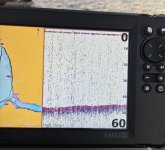
sonar - 1.jpeg
 

eggs712

Chief Petty Officer
Joined
May 8, 2012
Messages
442
That's normal interference from running. You can adjust 'gain' to minimize clutter like that; the tradeoff would be a little less sensitivity for smaller objects like scattered bait fish.
 

rolmops

Vice Admiral
Joined
Feb 24, 2002
Messages
5,752
Having a clean picture from a transducer when running on plane speed is very hard , mostly because at that speed there is simply to much info fed into the sonar
Make sure that the sonar is on autmatic or if manual adjusted for your speed.
 

Mc Tool

Commander
Joined
Aug 7, 2024
Messages
2,099
Yep , thats not to bad for speed , wee bit messy . Transducer is best placed on the starboard side of the prop if it rotates normally and the further away the better . Fiddling with the heigh or even the angle of the transducer can help and make sure its not behind something that creates turbulence like a strake or change of hull profile . You could adjust sensitivity as others have said but personally Id trade a bit of clutter at speed for better performance whilst at slower speeds looking for fish or structure . Pretty much the only thing Im interested in at speed is the depth and maybe what the bottom actually is ...sand gravel or rocks .
 

airshot

Admiral
Joined
Jul 22, 2008
Messages
6,770
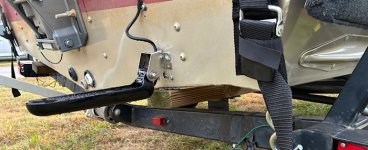
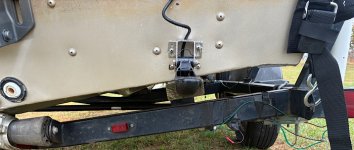
What kind of boat hull and a couple pics of how the transducer is mounted.
It may very well take some adjusting to get a better picture on your screen. Depth and angle of the transducer can make a big difference as well as adjusting the gain and sensitivity settings. It can take awhile to get the best setup and adjustment. With today's boats running at higher speeds than they did years back, high speeds can be well over 40-45 mph where 30-35 was normal years ago. This high speed can cause interference on the transducer from air bubbles passing over the surface.
 

Elkins45

Petty Officer 2nd Class
Thread starter
Joined
Dec 9, 2010
Messages
134
What kind of boat hull and a couple pics of how the transducer is mounted.
It may very well take some adjusting to get a better picture on your screen. Depth and angle of the transducer can make a big difference as well as adjusting the gain and sensitivity settings. It can take awhile to get the best setup and adjustment. With today's boats running at higher speeds than they did years back, high speeds can be well over 40-45 mph where 30-35 was normal years ago. This high speed can cause interference on the transducer from air bubbles passing over the surface.
It’s a 17 foot V hull aluminum G3. This boat tops out at 30 mph.

IMG_5077.jpeg

IMG_5078.jpeg

Looking at these photos (especially the one from directly behind) I think it needs to be raised a bit.
 

Mc Tool

Commander
Joined
Aug 7, 2024
Messages
2,099
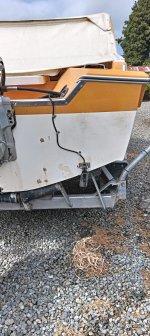
That transducer looks a hellava lot like my Lowrance triple shot transducer and I think it needs to be lifted up until the bottom of the transducer is just below level with the bottom of the boat . Apart from that it looks pretty good to me . Lowrance refers to these transducers as a "skimmer " and thats what I had in mind when I mounted it .
IMG20261103113739.jpgIMG20261103113759.jpg
please excuse spider webs
 
Top