

J115PLSOR cylinder bank temp difference

Harkonnen

Petty Officer 2nd Class
Joined
Mar 29, 2022
Messages
105
Ran into an interesting case, 2005 J115PLSOR, 60 degree V-4 2-stroke looper, aftermarket cylinder head gauge showing temps separately for port and starboard.

At WOT, port bank runs about 30F cooler (120 vs. 150F). Has anyone seen this?

What I know so far:
1. Probably real - heat cam confirms, gauge calibrates correctly.
2. Probably not one cylinder dead - starts and fires with any three cylinders disconnected, heat cam shows uniformly cooler head.
3. Probably not ignition - new coils and powerpack: replaced as a result of an earlier incident, spark looks good.
4. Probably not thermostats - swapped between banks, same picture.
5. Power loss - maybe. Fails to get to full RPM, but that may be an unresolved trim issue.

Less than 10 hours after break-in on a new powerhead, compression good across the board, carbs redone at that time, new Boyesen reeds.

Another observation: if I throttle up to 2000 rpm and just let it sit there, both banks warm up to 140F, and then port temperature drops.

What am I missing here, and do I panic yet?

Thanks!
 

dingbat

Supreme Mariner
Joined
Nov 20, 2001
Messages
17,199
Unlike a pressurized automotive cooling systems which share a common heat sink/source, the temps on open loop cooling system are not homogeneous.

The intake side of the loop is always going to be cooler than the exhaust. The colder the intake the higher the temp differential between intake and exhaust
 

Harkonnen

Petty Officer 2nd Class
Joined
Mar 29, 2022
Messages
105
The colder the intake the higher the temp differential between intake and exhaust
Except is is not coolant, and it is not intake/exhaust. It is port cylinder head vs starboard cylinder head, temperature of actual metal.
 

Harkonnen

Petty Officer 2nd Class
Joined
Mar 29, 2022
Messages
105
Read the manual finally ("if all else fails..."). Thermostats open at 143F+/-, idle head temp is 143F+/-, WOT 160F max. Thermostat bypass valves open around 1800 rpm.

What bothers me is that port temperature drops just as thermostats are supposed to open, except that it should not matter, because at 2000 rpm flow should be controlled by thermostat bypass. And there is no corresponding drop on starboard side.

There must be a piece I'm missing here.
 

Harkonnen

Petty Officer 2nd Class
Joined
Mar 29, 2022
Messages
105
Replace springs on bypass valves ??
I like the idea, but I suspect it may not be that simple.

The springs are fairly new - they came with the replacement powerhead - and even with the thermostats removed entirely, the port bank still runs cooler. That makes me think less about the control side and more about a downstream restriction on the starboard side causing flow to favor the port bank.

The reason I am leaning that way is this: if I feed water through the flush port and let it flow through the block, the amount of water reaching both thermostat openings appears roughly equal. However, if there is a restriction downstream of the starboard head, I would expect greater water retention on that side, which in turn would divert more flow through the port side and make it run cooler.

Interestingly, the starboard side of the midsection also appears warmer, although I cannot tell whether that is simply hotter exhaust or evidence of reduced water flow.

Is there an easy way to measure cooling water pressure without investing in expensive tools (or mechanics)? That is, before I pull SB head and start poking around with a wire.
 

Harkonnen

Petty Officer 2nd Class
Joined
Mar 29, 2022
Messages
105
So I rigged up a crude gauge. Pressure at the test outlets, on a hose, thermostats out, engine off, is 0.1 PSI port, 0.08 sb. Not quite what I expected, but roughly consistent with a blockage between thermostat and test outlet on sb (warmer) side. Off with its head!
 

Harkonnen

Petty Officer 2nd Class
Joined
Mar 29, 2022
Messages
105
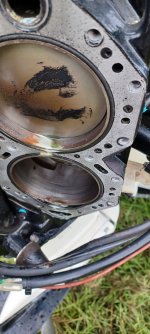
I don't like this picture one bit. Warm SB bank. Rebuilt powerhead, seriously?
 

Attachments

  • 20260620_174036.jpg
    20260620_174036.jpg
    848.3 KB · Views: 14

Chris1956

Supreme Mariner
Joined
Mar 25, 2004
Messages
28,874
I have a '98 60* 150HPV6 Johnny. Although I have never measured the water pressure at the thermostats, the block water pressure is 35PSI at cruise. Water pressure is measured at one of the plugs on the port cylinder head.

The thermostat springs are pretty strong and hold the thermostats in the cylinder heads, thus building that high pressure. If you have the plugs on the heads, it would be simple to test pressure on both banks, with the 'stats installed. That may give a hint.

Not sure if it helps
 

Harkonnen

Petty Officer 2nd Class
Joined
Mar 29, 2022
Messages
105
I have a '98 60* 150HPV6 Johnny. Although I have never measured the water pressure at the thermostats, the block water pressure is 35PSI at cruise.
It's free-flowing downstream of thermostats; did not expect more than a psi anyway. I hoped to catch an obstruction that way. Found another issue, which seems to explain this problem (and a couple of others, maybe). We'll see once spares are in.
 

Chris1956

Supreme Mariner
Joined
Mar 25, 2004
Messages
28,874
In your picture, the oring looks stretched and there is no silicone around the water ports. Did you clean the remnants of it? Are the Orings correct for the engine?
 

Harkonnen

Petty Officer 2nd Class
Joined
Mar 29, 2022
Messages
105
In your picture, the oring looks stretched and there is no silicone around the water ports. Did you clean the remnants of it? Are the Orings correct for the engine?
Silicone was mostly stuck to the heads. O-rings - no idea, but since the rebuilders put silicone where manual tells them not to - I wouldn't be surprised. I'll have to see what happens with new O-rings, thermostat seal, and thermostats/springs.

I am more concerned about mayo in the cylinder, and looks like a bit of corrosion, too.
 

Chris1956

Supreme Mariner
Joined
Mar 25, 2004
Messages
28,874
Compression leaking to the water jacket will cause overheat. You might check the head for warpage as well.
 

Chris1956

Supreme Mariner
Joined
Mar 25, 2004
Messages
28,874
The service manual for my motor says grease on the orings, silicone around the water ports, when installing the cylinder head.
 

Harkonnen

Petty Officer 2nd Class
Joined
Mar 29, 2022
Messages
105
The service manual for my motor says grease on the orings, silicone around the water ports, when installing the cylinder head.
Yep. That's the part they apparently never read.

Never replaced thermostat seals, it looks like, either.
 

Harkonnen

Petty Officer 2nd Class
Joined
Mar 29, 2022
Messages
105
Send it back.-----If water got on any bearings it will soon come to a " dynamic halt "
Too late for a warranty claim, but I do not think bearings are involved.

If it fails, it fails. I am repowering... and re-hulling if that happens.
 

Harkonnen

Petty Officer 2nd Class
Joined
Mar 29, 2022
Messages
105
Post-mortem (sort of) of the incident

The replacement powerhead was purchased in August 2023 from a certain marine supplier in Colorado (which shall remain unnamed for now, although I hope they recognize themselves and do the right thing). The remanufacturing - using the term rather broadly - was apparently performed by a third-party shop in Alabama, if I remember correctly.

I didn't get around to installing it until 2024, so there went the warranty. In hindsight, I am not even sure these issues could have been discovered without tearing the engine down.

From day one, compression was only borderline acceptable at about 90 psi across all four cylinders. That should have raised a red flag. Ironically, the original powerhead I sent back as a core had essentially the same compression, but none of the issues described below. To add insult to injury, my core charge was never refunded, and I never received an explanation for the denial.

Break-in consisted of about 10 hours on double oil, rpm regime per the service manual. The engine ran... acceptably, but there were signs:

  1. Excessive smoke, even for a two-stroke.
  2. Cold starts routinely required several crank attempts.
  3. After sitting for an hour following a run (especially after extended idle), the engine would drop a rather impressive water/oil loogie from the exhaust.

After the break-in period, I began running the engine under loads approaching normal. Additional symptoms (described above) appeared, eventually leading to a teardown. What I found was disappointing, to put it mildly.

  1. I have no idea whether the combustion chamber O-rings were replaced, but someone had applied silicone sealant to them. My suspicion is that they were reused.
  2. The thermostat seals clearly were not replaced. The amount of scale buildup is not consistent with an engine having fewer than 20 hours of operation. Here again, silicone sealant appears to have been used as a substitute.
  3. The thermostats themselves appear used rather than recently replaced.
  4. The cylinders show no obvious evidence of a fresh hone. There are traces of what appear to be original honing marks, but the overall glazing and wear pattern look much more consistent with a several-hundred-hour engine than with a freshly rebuilt one.
  5. Both cylinder heads showed evidence of water intrusion, including water/oil emulsion in the combustion chambers, consistent with leaking head seals.
  6. At this point, I am almost afraid to find out what the crankcase looks like.

Based on what I found, my impression is that this powerhead received little more than cosmetic attention rather than a comprehensive rebuild. I obviously cannot say exactly what work was - or was not - performed internally, but what I observed does not match my expectations of a professionally remanufactured powerhead.

The good news is that replacing the thermostat seals, combustion chamber O-rings, thermostats, and properly resealing the water passages appears to have resolved most of the issues. Both banks now warm up consistently, smoke has dropped to believable two-stroke levels, cold starts have improved dramatically, and so far there have been no more oil/water loogies.

I'll post photos next. If there is no follow-up after that, it probably means the engine survived the water test.
 
Top