My first boat... a 1972 100hp money pit.

Brookinsusmc

Recruit
Thread starter
Joined
Jul 29, 2017
Messages
5
Until recently I didnt know a whole lot about outboards. But ive have been doing nothing but studying and reading on this motor so here it goes.

Its a 88 cajun bass boat with a 72 100hp johnson on it. Paid 1k for boat motor and trailer so i thought i got a fair deal. That is until i learned more about it. Three different mechanics have told me that they won't even touch it because it has electric shift so I'd suppose the resale value on the outboard is nil. The ignitions been converted to the CDI pulse pack with the magnetic pickup and stator / distributor cap. The pulse pack is bad and from what I've researched is normal and 400 bucks a pop it's not a pretty sight.

So my question is can anyone tell me more about the MSD ignition conversion? I have tried and tried to find pictures of it but the photos are all blocked for some reason. I'm an calibration technician by trade and grew up working on my own cars so between the two I know what I'm doing what I don't know is how this setup looks like when it's hooked up. If there is already an open topic on this I apologize but all of the topics I found were very old. Also I'd like to get more information about this electric shift and why it is so hated among boat mechanics and dealerships. To my knowledge there is nothing wrong with the electric shift, of course I won't find out until I get it in the water. So far this boat has cost me about 400 over what I paid originally and is adding up faster than I'd like any input or suggestions would be greatly appreciated I will leave my email at the bottom if anyone has pictures they can send of this MSD ignition swap that is what I'm most curious about in particular.
Brookinsusmc7@gmail.com

Side note I'm writing this on talk to text while traveling that's why there are so many grammatical errors not that it's important.
 
Last edited:

just_james

Seaman
Joined
Nov 9, 2016
Messages
57
As they SAY BOAT= Break out another thousand. If I was you, I'd look to find another motor for it.
 

Brookinsusmc

Recruit
Thread starter
Joined
Jul 29, 2017
Messages
5
Oh No Doubt and my personal favorite,boat:" a hole in the water made out of wood and which a man pours money"

I also forgot to mention in my first post that I have a 76 85 horsepower Johnson motor that I bought for a hundred bucks for parts but the powerhead is good on it and all of the ignition parts seem okay does anyone know if they could be swapped out?
Edit*
Midsection and lower unit are damaged in the parts motor. But for the most part they appear to be the same exact bolt pattern.
 

F_R

Honorary Supreme Mariner
Joined
Jul 7, 2006
Messages
28,226
That is not electric shift, it hydro-electric shift. There is nothing wrong with the system, the problem is neglect. The oil in the lower unit serves as hydraulic fluid which actually does the shifting. As such, it is extremely important that it be the correct oil, and uncontaminated. Proper maintenance will take care of that (change the durn oil like you are supposed to. The second problem is the motor is 42 years old and the wiring is probably in poor condition. You will have to deal with that, it is.

People won't work on them because they don't know how, don't have the tools, or just don't want to. Really, I would say they are afraid of running up a $900 bill only to have the customer say h---- no, you can keep it.
 

Faztbullet

Supreme Mariner
Joined
Mar 2, 2008
Messages
15,938
I would say they are afraid of running up a $900 bill only to have the customer say h---- no, you can keep it.

That's exactly why no one will work on it...when stuff like this comes to me I ask customer upfront for $500 deposit.
 

Brookinsusmc

Recruit
Thread starter
Joined
Jul 29, 2017
Messages
5
That is not electric shift, it hydro-electric shift. There is nothing wrong with the system, the problem is neglect. The oil in the lower unit serves as hydraulic fluid which actually does the shifting. As such, it is extremely important that it be the correct oil, and uncontaminated. Proper maintenance will take care of that (change the durn oil like you are supposed to. The second problem is the motor is 42 years old and the wiring is probably in poor condition. You will have to deal with that, it is.

People won't work on them because they don't know how, don't have the tools, or just don't want to. Really, I would say they are afraid of running up a $900 bill only to have the customer say h---- no, you can keep it.


well here's hoping the shift system is in working order. If it is ill take very good care of it. For now, it doesn't matter because I'm still not getting any spark from to the coil. After checking all the wiring and other components I found what I believe is my problem.
According to the tech at CDI the pulse pack should output 120V or more. less than 120V = no spark. Mine was putting out 72V, I'm Referring of course to DVA voltage. I measured it using a Fluke 289 that I calibrated in our lab at work so i know its accurate. So its either 3-400 for another CDI pulse pack. or change the ignition over to an MSD or similar line of ignition box. Unless there is something else I could do to it? thoughts, suggestions?
 

racerone

Honorary Supreme Mariner
Joined
Dec 28, 2013
Messages
40,028
Test the shift system.----Take sparkplugs out.-----Put 1-5/16" socket on the flywheel nut.---Turn key to on , lever in nuetral.---Turn flyweel using say a speeder handle.---A good unit will go to nuetral after about 1 turn of the flywheel.----Pull lever to reverse.-A good unit will shift to reverse after about 2 turns of the flywheel.
 

jimmbo

Supreme Mariner
Joined
May 24, 2004
Messages
14,699
I think the Hydro-electric shift was fantastic. Very quick shifts, which resulted in a very long life for the gears and clutch dog. Defaulted to forward, so if something went wrong, it would get you home, unless it lost the oil. I think it was discontinued as the engine could be rope started in gear without the key and remained in gear.
 
Last edited:

F_R

Honorary Supreme Mariner
Joined
Jul 7, 2006
Messages
28,226
I think the Hydro-electric shift was fantastic. Very quick shifts, which resulted in a very long life for the gears and clutch dog. Defaulted to forward, so if something went wrong, it would get you home, unless it lost the oil. I think it was discontinued as the engine could be rope started in gear without the key and remained in gear.


I've never heard that theory. But I have heard the theory that it was because it can be started (electrically) with a non-working shift which would be defaulted to forward.
Personally, I've never seen a worn-out clutch dog in a Hydro-Electric. Certainly cannot say that about manual shift.
 

F_R

Honorary Supreme Mariner
Joined
Jul 7, 2006
Messages
28,226
Come to think of it, I owned a '72-100hp back in the day. I bought it brand new, in the box, It was light years better than the older V4-75hp that I replaced it with. For one thing, it used a lot less gas, even though it had a lot more horses. Never gave me one minute's trouble.
 

jimmbo

Supreme Mariner
Joined
May 24, 2004
Messages
14,699
I think the Hydro-electric shift was fantastic. Very quick shifts, which resulted in a very long life for the gears and clutch dog. Defaulted to forward, so if something went wrong, it would get you home, unless it lost the oil. I think it was discontinued as the engine could be rope started in gear without the key and remained in gear.

I've never heard that theory. But I have heard the theory that it was because it can be started (electrically) with a non-working shift which would be defaulted to forward.
Personally, I've never seen a worn-out clutch dog in a Hydro-Electric. Certainly cannot say that about manual shift.


In the 70s, one of the neighbours at the lake had a Hydro-electric shift 85hp Johnson. During the week when the dad was back at work, his kid and a bunch of us would use the boat to waterski, but because the dad had taken the key with him, figuring the boat was secure, we would remove the cowl and with no key in the ignition, rope start the engine. It ran in forward with no neutral or reverse. to shut it off we just choked it manually. On the weekends the key was there and the engine worked normally.
 
Last edited:

jimmbo

Supreme Mariner
Joined
May 24, 2004
Messages
14,699
Come to think of it, I owned a '72-100hp back in the day. I bought it brand new, in the box, It was light years better than the older V4-75hp that I replaced it with. For one thing, it used a lot less gas, even though it had a lot more horses. Never gave me one minute's trouble.

That was a hopped up 85 hp, same 92.6 displacement. Sharp looking trim on the side of the cowl too
I think a 140 would have burned less gas than the 89.5 cu in 75hp. Those 1969 - 1972 V4s were great engines
 
Last edited:

Faztbullet

Supreme Mariner
Joined
Mar 2, 2008
Messages
15,938
Pretty sure you need the DVA adapter to get a true reading no matter the meter...only 1 brand has a built in DVA and its a analog.
 

Brookinsusmc

Recruit
Thread starter
Joined
Jul 29, 2017
Messages
5
Pretty sure you need the DVA adapter to get a true reading no matter the meter...only 1 brand has a built in DVA and its a analog.

No, DVA voltage is just Peak AC voltage. I have a $3000 fluke 289 (courtesy of my employer) that can read it. you cant read DVA with your typical meter from lowes however.

Even if it was wrong still, I've tested all this so far:
Sensor pickup- 5 ohms
stator output leads- 1 ohm
stator plug wires to stator windings- 500ohms each
purple wire- 11.8V while starting
black and white wires to sensor pickup 1.6v
coil pack primary and secondary- within specs (i cant remember the exact reading.)
red wire to rectifier from solenoid- 11.8v hot

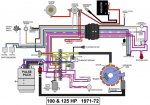
everything is wired exactly as it should be according to this diagram.
 

Attachments

  • wiring diagram2.jpg
    wiring diagram2.jpg
    69.2 KB · Views: 0

Brookinsusmc

Recruit
Thread starter
Joined
Jul 29, 2017
Messages
5
Also just wanted to backup my claim about DVA voltage. This is from the CDI electronics troubleshooting guide on DVA voltage explained.

"DVA stands for Direct Voltage Adapter, which is used to measure peak AC voltage. This type of measurement of AC voltage takes the absolute peak or highest value of the fluctuating AC voltage signal. Peak readings will be substantially higher than standard or RMS AC values and are typically used when testing marine CD (capacitor discharge) ignition systems due to their high variance in frequency as RPM increases and decreases. An example would be that the typical RMS AC reading of a wall outlet in North America is 120V. However, a DVA measurement of this same AC voltage would reveal that the peak of the AC sine wave is typically between 160-170V. Some meters are capable of reading DVA or peak voltage pulses. Many ignition system components produce short AC voltage pulses. A peak-reading analog meter or DVA adapter plugged into a digital meter captures and holds the peak value of an AC sine wave long enough for the human eye to see it displayed on the meter. A conventional meter is incapable of accurately measuring these short-duration voltage pulses. A peak-reading voltmeter has special circuits that allow the meter to capture the maximum voltage produced during these short duration pulses and display the voltage as DVA or peak voltage. Failure to measure DVA can cause good ignition components to be incorrectly diagnosed as faulty"
 
Top