20hp Johnson won't stay running

jruempel

Cadet
Thread starter
Joined
Jul 15, 2015
Messages
10
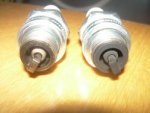
I recently bought a 20hp Johnson and when I can get it to run, it idles very fast and the choke plate "bounces" with great speed(opens and closes). It helps to keep it running if I hold the plate with my finger to limit the "bouncing". I came across a thread on here where "racerone" was talking about reed valve problems. He said to remove top plug and see if motor will start and keep running and then to put that one back in and remove the bottom plug and see if it will start and run. I removed the top plug and it would not start. I put that one back in and removed the bottom plug and it started immediately and stayed running. To be sure I did not have a bad plug, I put the bottom plug(the one that would NOT run) in the top cylinder and tried to start it. It did not run. So I figured I had a bad plug. I went and picked up two new plugs, gapped them and installed them. I started the motor and right away I could tell it didn't fix my problem. I tried to adjust the idle speed knob on the front of the motor to no avail. It had absolutely no effect on idle. After about 20 seconds of run time, I killed it and pulled the plugs. Below is a picture of the plugs.

racerone, if you see this would you mind telling me what to do next in determining a reed valve problem.

Left one is the top cylinder plug and the right one is the bottom cylinder plug.
DSCN4352.JPG

After pulling the plugs, I called it a night.

Are these plugs and what I have observed symptoms of a reed valve problem? Or something else?

Thanks in advance,
Jeff
 

tomhath

Master Chief Petty Officer
Joined
Dec 5, 2007
Messages
814
Sounds to me that you have no either no spark or no compression on the bottom cylinder. They will start and run fine on just one, but obviously won't have much power. Check compression first, if that's good fix the ignition. Don't worry about the reed valves until you're sure you're sure it's running on both cylinders.
 

jruempel

Cadet
Thread starter
Joined
Jul 15, 2015
Messages
10
Both cylinders had compression of about 125-130. I will do what I did above with the new plugs to make sure I have decent spark. Thank you for the advice.

Jeff
 

bonz_d

Vice Admiral
Joined
Apr 22, 2008
Messages
5,276
Also check the linkage and spring for the choke. It should not bounce.
 

jruempel

Cadet
Thread starter
Joined
Jul 15, 2015
Messages
10
Sounds to me that you have no either no spark or no compression on the bottom cylinder. They will start and run fine on just one, but obviously won't have much power. Check compression first, if that's good fix the ignition. Don't worry about the reed valves until you're sure you're sure it's running on both cylinders.

I have spark on both cylinders and the compression is about 125-130. I have the carb yanked and I am rebuilding it. So far I have not seen any clogged orifices, there is a little corrosion. After I get it back together, I will see where I stand. The only reason I am even considering a problem with the reed valves is because I believe there is air blowing back through the carb and that is what is causing the choke plate to "bounce". When I tried to hold it still with my finger, it was pretty difficult.

Jeff
 

Sirrobin53

Petty Officer 2nd Class
Joined
Mar 13, 2012
Messages
189
Are the reeds are common to both cylinders?
 
Last edited:

racerone

Honorary Supreme Mariner
Joined
Dec 28, 2013
Messages
40,028
Sorry , but reed valves are NOT common to both cylinders.----Each crankcase has its own set of reeds !!!!--And the crankcases are sealed / seperated from each other.
 

racerone

Honorary Supreme Mariner
Joined
Dec 28, 2013
Messages
40,028
Do a proper spark test.---------The ignition system was engineered to be able to produce up to 28000 volts.------So does spark jump a gap of 1/4" or more, yes or no ?
 

jruempel

Cadet
Thread starter
Joined
Jul 15, 2015
Messages
10
Do a proper spark test.---------The ignition system was engineered to be able to produce up to 28000 volts.------So does spark jump a gap of 1/4" or more, yes or no ?

I will check the spark jump tomorrow morning.

Again thanks to all that have chimed in, I appreciate it.

Jeff
 

jruempel

Cadet
Thread starter
Joined
Jul 15, 2015
Messages
10
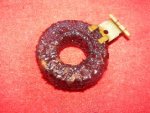
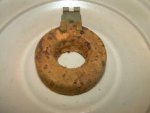
BTW, were the original floats in 1967 on these motors made from cork? If so, were they coated with something so they would last sitting in fuel? I took this float out thinking it was made of plastic and soaked it in carb cleaner overnight. Below are pics when I pulled it out of the cleaner and then after removing the material that was all over it. I'm afraid I f'ed up.

DSCN4377.JPG


DSCN4379.JPG

Thanks again,

Jeff
 

dshanks

Cadet
Joined
Jul 11, 2015
Messages
12
The float on my 1954 looked like that when I opened the bowl. I bought an OEM carb kit that included a new float made of some synthetic material. I think you can buy the float separately too.

Alternately, you could dry the original float and coat it with something that modern fuel won't eat. Model airplane dope is said to work well. Superglue too.
 
Last edited:

jruempel

Cadet
Thread starter
Joined
Jul 15, 2015
Messages
10
I noticed when I was taking the carb apart that it was really clean and a piece was missing...the seal between the two halves of the carb(nozzle gasket). Anyway, I have the carb assembled and ready to bolt on. I hope I finally get some GOOD luck. Will post if this fixes it or not.

Jeff
 

Sirrobin53

Petty Officer 2nd Class
Joined
Mar 13, 2012
Messages
189
I noticed when I was taking the carb apart that it was really clean and a piece was missing...the seal between the two halves of the carb(nozzle gasket). Anyway, I have the carb assembled and ready to bolt on. I hope I finally get some GOOD luck. Will post if this fixes it or not.

Jeff
Important gasket. You may have found the problem.:eagerness:
 
Top