


Possible to cause damage when checking voltage from PowerPack, Stator, etc?

son_of_squinch

Recruit
Joined
Sep 13, 2018
Messages
3
Howdy all.

This thing's gonna be the death of me...

Quick facts:
-- Motor: 1974 Evinrude Sizzler 50442M 50 HP, 2 cylinder two stroke.
-- New: stator, timing sensor, rectifier, coils, plugs, and power pack
-- Engine cranks but won't start
-- Intermittent exhaust backfire while cranking

Before I take voltage readings from the power pack and elsewhere, is there anything I should "not" check or any precautions I should take? I'm looking for someone to say "never check the such and such while cranking" or something like that. I just don't want to damage the new components and cause myself more grief!


Thanks!
Paul
 

F_R

Supreme Mariner
Joined
Jul 7, 2006
Messages
28,226
Backfiring out exhaust may be due to firing out of time. That might be due to wires mixed up at powerpack. Or sheared flywheel key. Did you torque the nut to 100-105 ft/lbs?

Do you have a DVA meter for those readings you are planning? Regular multi-meter readings are mostly meaningless.

NEVER connect a voltage to the black/yellow kill wire. That might be done carelessly or by a defective ignition switch or leaky wires insulation.
 

racerone

Supreme Mariner
Joined
Dec 28, 2013
Messages
39,199
Replacing all those parts is an expensive way to fix a motor !!----Maybe the issue is a bad starter not turning it fast enuff.
 

son_of_squinch

Recruit
Joined
Sep 13, 2018
Messages
3
F_R,

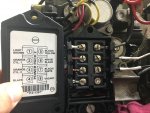
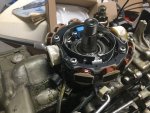
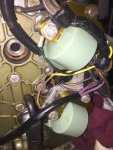
I've checked and double-checked the wiring at the power pack. I've attached a few images showing power pack wiring labels and current wiring. Flywheel key is good and nut is torqued. When I pull the top (#1) cylinder plug and check the piston position, it aligns with the TDC mark on the flywheel at the top of the stroke.

Multimeter is a low range Tacklife DM07 from Amazon (https://tinyurl.com/ybn4q3qe) with an add-on Electronic Specialties 640 Dva Adapter, also from Amazon (https://tinyurl.com/y9olzuu7). That's another story because the outboard voltage readings don't "hold" on the multimeter screen like they should. I'm using the DC setting and this does work on a wall socket in the kitchen. This is the first time I've ever used the DVA adapter though, so could be operator error after all.

The multimeter has been more accurate than my old Craftsman, but if anyone knows of a great meter in the $50-$100 range I'd grab it to ensure I'm giving accurate readings. But, for now, I'm just watching the output to see what the max is while cranking with a remote unit. Not ideal, but my wife bailed on being my cranking assistant after the backfiring started.

Great tip on the kill wire! Basically, I've got enough knowledge to be dangerous. I just worry that while I'm testing, I'll do something stupid and burn out one of the brand new parts by touching X lead to Y terminal.
 

Attachments

  • IMG_4209.jpeg
    IMG_4209.jpeg
    1.5 MB · Views: 2
  • IMG_4206.jpeg
    IMG_4206.jpeg
    1 MB · Views: 2
  • IMG_4207.jpeg
    IMG_4207.jpeg
    1.3 MB · Views: 2
  • IMG_4208.jpeg
    IMG_4208.jpeg
    1.6 MB · Views: 2

F_R

Supreme Mariner
Joined
Jul 7, 2006
Messages
28,226
Assuming you have orange #1 and 2 correct, your hookup looks good. I suppose you have checked for spark? Should jump a 7/16" open air gap.

Other than that, I don't know what to say. Except in direct reply to the question, the black/yellow caution. There is a CDI website detailing the tests.
 

son_of_squinch

Recruit
Joined
Sep 13, 2018
Messages
3
racerone,

Tell me about it! I'm hoping it's not a case of good money after bad. I don't want to jinx things, but I'm honestly wondering what else there is that could need replacing in the ignition system. I've been buying all brand new parts, for what it's worth.

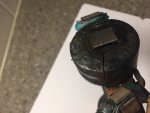
I should mention that the motor was running very well just two months ago. I had only replaced the coil packs at that point because one of them was cracked and I wasn't getting spark. After replacing both coil packs, it cranked and ran very well for about three outings. Then, after sitting at the storage lot for a month, I was getting no spark at either cylinder. I took it to a local repair shop and they were hesitant to work on a motor so old, but they did some quick troubleshooting and guessed the stator might be the culprit. There's a picture of the old stator attached showing a big crack in the charge coil, so that seemed like a good next move. I replaced the stator and rectifier together and still no spark. I replaced the timing sensor, and that's when the backfiring started. The motor hasn't backfired in the two years I've owned it before that.
In desperation, I just last week replaced the power pack because I still wasn't getting a reading from the cylinder #1 power pack terminal. The stator lead was also providing about 50 volts while connected to the power pack terminal, but about 260 volts while disconnected.

Probably a silly question -- if I'm not getting spark at either cylinder, can I use the timing light to check the cranking RPMs?

Thanks!
 

F_R

Supreme Mariner
Joined
Jul 7, 2006
Messages
28,226
Not a silly question, but I imagine you already know the timing light needs a spark to trigger it.
 

Joe Reeves

Supreme Mariner
Joined
Feb 24, 2002
Messages
13,262
Backfire... That is... actually a shotgun blast like firing out the exhaust! This is what "backfire" means. Are you meaning anything different than this?

Actual backfiring is caused by: Sheared flywheel key, wires crossed from timer base to powerpack, wires crossed from powerpack to coils, coil HT leads fed to wrong cylinder.

Spark test is to be done with "all" spark plugs removed in order to obtain highest cracking rpm. Cranking speed needs to be at least 300 rpm. A slow cranking engine will have no ignition/spark.

Disconnect black/yellow wire from the "M" terminal of the ignition switch. If you have spark with that wire disconnected but no spark with it connected... the ignition switch has an internal short, in which case, replace it.
 

F_R

Supreme Mariner
Joined
Jul 7, 2006
Messages
28,226
Backfiring in the exhaust can also be caused by TOO MUCH fuel. It can have too much to run (too rich), and it goes out into the exhaust housing where a stray spark comes along and ignites it, and Bang!!!!!

EDIT: Same thing can happen with normal amount of fuel and continued cranking with no spark. Exhaust fills up with fuel and it happens to fire one time and bang!
 

Rogue14

Cadet
Joined
Sep 9, 2018
Messages
25
There’s only a couple things it could really be seeing as you’ve replaced everything else..

1: Flywheel itself, the magnets might be no good for either the trigger/timing base or for the stator charge coil.

2: Fuses? Have you checked for any fuses that may be blown.

3: Corroded or bad connections in any of the wiring or plugs.

4: Have you removed the black/yellow wire yet at the power pack? Could be dodgy safety lanyard or something of the like.

5: Is the battery in good condition?
 
Top