Johnson 35 Seahorse Kicking Out of Gear//Low RPMs

swier

Cadet
Joined
Feb 28, 2018
Messages
24
I have a Johnson 35 Seahorse which i believe to be a mid 70s or 80s model, and I am having several issues.

1) Motor will idle fine, but once put into forward, and given throttle, it starts kicking out of gear and will ultimately go back into Neutral, where i will have to cut it off due to the rpms being way too high

2) I don't have full power. When throttle is all the way down, it seems like i'm only getting about 2000rpms or so

3) The lower end unit is leaking fluid, and there is a hole that is open, where the fluid leaks out. It is not threaded, so i am wondering how the hole got there, and if it is supposed to be there.

I have been told i need to check the dog clutch, and make sure its not worn, but have yet to do so. It seems like the throttle mechanism inside the engine is hard to move, so i may need to lubricate it, but dont know how.

Anyone with experience in these issues or have any input?

All help is greatly appreciated!
 

racerone

Supreme Mariner
Joined
Dec 28, 2013
Messages
39,414
How long have you owned it ?----Some inspection on your part needs to be done.----Compression test and a spark test.----Sounds like it is running on one cylinder.----Pressure test lower unit.----Any sign of water in the lower unit ?
 

lindy46

Captain
Joined
Nov 27, 2008
Messages
3,886
A model number would help, so we know what motor we're dealing with.

1. Could be a bad clutch dog, could be a bad/improperly adjusted remote shift cable (assuming it's not a tiller motor). Disconnect shift cable and shift at the motor - see if it still kicks out of gear.

2. Most likely running on one cylinder - as racerone says, spark test.

3. Unthreaded hole is likely a drain hole in the leg to drain unburnt fuel/oil. Normal. I'd still check for water in the gearcase.

A stiff throttle could be a number of things, but lets work on one thing at a time.
 

Chinewalker

Fleet Admiral
Joined
Aug 19, 2001
Messages
8,902
If its running on one cylinder, which it sounds like it is, then that cylinder's fuel is going through unburned, adding to the sludge exiting the drain hole.
 

swier

Cadet
Joined
Feb 28, 2018
Messages
24
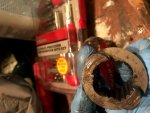
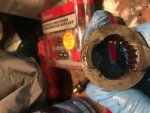
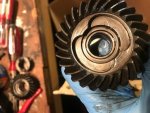
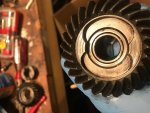
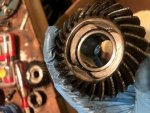
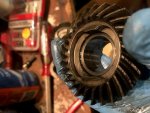
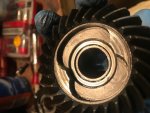
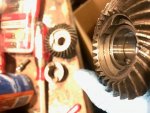
Guys, thank you all for the responses. After removing the bearing housing, and drive shaft, I determined that it is indeed the clutch dog. Not only is it worn, but the clutch teeth on both the forward and reverse gears are worn down. I believe this was all due to the shifting rod being the incorrect length. I am going to send the gears to my buddy who is a really good welder, so he can weld back the right angle, then grind it down to like new. Pics attached. Please let me know if you think it will be possible to re-weld these teeth.

My issue now is, how do I get the shifting rod to the right length? I also noticed that when removing the dog clutch off of the prop shaft, that it was really difficult to move. Is this how it is supposed to be? I figured it would be a part that easily slides back and forth on the prop shaft, in order to easily engage either the forward or reverse gear.

I would also like some insight on how to replace/re-do the shifting and throttle cables, as it is very hard to get the engine to shift and they are really sticky.

All info is greatly appreciated.
 

Attachments

  • gear 2.jpg
    gear 2.jpg
    66.9 KB · Views: 0
  • gear 1.jpg
    gear 1.jpg
    64.9 KB · Views: 0
  • gear 3.jpg
    gear 3.jpg
    86.2 KB · Views: 0
  • gear 4.jpg
    gear 4.jpg
    80.3 KB · Views: 0
  • gear 5.jpg
    gear 5.jpg
    88.4 KB · Views: 0
  • gear 6.jpg
    gear 6.jpg
    75.1 KB · Views: 0
  • gear 8.jpg
    gear 8.jpg
    74.5 KB · Views: 0
  • gear 7.jpg
    gear 7.jpg
    71.9 KB · Views: 0

Chinewalker

Fleet Admiral
Joined
Aug 19, 2001
Messages
8,902
Those actually don't look to bad. And unless your buddy can case harden the welds, they'll wear down in short order.

Yes, the clutch dog should slide easily. Check for burrs in your shaft splines.

Adjustment of the shift handle is usually done up top at the handle. No adjustment in the shaft or lower unit portions of the system.
 
Top