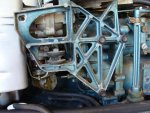
Re: Fuel/air lines diagram
A few pumps of the tank knob has fuel shooting out of one hose.... that hose obviously leads to the carburetor.
There is usually a small fitting on the from bottom portion of the powerhead that emits a shot of air every time the related piston goes into the power mode (down)... the other hose of the fuel tank leads to that connection.
There should be, on the side of the powerhead, in line with the crankshaft, a fitting at the bottom main bearing and one at the top main bearing... a small hose or metal line should connect these two fittings (lubrication route between the two main bearings).
There will be (usually) a hose between the powerhead and a vaccum switch.
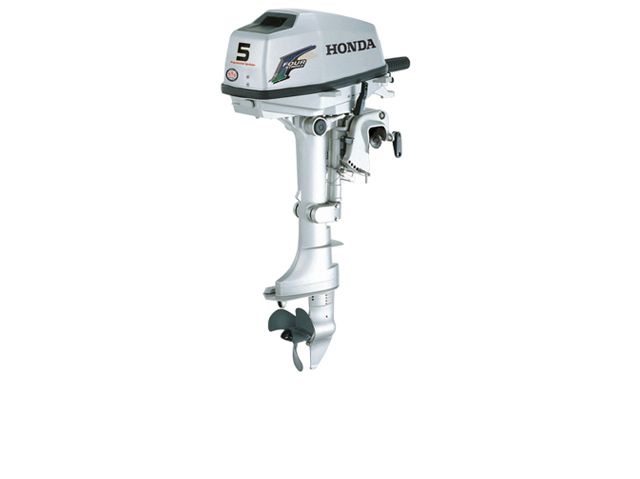
Pictures of that engine would be useful if the above isn't sufficent.
(Carburetor Adjustments - Two Adjustable N/Vs)
(J. Reeves)
Initial settings are: Bottom high speed = seat gently, then open 1 turn out. Top slow speed = seat gently, then open 1-1/2 turns.
Setting the high and low needle valves properly:
NOTE: For engines that DO NOT have a shift selection, obviously there is no NEUTRAL position. Simply lower the rpms to the lowest setting to obtain the low speed needle valve adjustment.
(High Speed) Start engine (it will run pretty rough), shift into forward gear, take up to full throttle. In segments of 1/8 turn, waiting for the engine to respond between turns, start turning in the bottom high speed needle valve. You'll reach a point whereas the engine will either start to die out or spit back (sounds like a mild backfire). At that point, back out the needle valve 1/4 turn. Within that 1/4 turn, you'll find the smoothest setting.
(Low Speed) Slow the engine down to where it just stays running. Shift into neutral. Again in segments of 1/8 turns, start to turn the top needle valve in. Wait a few seconds for the engine to respond. As you turn the valve in, the rpms will increase. Lower the rpms again to where the engine will just stay running. Eventually you'll hit the point where the engine wants to die out or it will spit back. Again, at that point, back out the valve 1/4 turn. Within that 1/4 turn, you'll find the smoothest slow speed setting.
When you have finished the above adjustments, you will have no reason to move them again unless the carburetor fouls/gums up from sitting, in which case you would be required to remove, clean, and rebuild the carburetor anyway.