





Formula for speed increase - hp to speed?

mickjetblue

Chief Petty Officer
Joined
Aug 23, 2007
Messages
509
I was wondering if anybody knows the formula, or a proximity estimate,
of how an increase in hp translates to an increase in speed.

For example, starting with a 10 hp motor on a typical boat, it would probably
push that boat at a maximum speed of 15mph.

If you change the motor to a 20hp, you are doubling the power.
It is not likely that the resulting speed increase would be 30mph, though.
It is more likely that the speed increase will yield about 20mph, and that
is only a speed increase of 1/3 from what we had before with the 10hp.

So, let's use the 20hp as a starting point, and we have 20mph with it.
If we increase the motor size to 40hp, what is going to be the resulting speed?
The new speed would definitely be much less than 40mph, which would be the
proportional increase to match the motor hp increase. Probably be around 26mph.

Ok, thinking ahead now, we have a 40hp, going about 26mph, and we put
on an 80hp motor. How much speed increase are we going to see?

My guess is that the more we increase the motor hp above the 10hp, the less
we will see in proportional speed increase.

There are some variables involved, like the type of boat and motor combo,
but I think I have gotten the idea across.

Anybody have a guess at this proportional mystery? One idea is as valid as another.
I don't think there is a
scientific answer...
 

jevery

Chief Petty Officer
Joined
Jun 16, 2006
Messages
538
Re: Formula for speed increase - hp to speed?

.
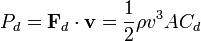
The power required to overcome the aerodynamic drag is given by:
1d6ff8f88450295e8a235a54d626ea78.png

Note that the power needed to push an object through a fluid increases as the cube of the velocity. A car cruising on a highway at 50 mph (80 km/h) may require only 10 horsepower (7.5 kW) to overcome air drag, but that same car at 100 mph (160 km/h) requires 80 hp (60 kW). With a doubling of speed the drag (force) quadruples per the formula. Exerting four times the force over a fixed distance produces four times as much work. At twice the speed the work (resulting in displacement over a fixed distance) is done twice as fast. Since power is the rate of doing work, four times the work done in half the time requires eight times the power.
It should be emphasized here that the drag equation is an approximation, and does not necessarily give a close approximation in every instance. Thus one should be careful when making assumptions using these equations.

http://en.wikipedia.org/wiki/Drag_(physics)​
 

JB

Honorary Moderator Emeritus
Joined
Mar 25, 2001
Messages
45,907
Re: Formula for speed increase - hp to speed?

A useful formula for estimating theoretical top speed for a planing hull is:

mph=[square root of (HP/weight)] X bottom factor.

The bottom factor is an estimate of water drag on plane, where a flat bottom is 250, a deep vee about 150 and other hulls somewhere between. My 17' Boston Whaler bottom factor calculated to 195.
 

Frank Acampora

Supreme Mariner
Joined
Jan 19, 2007
Messages
12,004
Re: Formula for speed increase - hp to speed?

Since at higher speeds we need to account for not only air drag but water drag against the hull, and since this drag is usually greater than the air drag, and since wetted area of the hull USUALLY decreases with increasing speed: Given the same hull and weight considerations, I like to guestimate that it is going to take at least 4 times the horsepower to double speed.

It would probably take a mathematician or really good computer guy to crunch actual numbers to insert into the formula and come up with a horsepower number---which would vary from hull to hull and water conditions. Smooth water and big waves take more horsepower, slight ripples get more air under the hull and take less.

So although the formula is sound, it is impractical for the average Joe to use because of the number of variables. Let's just say it takes a LOT of horsepower and a LOT of money to go fast--in anything.

I can empirically state that an increase from 90 to 125 horsepower on my 14 foot flat bottom yeilded only 5 MPH more --50 to 55. 35 % increase in HP yeilded 10 % increase in speed. ---About what I expected.
 

Benny1963

Lieutenant
Joined
Sep 17, 2006
Messages
1,476
Re: Formula for speed increase - hp to speed?

i went from 150 crossflow on mckee to 175 crossflow and saw no difference
it runs about 2 mph faster but without dnyo both motors tuneing could
have played a factor since right know im still trying to get setup right
 

mthieme

Captain
Joined
Oct 6, 2007
Messages
3,270
Re: Formula for speed increase - hp to speed?

Where does my prop slip and angle of attack come into those formulae?
Way too much math for me.:)
 

jevery

Chief Petty Officer
Joined
Jun 16, 2006
Messages
538
Re: Formula for speed increase - hp to speed?

.
1c4324ffa23e907e24a08ea376d7ed99.png
is the force of drag,

eee46d1e74736ad996b1bb9f715080e8.png
is the density of the fluid

0ae00583bb2847dd6af36d093568d7d4.png
is the speed of the object relative to the fluid,

61fabb89e875ffa3f2cfa254bd485dea.png
is the reference area,

312af36c09619fbcb81ee92ee134e2c1.png
is the drag coefficient (a dimensionless paramater, e.g. 0.25 to 0.45 for a car), and

6ab377c3a0c3a17e934aabe7d43c5832.png
is the unit vector indicating the direction of the velocity (the negative sign indicating the drag is opposite to that of velocity).

Just in case someone wants to plug some numbers in. Beyond my ability I?ll admit. It seems that calculating drag on a vehicle moving through a single medium such as an airplane or a submarine would be relatively simple as compared to a planing hull, (emphasis on relatively). A planing hull on the water surface is moving through two mediums simultaneously with, as mentioned, multiple variables that include a transition from a displacement state to a planing state. I suspect that transition between states of movement is why it would appear to require less than eight times the power to double speed under these circumstances. To make that transition requires a relatively large force, but to increase speed after the transition is made, (up to a point), requires proportionally less force. As Frank A observed, it would require a mathematician and computer support to actually use the formula in designing hulls, but I would guess that it?s utilized more than we know in the design of many things.
 

fdmsiv

Petty Officer 1st Class
Joined
Mar 2, 2008
Messages
283
Re: Formula for speed increase - hp to speed?

Simply, there is no single formula to get you an exact answer, but the process is scientific. The number of variables and unknowns are just too numerous to compute. Drag is just one component of the equation, even finding that is not very easy. To get an accurate number you would have to calculate the drag for each component of the hull.

A guy named Savitsky came up with a method to ballpark the powering requirements for planning hulls (I assume we are dealing with a planning hull form). Google savitsky method and take a look.

In general the manufactor/designer of the hull will have a power curve that plots the hull resistance as a function of the velocity. These are usually based on model test. Here is where it gets interesting. Planning hulls are more efficient than a displacement hull when they are on plane. Looking at the resistance curve, there is a hump in the 10~20 mph range. Post hump, less power require to move at higher speeds.

Lets take your example, 10 HP and you want to go to 20 HP and lets say the top of the hump is around 21HP at 15 mph. Here you would only see about an increase of 5 mph for 10HP increase. If you then moved up to a 25HP, you would be looking at speeds of 25 ish, an increase of 15 mph for 15 HP.

There is a point after the hump that the required amount of power grows exponentially for a small increase in speed. In this case you lets say you max out at 40mph with 40HP. You could strap 100HP to that hull, but you will maybe see 41mph.

Once you have the expected resistance you can go to a prop guru for the proper size prop. Selecting a prop is a little bit of crap shoot, but you can expect to lose about 10% or so of power in the transfer from the motor to the water.
 
Top