Re: bass tracker tx17 trim
This looks like the fuse back then was inline, course they didn't have the little plastic things we use today; most all fuses were inline.
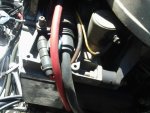
Just to the left of the red wire in pic #1 is a little barrel thing with a small red wire coming out this end. This is a fuse holder and is made water tight. So look at where it comes apart and grasping both ends work it loose. When you get ready to reinstall or install a new one, a little silicon spray on the rubber will help it go together.
What is the condition of the fuse?
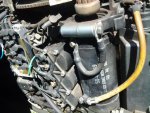
I don't see any trim relays here. A lower picture of the left side (fuse side) and a rear shot would help.
Or, a better question is where is your/where are your trim cylinders? If you have one on each side of the engine then the trim is an after market sort of thing and yes the control circuitry will be elsewhere in the boat. Been a real long time for me; I had an 85 hp back around then. It had the silver, blue, and red band that at the rear end just fell off, like Ranger boats logo does on the side of their boats.
Follow the hyd hoses from the trim cylinders. You are going to have some kind of manifold somewhere whereby one pistons hyd hoses plugs into one side and the others the other side. In/on that manifold will be the separate relays for up and down, a hyd. fluid reservoir a drive motor and some control wires.
Guessing here: The wiring to this unit will have 4 wires:
Large Black (10 awg maybe) for ground and goes to the batt neg term or back to the engine block which is ground for motor drive and ground for the primary circuits of the relays (the little blue and green wires need ground too to pass current through the relay and energize it hooking up the big, high current contacts and moving the cylinders.
Large Red (also 10 awg maybe) for power to drive the motor.
Possibly small blue (is blue in later model harnesses like mine) 16 awg for one direction and small
green 16 awg for the other.
I doubt your engine has a cowl mounted switch. The blue and green wires go back to your trim button, usually mounted on the control.
The trim button has an additional wire which is red (in later models) and is battery 12v from that fuse we finally found. When you select either direction, the 12v goes through the switch and through the blue or green wire to the trim relay controls where one or the other will energize. This will cause the motor to turn in the desired direction forcing hydraulic fluid out the pair of corresponding hoses for trim up. For trim down, the opposite occurs being activated by the other color control wire. The other pair of hoses to the cylinders are just return lines, or drive lines depending on which way you are going.
If the fuse is blown, and was just an accidental blowing then you problem is solved by merely replacing it with the same numbers stamped on the side of the cap. Numbers will be something like 3AG 20A and the good fuse will have an easily seen metal strip inside the glass going from one cap to the other. The blown fuse will look blown and the connecting wire would be vaporized.
The other marking on it may be 32v or higher which is the breaking voltage gap when it blows. For what you need that V number is not important. You only have a 12v circuit and any voltage rating these fuses carry will work.
Buy a pack of 5 fuses as you may need a spare and they come in 5 packs at auto parts stores.
If you replace the fuse and it immediately blows again then you have a problem somewhere. It may be a shorted red wire some where that it chafed and the metal was exposed to ground down wind of the fuse. It may be a switch shorted to ground internally or externally. Could be a shorted or malfunctioning trim relay, but probably not if you didn't touch the switch and the fuse blew.
This control circuit coming from that fuse only goes to the control coil windings of the relays through the trim switch to make the relays function and supply power to the motor. It has nothing to do with the actual operation of the motor. The big red wire and ground do that.
But you could have a relay that has failed and internally the coil windings are shorted to something else thus blowing the fuse.
Again, if you replace the fuse and it blows again, without your touching anything you have a problem with the red wiring to the switch, including the switch being defective; something is shorting to ground. In normal operation there is no ground associated with that red wire nor the blue or green wires so if you find one you have your smoking gun.
If you pass the initial test of fuse holds without you touching the switch then the problem is down circuit and could include a shorted blue/green wire to ground or a bad relay coil. Briefly push the switch in one direction and release. Check the fuse. If you have a short the fuse will be blown again. If not blown, reassemble fuse in holder and briefly put the switch in the other trim position. If it holds the blown fuse may be a fluke. Sometimes fuses separate due to old age or vibration. If you pass this bidirectional quick test then attempt to move your engine with your trim switch, probably up as I think you have it down now. What happens?
Work through this and any questions, ask. Hopefully you will stay with one source of info to keep from getting confused. If I am wrong and another person has the correct answer I will gladly recognize that for you.
Mark