60 Johnson RDS-22 40Hp Electrical Short

dcygan

Cadet
Joined
Sep 26, 2017
Messages
27
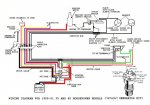
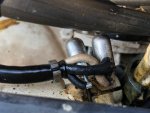
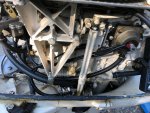
I just acquired a 1960 Johnson RDS-22 40Hp engine to replace a 1958 Johnson 35Hp Seahorse that has very low compression. To get to the point, I mounted the engine to the transom and attempted to start it. It has an electric start and so the engine was connected to the boat wiring harness. Upon trying to start the engine, the Mercury switches wiring stared smoking indicating a short. Here's where I am confused, at any point should the mercury switches cause a short resulting in overheated wires? It seems like both mercury switches are wired correctly and using an Ohm-meter, I found that the first switch opens when the throttle control is directly at the Start location or faster, whereas the mercury switch to the right doesn't create an open circuit until the throttle is opened to its fullest extent. I am stumped as to what I'm missing. Any help resolving this will be greatly appreciated.

 

Attachments

  • photo300163.jpg
    photo300163.jpg
    70.1 KB · Views: 4
  • photo300164.jpg
    photo300164.jpg
    524 KB · Views: 4
  • photo300165.jpg
    photo300165.jpg
    885.8 KB · Views: 4

RCO

Petty Officer 1st Class
Joined
Jun 15, 2016
Messages
350
Does the starter turn the engine over?
 

dcygan

Cadet
Joined
Sep 26, 2017
Messages
27
Is it possible that if the throttle lever is not fully at the start position that the mercury switches ground the line causing the short? This seems like the only possible reason for this, but yet it doesn't make sense that the manufacturer would allow a short to occur in any range of the throttle lever.
 

F_R

Supreme Mariner
Joined
Jul 7, 2006
Messages
28,226
If I were a gambling man, I would bet you have installed a car (Ford) solenoid on it. Car solenoids look identical but are different inside than an OMC solenoid, and will destroy the safety switch.

Heck, I'm not a gambling man, but how much do you want to bet?
 

F_R

Supreme Mariner
Joined
Jul 7, 2006
Messages
28,226
Link is to a competitor's website. But I know what that Sierra 18-5807 solenoid is, and yes it is the correct one. So I lost the bet.

So what now? As I see it, they either sent you the wrong part under the right number OR you made some sort of wiring error.

Do you have a multimeter and know how to use it? Check the resistance across the two small solenoid terminals (wires removed and solenoid not activated). Should show a few Ohms resistance, I don't know the exact figure, probably less than ten. If you get an open circuit, it is a Ford solenoid.
 

F_R

Supreme Mariner
Joined
Jul 7, 2006
Messages
28,226
There is another possibility. The wire going to the mercury switch might be nearly broken and/or corroded in two, causing a high resistance and thus heat.
 

dcygan

Cadet
Joined
Sep 26, 2017
Messages
27
What if the throttle wasn't all the way to the Start position, would that cause the overheating since both mercury switches in that position ground that section of the wiring harness? I moved the throttle forward so it's all the way to the Start position and the wiring harness doesn't smoke or get hot. I have not tried it again with the throttle at a lower speed than Start to see if it still has the issue.
 

F_R

Supreme Mariner
Joined
Jul 7, 2006
Messages
28,226
What if the throttle wasn't all the way to the Start position, would that cause the overheating since both mercury switches in that position ground that section of the wiring harness? I moved the throttle forward so it's all the way to the Start position and the wiring harness doesn't smoke or get hot. I have not tried it again with the throttle at a lower speed than Start to see if it still has the issue.

That brings up an interesting possibility. If the wire is almost broken in two as I suggested, moving the throttle might be flexing the wire enough to make better contact.
 

dcygan

Cadet
Joined
Sep 26, 2017
Messages
27
I'll check on that, but can you tell me what the purpose of the mercury switches is for? It seems like when they are rotated one way or another they create either an open or closed circuit so rotating them to the end of the Slow Speed range closes / grounds the circuit whereas opening the throttle from the Start position and faster opens the circuit. This is only my perspective based on what I know about mercury switches. Essentially, is the slow speed range they ground the circuit and if there's voltage going to that wire, it's going to heat up. I have not checked the solenoid yet since it was getting late by the time I got your message so I will do that today. If you're correct and the solenoid I bought is the wrong one, would it be sending too much voltage through that wire when turning the engine over/when the solenoid is engaged?
 

F_R

Supreme Mariner
Joined
Jul 7, 2006
Messages
28,226
Ok, not to beat the subject to death, but an OMC solenoid has the pull-in coil in series between the two small terminals. So voltage goes in one terminal, through the coil, and out the other terminal and on to one of the mercury switches. In going through the resistance of the coil, the voltage is reduced (Ohm's Law). What this means is you have 12V going in and somewhat less going out to the m. switch. Related to that is the amperage in the circuit is also reduced (Ohm's Law again). It the high amperage that burns up the wires, if that pull-in coil is not in series.

Contrast with a Ford solenoid. Ford uses a resistor in their ignition / coil circuit. They bypass that resistor when starting the engine to give hotter spark to the plugs. That bypass happens in their starter solenoid. Their solenoid does not have the pull-in coil in series with the two small terminals. What it does have is a full 12V whallop at the output small terminal, sent to the ignition resistor. If used on an OMC that full 12V whallop goes to the mercury switch and burns the wire off.

Purpose of the mercury switches: One is in the starting circuit to allow starting at low throttle setting only. The other is in the vacuum cut-out switch circuit so the cut-out is disabled at high throttle settings. That is to prevent a high speed miss that could happen at certain throttle/load settings.

Other than sharing a common ground screw, the two mercury switches are completely unrelated.

Hope this helps with your understanding.
 

F_R

Supreme Mariner
Joined
Jul 7, 2006
Messages
28,226
Still beating the subject to death, if you do a voltage check on the two small terminals while cranking, even with the correct solenoid, And the mercury switch is open or wire burned off, then you will get 12V at the output terminal and fool yourself. It all goes back to Ohm's Law again. I did not intend to teach Electricity 101 when I got into this though. But so be it.
 

dcygan

Cadet
Joined
Sep 26, 2017
Messages
27
Checking both an original and the new solenoid I bought, the new one reads 0 ohms and the original reads 6 ohms. From what you're saying, all of the new solenoids are junk and nobody should be selling them. I swapped out the solenoids and hope it solves the issue. I sincerely apologize for asking too many questions and taking up too much of your time, but I appreciated your input and thanks.
 

F_R

Supreme Mariner
Joined
Jul 7, 2006
Messages
28,226
Zero Ohms? That's odd. Don't know what to say about that.

Hey, no problem with "taking my time". I come here for fun and enjoyment. I like a challenge once in awhile.
 
Top