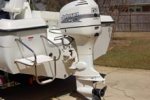
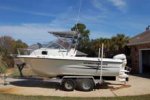
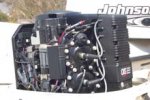
Re: 2000 Johnson Ocean Pro...brand new to me...
Hi Joel,
Congratulations on your new purchase, she's a beauty! I've heard the Ocean Pros are VERY strong so I hope all goes well for you! While I am also new to outboards, I came across a GREAT article and must give credit to
http://synthetic-motor-oil-air-filters.com/amsoil/winterize.htm which is where I found the article. This is a nice combination of general maintenance suggestions and how to winterize an outboard. Article begins:
Note: Although outboard motors vary, these steps should apply. Reference your owners manual for details. Be safe! Never stand near an outboard when running. Use hearing protection while engine is running. Be considerate and don't perform this maintenance at night. Outboards are very loud when out of water.
First Step: Remove your stop switch lanyard cord and ignition key if equipped.
Second Step: Remove your propeller.
Using a pair of pliers, straighten the cotter pin and remove. Unscrew the castle nut. Remove the shear pin if equipped. Now pull the propeller straight off the shaft.
Third: Add Sta-Bil gasoline stabilizer to your fuel tank.
Fourth: Replace your stop switch lanyard, and Thoroughly flush your engine with clean, fresh water and let the water completely drain from the engine.
For larger engines leave engine mounted to the boat, or mount to a suitable platform. Use flushing "ears" available at most discount or marine supply stores or the flushing plug to supply cooling water from a garden hose. If using the "ears" be sure the cooling intake ports located on the lower unit are completely covered. For smaller engines, use a sawhorse or similar platform to mount the engine, and submerge the lower unit into a large bucket full of fresh water to flush your outboard . Be sure the bucket is large enough to completely cover the water intake ports on the lower unit.
Turn on the water, and then start your engine. Run for five to ten minutes at low idle. (some outboards have a thermostat, and must be up to operating temperature before cooling water flows) Be sure cooling water is squirting out of the outlet usually just below the power head.
Note: It only takes 30 seconds without water to destroy your cooling impeller. Be sure the water is on before starting your engine!
After flushing your outboard, allow the water to completely drain from the engine. Leave your outboard in the vertical position for the water to drain completely. You can clean the outside of your outboard while you wait for it to drain. Use a top quality finish protector to keep your finish like new.
When you have completed the engine flush, disconnect the fuel line at the motor and continue running the motor until it runs out of gas. It's important to take steps tosure that all of the fuel has been drained from the carburetors or injectors so that the fuel-oil mixture remaining will not evaporate and leave varnish.
Fifth: Drain the fuel from the carburetor. As the fuel begins to run out and the motor starts to lose power, choke the engine until you hear the RPM's increase slightly. Continue choking the engine as the engine starts to use up all available fuel.
Sixth: Disconnect your battery (s), clean posts and coat with vaseline petroleum jelly. Remove the stop cord lanyard. Remove your spark plugs and spray a liberal amount of fogging oil into the cylinders. Rotate your flywheel one half turn each time you spray into a cylinder. Replace your spark plugs with quality spark plug like Bosch Platinum +4. Spray the entire power head with metal protector to prevent head bolts from rusting. (should be done occasionally during boating season also) The metal protector will help keep salt water from corroding engine parts.
Seventh: Change the gear oil in the lower unit. Place an oil collection container under the outboard. Locate two large stainless steel slotted screws on the lower unit. Remove the bottom screw. Remove the top screw and wait for the gear lube to drain completely. Once the gear oil has drained completely from your engines lower unit, you can pump your new marine lower unit gear lube in through the lower screw hole. If you need more lower unit lube than is available in your first container, simply replace the top screw or place your finger tightly over the top hole while you prepare a new container. The vacuum created will prevent any gear lube from escaping from the lower hole. Keep adding gear oil to the lower unit until gear oil starts to flow out of the top hole. Quickly replace the top screw and tighten, then replace the bottom screw and tighten.
Eighth: If your outboard motor is a four stroke, drain and replace your crankcase oil with a quality four stroke marine motor oil like Amsoil 0W 40, 10W 30 or 10W 40 synthetics.
Ninth: Apply a quality water resistant grease to all zerk (grease) fittings, moving parts, joints, bolts, nuts, and plastic fittings, then apply water resistant grease to the propeller shaft and threads. Cover shaft with a plastic bag and bread tie.
Tenth: Store your engine vertically in a dry area.
Also: I highly recommend the use of bearing Bearing Buddy automatic greasers, and water resistant grease for your trailer for care free towing all year long.
Tip: When towing your boat for long distances, let your bearings cool before launching your boat. Launching while bearings are hot will eject grease, and draw water into your bearings causing constant bearing trouble.
Disclaimer: The information provided on this page is to be used as a general reference, and no claim is made as to accuracy. Use this information at your own discretion and risk. Amsoil inc. is not responsible for this content and assumes no liability for it's accuracy.