Re: 1965 johnson super seahorse 33 hp Not staying in Forward gear
(Centering Shift Linkages - Manual)
(Joe Reeves)
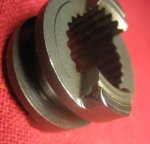
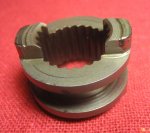
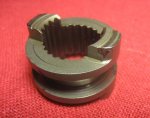
The engagement of forward and reverse gear must be evenly set. The shifter dog and the gears both have what is called lobes. The lobes of the dog must be side by side with the gear lobes in order for the dog to engage one gear or the other which results in turning the propshaft.
To grasp this scenario, with your left hand form a "C" with your thumb and forefinger. Now, with your right hand, form a backwards "C" with your thumb and forefinger. Your fingers will represent the dog and gear lobes.
Slide the finger and thumb of your right hand alongside the thumb and finger of your left hand so that they overlap. This is the position of the dog and gear lobes when properly in gear.
To have the gears adjusted so that they engage evenly, it is best to have those lobes set so that they butt up against and face each other.
To visulize this, butt the tips of the finger and thumb of your right hand up against the finger and thumb tips of your left hand. This represents having the gear and dog lobes directly facing each other. Should you atempt to force the engine into gear with this condition existing, damage to the shift mechanism will surely ocurr, so keep in mind that this is just for adjustment purposes only.
To obtain the above adjustment position, spin the propeller while shifting into forward gear (lobes alongside each other). Now, shift into neutral and turn the propeller ever so slightly to have those lobes face each other (1/4" would do it), then move the shift lever back into gear but only as far as it will go without forcing it.. Adjust the shift lever/linkages so that this point of engagement is half of the shift lever's travel. Now, do the same with reverse gear.
-------------
(Centering Shift Cable)
(J. Reeves)
When all is as it should be, the proper method to adjust the shift cable is to disconnect the cable from the engine. Move the shift linkage on the engine to find the center of the play in neutral, and when found, leave it centered.
Now, grab the end of the shift cable sleeve, push and pull it to find the center of the play there, and center that play.
Adjust the trunion on the threaded portion of the shift cable so that the centered play of the cable lines up with the centered play of the engine's shift linkage. Install and lock the shift cable with the retaining clamp in that position. That's it.
------------------
(Jumping Out Of Gear - Manual Type)
(J. Reeves)
This pertains to lower units on all OMC manual shift outboard engines, or any OMC engine with lower units defined as a Shift Assist or a Hydro Electric Shift unit which incorporates a "Shifter Clutch Dog".
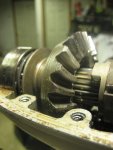
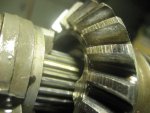
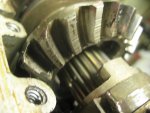
Within the lower unit, splined to the prop shaft is what is most often referred to as a clutch dog, hereafter simply called dog. The dog has at least two lobes protruding from it on both ends, facing both forward and reverse gear. The forward and reverse gears also have lobes built into them near their center area. When the engine is running, in neutral, the gears are spinning constantly via the driveshaft being connected directly to the powerhead crankshaft, but the propeller does not turn due to the fact that the dog is centered between the two gears, and the dog lobes are not touching either of the gear lobes.
When the unit is put into either gear, shift linkages force the dog (and its lobes of course) to engage the lobes of the gear. The lobes of the spinning gear grab the lobes of the dog, and since the dog is splined to the prop shaft, the propeller turns.
The lobes of the dog and gears are precisely machined, most with right angled edges that could be installed in either direction, and some with angles slightly varied that must be installed in one direction only (one end only must face the propeller). Dogs that can be installed in one direction only, if reversed, even if the dog and both gears were new.... would jump out of gear almost immediately. Keep in mind that the lobes are precisely machined with sharp angles!
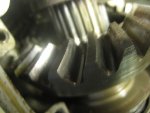
Due to improper adjustment or worn shift linkages, but usually due to improper slow shifting, those precisely machined sharp edges of the lobes become slightly rounded. Now, with those lobes rounded, as the rpms increase, the pressure of the gear lobes upon the dog lobes increases to a point whereas they are forced apart (jumping out of gear), and due (usually) to the shift cable keeping tension on the engines shift linkages..... the unit is forced back into gear giving one the sensation that the engine has hit something, and the cycle continues.
Some boaters with manual shift engines have the mistaken belief that shifting slowly is taking it easy on all of the shifting components..... Wrong! Shifting slowly allows those precisely machined sharp edges of the dog and gears to click, clank, bang, slam against each other many times before they are finally forced into alignment with each other..... and this is what rounds those edges off! The proper way to shift is to snap the unit into gear as quickly as possible.