


1959 Evinrude Lark 35hp - No Spark Issue

Joined
Sep 15, 2015
Messages
14
Hello all. I need some help fixing my 35hp Evinrude outboard.

A brief introduction. I've fixed my own cars since I was 15 (I'm now 29). I've rebuilt the top end of a jaguar V12. I'm not mechanically illiterate. That said, old engines aren't my forte, and this one has me stumped. I purchased this unit used for $150 with a cracked draw string "cover" (so it would only work if you had the electrical harness to use the starter). I purchased a used replacement on ebay. The owner said it worked last time he used it some 6 years ago, and it has sat in his garage since. There appears to be no damage anywhere on the unit, and no water in the oil in the lower end. It appears to have been decently well maintained. The motor was not seized and all of the grease points were well lubricated. I have not yet done a compression test, but there is a huge difference in the amount of force required to pull the draw string when the spark plugs are removed vs when they are in place. This would lead me to believe that there is compression, but if it is worthwhile to check, I can do so.

I purchased a new fuel hose. I can pump the bulb and I get fuel in the glass bowl. When I try to start it, I can smell fuel in the exhaust, and after enough tries, the spark plugs are wet, but the engine never gave any indication that it wanted to start. Not even a burp. Now, I have it mounted on a makeshift 2x4 frame in my garage, so when I pull the draw string, I can only really get 2 revolutions out of it before I can't pull any farther, if this is of any relevance.

I removed the spark plugs, left one connected, and wrapped a wire around the thread of the spark plug, then grounded it to the engine. I pulled the draw string, and got no spark. I tried another spark plug that I knew worked, and again, got no spark. I am assuming here that I should have been able to see and/or hear a spark at the spark plug while pulling the draw string, which I was able to do completely with no spark plugs in.

Now, my process for trying to start the engine was:

- pump bulb until it gets stiff
- set handle to "start" position
- set choke to closed
- pull draw string. repeat.
- if engine doesn't start, open choke. Repeat.

I repeated that process, occasionally pulling out the spark plugs, blowing them dry with a pistol grip attachment to my compressor hose, and attempted to start it with the choke open. Nothing. I cannot find any on/off switch on this thing, and I don't have the harness that is supposed to connect to the side of the unit to use the starter motor.

I was going to remove the flywheel in order to inspect the electrical components underneath, but discovered I needed a puller, which I don't yet have, so that's where I am now.

What should I be looking for with regard to potential causes? If I do remove the flywheel, what should I consider replacing, assuming everything is original?

Many thanks for your help.
 
Last edited:

oldboat1

Fleet Admiral
Joined
Apr 3, 2002
Messages
9,612
harmonic balancer puller will work for removing flywheel. Will likely need new coils (looked for cracked and nasty), new or cleaned and reset points, new condensers, new plug wires (7mm, solid wire core), new plugs (probably Champion J6C -- check on that). Should expect spark if points are set correctly at .020, and magneto assembly is correct. (Do half of it at a time.) Probably $80 - $100, give or take. Replace the impeller in the lower unit (maybe $20), and thereafter turn it over with the lower unit sunk in a barrel or similar, about up to that exhaust port on the back of the leg. Takes about a 24:1 fuel mix.
 
Joined
Sep 15, 2015
Messages
14
Spark plug wires looked original. Old, to say the least.

I have some AMSOIL MP that is a phenomenal penetrating spray. I will soak that over the shaft to hopefully get that flywheel loose. I've read they can crack. I was told a fine way to do it was to place some tension on the puller while hitting the flywheel with a hammer to give it some shock without forcing the metal. Alternately, I can keep pressure applied while heating the flywheel with my MAPP gas torch, which should expand the aluminum at a faster rate than the steel shaft and allow me to remove it.

Flywheel removal aside, I watched a video on youtube on adjusting the points, and a specific tool was used that slid over the shaft and allowed one to adjust points at an ideal location. Do you know where I can purchase this tool or what it's called? Here's the video

https://www.youtube.com/watch?v=eNK2TEeQQv0

That is, unless you believe that feeler gauges would be adequate for this purpose. Also, do you know where I could source that wiring harness that allows me to utilize the starter? That draw string really does have a hefty pull to it.

Thank you for your assistance.
 

oldboat1

Fleet Admiral
Joined
Apr 3, 2002
Messages
9,612
lots there. got other issues if the flywheel is frozen, but will assume you mean it's going to be pretty stuck on the shaft (likely true). But watch out for heat, and watch out for too much force in the wrong place. Really need a puller (fits the three holes surrounding the shaft). If curious in the meantime, can take that peep hole cover off (think the '59 still had it) and see what's there. Haven't checked the youTube, but think I know what device is probably described -- don't need it. I use a feeler gauge for the points. You can make a wire harness for the starter (need a working solenoid and a pushbutton starter switch). Need a stand for that thing, so something to work on initially -- heavy enough it needs to be pretty sturdy.
 

HighTrim

Supreme Mariner
Joined
Jun 21, 2007
Messages
10,486
Those motors are very difficult to start on a stand like you mention. Much easier when they are on the boat, and you can get some leverage to pull.

You can wire up your own harness, or they can be bought new at www.nymarine.ca, or post an ad for a good/used one at aomci.org

I wouldn't worry about a stuck flywheel, until you actually get there. I pop a TON of these 50s omc flywheels, and have ever had trouble with 1 out of hundreds. If you buy a harmonic balancer puller, get good grade 8 bolts for it. Thread them into the flywheel 7/16". Too shallow and you will pull the threads out, too deep and you will damage coil, although yours are likely already shot.

Forget the spark test setup you have there. Go to an auto parts store, and buy an adjustable open air gap tester. They are like 5 bucks. Set it to 1/4". The spark should jump that with a bright blue zap!! You MAY have trouble getting spark on that wobbly stand, as you cannot get a good pull on it. You can bump the electric starter with a batter, which will make it easier.

The compression on that motor should be about 95 to 125. I would test it before spending any money.

The tool you describe is called a timing fixture. While you can adjust points with a simple feeler gauge, if you are going to do this more, the timing fixture is by far the best way. It gets them to fire 180 degrees apart exactly, and exactly on time, which results in a low, smooth idle. F_R on this forum makes them, PM him, or check out his website.
 

HighTrim

Supreme Mariner
Joined
Jun 21, 2007
Messages
10,486
..also never hit the flywheel! Tighten the heck out of the bolts, you will need to rig a way to hold the flywheel from turning, you can then lift UP gently of flywheel with bar, and give the center bolt of pull a RAP with the hammer, NOT the flywheel.
 

F_R

Supreme Mariner
Joined
Jul 7, 2006
Messages
28,226
No Title

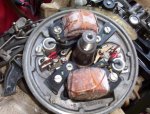
With all your experience, you should know it isn't going to run with no spark. Or even a weak spark. Expect the coils to look like this. If they don't, somebody has already replaced them. Disable the compression relief before doing a compression test if you do it using the rope starter. You don't need to soak that flywheel to get it off. A good puller is necessary and will get it off. It takes a LOT of pull. If the puller breaks, get a better puller. You DO need a torque wrench to tighten the nut to 60-65 foot pounds when putting it back on. Failure to do so will cause very serious damage. Many auto parts stores have loaners. Make sure the shaft and flywheel tapers are shiny clean and dry before installing the flywheel.
 

Attachments

  • photo218209.jpg
    photo218209.jpg
    67.8 KB · Views: 3
Last edited:
Joined
Sep 15, 2015
Messages
14
Those motors are very difficult to start on a stand like you mention. Much easier when they are on the boat, and you can get some leverage to pull.

You can wire up your own harness, or they can be bought new at www.nymarine.ca, or post an ad for a good/used one at aomci.org

I wouldn't worry about a stuck flywheel, until you actually get there. I pop a TON of these 50s omc flywheels, and have ever had trouble with 1 out of hundreds. If you buy a harmonic balancer puller, get good grade 8 bolts for it. Thread them into the flywheel 7/16". Too shallow and you will pull the threads out, too deep and you will damage coil, although yours are likely already shot.

Forget the spark test setup you have there. Go to an auto parts store, and buy an adjustable open air gap tester. They are like 5 bucks. Set it to 1/4". The spark should jump that with a bright blue zap!! You MAY have trouble getting spark on that wobbly stand, as you cannot get a good pull on it. You can bump the electric starter with a batter, which will make it easier.

The compression on that motor should be about 95 to 125. I would test it before spending any money.

The tool you describe is called a timing fixture. While you can adjust points with a simple feeler gauge, if you are going to do this more, the timing fixture is by far the best way. It gets them to fire 180 degrees apart exactly, and exactly on time, which results in a low, smooth idle. F_R on this forum makes them, PM him, or check out his website.

Well, looks like I need to put it in the boat to get it started by hand, because there's no way I'm getting enough pull. That may actually be the cause of my problems, although you'd think that with the spark plugs removed and no compression as a result, you could pull that draw string fast enough to actually get something to happen. Looks like the starter has a gear that moves up a shaft. Does this gear move automatically when the starter gets power? I may just mount it to the boat and try it from there.

I was planning on a harmonic balancer puller, and buying some grade 8 bolts as you mentioned to get the flywheel off. I'll pick up that spark plug tester while I'm there.

I do have a compression tester, so I may as well do that. Wouldn't hurt.
 
Joined
Sep 15, 2015
Messages
14
With all your experience, you should know it isn't going to run with no spark. Or even a weak spark. Expect the coils to look like this. If they don't, somebody has already replaced them. Disable the compression relief before doing a compression test if you do it using the rope starter. You don't need to soak that flywheel to get it off. A good puller is necessary and will get it off. It takes a LOT of pull. If the puller breaks, get a better puller. You DO need a torque wrench to tighten the nut to 60-65 foot pounds when putting it back on. Failure to do so will cause very serious damage. Many auto parts stores have loaners. Make sure the shaft and flywheel tapers are shiny clean and dry before installing the flywheel.

Where is this compression relief valve? I do have a torque wrench. Also, where can I purchase that timing fixture?
 

F_R

Supreme Mariner
Joined
Jul 7, 2006
Messages
28,226
Compression relief valves are on the rear of the cylinder head, operated by an arm going to the recoil starter. Remove the arm to disable them. Look for a You Tube video by cajuncook..(I am not cajuncook). https://www.youtube.com/watch?v=eNK2TEeQQv0
 
Last edited:
Joined
Sep 15, 2015
Messages
14
Welp, nevermind all that. I checked the compression and it was at 90psi on both cylinders with a leaky compression tester (o-ring was broken).

I decided to hook up the battery and start it using the starter, which is how I checked the compression.

After firing it for 10 seconds or so, it started to sputter. Wow, looks like I have spark.

Got it going for another 5 seconds, and it fired up, then died. I opened the throttle a bit (linkage looks like it needs adjusting) started it again, and boom, turned on and revved up. I ran the engine for another 5 seconds or so, then killed it.

Looks like I got myself a working 35hp outboard for $150 + $25 to replace the pull start cover.

Note to self: that pull start cord is as thick as it is for a reason.
 
Joined
Sep 15, 2015
Messages
14
I owe participating members of this thread the satisfaction of knowing they were right. After getting this outboard running, rebuilding the carb (and replacing the impeller), I got it running at idle. After I got tired of the constant smoke and my clothes and hair smelling like fuel, I pulled the top spark plug wire off while the engine was running and noticed no change at all in how the engine ran.

I either have bad plugs, or (more likely), I have a problem underneath the flywheel. I'll buysome new plugs, then pull the flywheel. I'll let you all know what I find.
 
Joined
Sep 15, 2015
Messages
14
Finally figured it out. I got the puller tool, popped off the flywheel, and had a look around. The coils had both been replaced once before, but the wires were original. I got my multimeter and checked both wires for continuity. Everything looked good there. Checked the gaps on the points. Again, everything looked good. Coils weren't cracked. I tested for continuity from the spark plug to the coil, and got a reading on the bottom, but zero on the top. I figured the coil was bad, so I took off both coils, tested both primary and secondary with a multimeter, and surprisingly, both were good. I noticed that the pin inside the top coil was corroded. Hmm...that's not right. So I checked the spark plug wire and discovered that it had never been pushed through far enough, and that the pin wasn't even touching the spark plug wire! I loosened the spark plug clamp and was able to push through another solid 1/2 an inch of spark plug wire. I cut off a sliver on the end to expose some good wire, pushed the coil through, and tested it for continuity again from the spark plug end of the wire through to the coil. Yep, got continuity now. Put it all back together and fired it up. On the second pull, it started right up, and sounded a lot differently than it had before.

Hopefully I'll be able to get out on the water tomorrow to give it a spin and do some tuning with the fueling.
 
Top