1989 OMC Cobra exhaust seal

rolmops

Vice Admiral
Joined
Feb 24, 2002
Messages
5,644
All this talk about bad bat wings made me wonder a bit. There are exhaust seals/flaps that are supposed to stop the water from rushing up into the engine. My engine has the bat wings, but I never had a problem.
So today I opened up the exhaust and checked the exhaust flaps. They are both complete and easily moveable. One hangs at an angle and if water or water pressure would come up it would push the flap up and close the exhaust. The other one, although complete, hangs vertical and this might cause the water to rush up along both sides instead of closing the gap. Should I replace this one or am I just imagining a problem where there is none?
 

Lou C

Supreme Mariner
Joined
Nov 10, 2002
Messages
13,754
See if you can work it free IIRC mine is like that too, one side moves easily the other not as much but I’ve never had water come up the exhaust & I’ve owned this boat for 23 years!
 

rolmops

Vice Admiral
Joined
Feb 24, 2002
Messages
5,644
So I took the the exhaust flap out and it was defective. At first, it looked just fine. There were some small burrs on the the holding bar and I polished those out. But then, I took a closer look at the plate and found a small hole. It was big enough to allow water to penetrate under the rubber coating. This water destroyed the balance and thereby the angle under which it was hanging on the bar. The larger side had become heavier because of the water penetration.
It is funny how a small amount of water in an exhaust flap can cause an engine to go to hell.
 

Lou C

Supreme Mariner
Joined
Nov 10, 2002
Messages
13,754
Good find there!
I think these problems also are a function of the static water line of the boat, i.e. how high up the water comes in the Y pipe, and also driver habits, not slowing down too fast unless it's actually necessary, etc.
PS
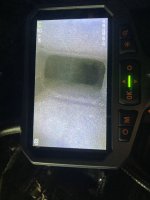
I found an easier way to check the 2 piece manifold/elbow system for leaks inside. The OMC/Volvo style elbows have a square plug on top that is actually for a heat sensor, for boats that have an actual exhaust overheat alarm. I found that I could snake my inspection camera down there and see all round where the joint between the elbow and manifold is. No leaks as of yet, this is the 6th season I've been using them, usually I would change them at the 7th, but I'll see how these hold up.
What's great about this is after assembling the elbows & manifolds, you can run it on land and check for leaks before you ever put the boat in the water, without taking anything apart! The only other thing is you should monitor the temps of the manifolds/elbows both at idle, and after coming off plane. Any increase from your baseline, means that rust can be clogging the passages and you need to then take them apart and investigate further.
exhaust staboard side.jpeg
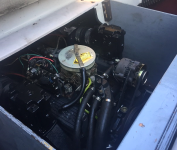
Here's a pic from inside, from a couple of years ago...
4.3 with new exhaust system.png
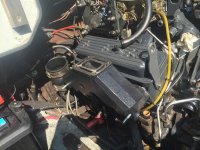
In this pic you can see the plugs in the top of the elbows, that are actually for heat sending units.....
 

Lou C

Supreme Mariner
Joined
Nov 10, 2002
Messages
13,754
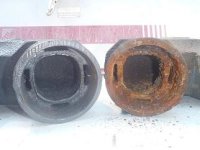
OMC batwings after 5.5 seasons vs new.jpgNew exhaust on OMC V6 with longer bolts for alignment.jpg
I had the batwings on mine for a long time but being in salt water you can't really use them longer than maybe 7 seasons, never had water in the engine from them. Went through a few sets of them. However, take a look at the wall thickness of the new ones on the left in that pic, vs the Barr aftermarket OMC/Volvo manifold in the other pic. I haven't measured it but the wall thickness on the Barr manifold sealing surface looks a lot thicker than the outlet on the batwings. The wall thickness was the problem with casting the batwings, I think both Merc and OMC ran into the same thing, OMC used em from 1985-1990, Merc, only from 96-99. The fact that both of them stopped having manifolds cast that way, suggests to me they felt it was too risky.
 

bruceb58

Supreme Mariner
Joined
Mar 5, 2006
Messages
30,733
Those batwing manifolds have been doing fine since 1989, which is about 36 years. It seems that I lucked out on these ones
You must not be in salt water then. Batwing manifolds were hard to cast properly so they easily got thin spots. You might have gotten lucky and gotten a set that didn't have that thin spot.

To me the danger of hydro locking an engine would be enough for me to be proactive and get rid of them ASAP.
 
Top