I/O (Sterndrive) Conversion to Outboards

Scott Danforth

Grumpy Vintage Moderator still playing with boats
Staff member
Joined
Jul 23, 2011
Messages
51,793
A K-plane is a trim tab on steroids
 

Attachments

  • Screenshot_20251130-182514.png
    Screenshot_20251130-182514.png
    1.2 MB · Views: 5

Scott Danforth

Grumpy Vintage Moderator still playing with boats
Staff member
Joined
Jul 23, 2011
Messages
51,793
Doesnt that really trade wide and short for long and skinny?
It's same width, and about 2' long. Some are 3' long

They extend the running surface, and react faster than traditional tabs. The really big ones have 3 cylinders and a dedicated hydraulic pump per side
 

tpenfield

Moderator
Staff member
Joined
Jul 18, 2011
Messages
18,771
Thank God now I know what I'm looking at.....

1) Why the diff colored things on top?
2) Why the holes into the bottom of the swim platform? Wire could go thu sterndrive holes?
3) Tabs should be functionally fine where they are at or what is a k tab?
#1 - I'm using lower density foam for less critical parts . . . spacers, etc.

#2 - I need to be able to reach areas inside the swim platform cavity to install bolts.

#3 Scott replied about the K-planes. . . They are more narrow, but longer. The cost is above my allowance.
 

tpenfield

Moderator
Staff member
Joined
Jul 18, 2011
Messages
18,771
For now, I'll unfasten the trim tabs and may re-locate them a wee bit further out towards the chine.
 

tpenfield

Moderator
Staff member
Joined
Jul 18, 2011
Messages
18,771
A day of fiberglassing . . .

I've started in on fiberglassing the structure. Probably should have glassed the pieces ahead of time, but I'll make this work.


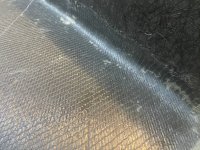
I read (on the Internet) in a couple of places of folks who had issues with de-lamination of fiberglass & Coosa board. So, I wanted to make sure to get a good bond. I am using VE resin and 1708 cloth (for much of the structure).

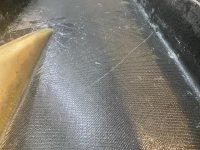
The results so far is not bad . . . a couple small air bubbles.
IMG_8903.JPG
.
My fillet work looks OK . . .
IMG_8904.JPG
.
My fiberglassing technique has been to brush the resin onto the Coosa surface. I noticed that the resin needs to be worked into the Coosa with some additional strokes of the brush, as it initially beads up a bit

Then, as for the cloth . . .
  • I usually lay down a piece of thin plastic sheeting (0.7 mil drop cloth or similar) on my 'wet-out' table.
  • I place the 1708 cloth on the plastic with the '08' (CSM) side up . I pour the remaining resin onto the fiberglass cloth and spread it around with a spreader blade. After a minute or 2 the resin has soaked into the cloth fairly well.
  • Then I pick up the whole thing (plastic sheeting & wetted fiberglass) and lay it in place, '08' side down. This technique gets a well-wetted piece without applying additional resin.:cool: If I want a smooth surface, I leave the plastic sheeting (now on top) in place. Otherwise I remove the plastic sheeting from the 1708 and resin roll as needed.
I am finding that 1 ounce of resin is good for about 40 sq. in. of 1708. So, for the size pieces that I was laying down, I was mixing 26 oz. of resin at a time.

Anyway . . . I'm going through nitrile gloves like nobody's business . . . :LOL:
 

Pmt133

Lieutenant Junior Grade
Joined
Jan 6, 2022
Messages
1,232
I got a case of gloves (box with like 20 boxes in it) from the county for free 99. They "expired" so they had to get rid of them. I mean technically my taxes paid for it but still. Yeah it's insane how many you go through. I tried the dishwasher gloves too but hate the loss in dexterity.
 

tpenfield

Moderator
Staff member
Joined
Jul 18, 2011
Messages
18,771
Yup, as for the gloves . . . they get all gooey from adjusting the fiberglass position . . . I tend to use 3 pair throughout a single piece of layup.
 

tphoyt

Lieutenant Commander
Joined
Jun 10, 2010
Messages
1,883
I had no idea nitrile gloves had an expiration date. That may explain why I had to toss a box once. Every time I would put them on they would rip apart. I’m with ya on the dexterity end of things. I don’t need anymore help dropping things. These days with my back bringing the way it is if I drop something I often think about if I really want it back.
 

Lou C

Supreme Mariner
Joined
Nov 10, 2002
Messages
13,769
Hardware store has real chemical resistant gloves; might be a good idea when doing that much ‘glassing. Some people get allergic reactions to certain resins…
 

tpenfield

Moderator
Staff member
Joined
Jul 18, 2011
Messages
18,771
My challenge with the gloves is that I get resin on them handling and adjusting the glass cloth during layup. It is all the 'cost' of laying up wet cloth rather than dry cloth. The results are much better (IMO) so the volume of gloves used is worth it.

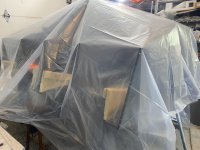
This morning, I did the inner part of the outside walls. These pieces were 58" x 20" so . . . (58 x 20 / 40 = 29 oz. of resin.) As I 'bang off the rust' on my glassing skills things are getting easier. My biggest challenge is the weather (temperature). My work area stays about 60˚F during the winter months. so, I usually need to 'tent' the piece and add heat once I've got some fiberglass laid up . . .
IMG_8906.JPG
.
With the the work/piece covered and my little space heater, I can get the temperature (inside the extension pod) up to 80-85˚F. Usually an hour of heat gets the resin on its way. So, I glass a few things and then apply some heat. Of course, this results in a lot of starting/stopping, but it gets done.
 

tpenfield

Moderator
Staff member
Joined
Jul 18, 2011
Messages
18,771
Clearly you have put a ton of thought and effort into this. Just curious though if you have given any thought as to whether the vessel is going to pass the simplified stability test after the project is complete or not? If you are not familiar with it, here is a link to it - https://www.dco.uscg.mil/Portals/9/DCO Documents/5p/5ps/Design and Engineering Standards/Naval Architecture Division/Simplified Stability/SST-JOB-AID-EX-CG-4006.pdf?ver=2019-04-29-111425-850
The aspect of stability has come up to some extent. Essentially the weight of the engines, although less than their I/O equivalents is positioned higher on the boat.

My understanding is that the SST requirements apply to commercial vessels, not recreational vessels.

I googled the following explanation . . .
"No, recreational boats generally do not need a formal, complex stability proof test like commercial vessels; stability requirements for recreational boats focus more on proper PFDs (life jackets), safe loading, and general good seamanship, while the USCG Simplified Stability Test (SST) is for specific, smaller commercial passenger boats (under 2 decks, meeting other criteria) and large commercial vessels need full incline tests. Recreational boaters should focus on carrying sufficient PFDs, avoiding overloading, and understanding their boat's behavior."

I probably can (should) calculate the change (vertically) in the Center of Mass just to see how much it will change.

I calculated the horizontal change (9" towards aft), yet with the added planing surface (42"), it will be more forward than before from a planing perspective.
 

tpenfield

Moderator
Staff member
Joined
Jul 18, 2011
Messages
18,771
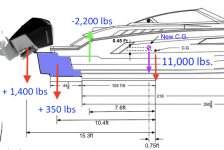
I did the 'vertical' calculations and it looks like the CoG (Center of Gravity) will move upward about 5.2" (0.45Ft).

The fact that the boat is a 10'-10" (130") beam will probably suffice for lateral stability. I may notice a slight bit (wee bit :LOL: ) more tenderness, but I'm thinking it will not be terribly so. Original CG is in Orange, the new CG is purple.

Vertical-CoB-1.png
.
Here is my previous CoG change diagram, now adjusted for the change in both directions. The original drawing and "C.G." is from the manufacturer . . .
CoG-After-3.png
.
I think this will be OK . . . I probably will store more 'stuff' down in the engine bay, which can only improve the balance point.
 
Top