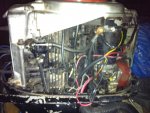
Re: mercury 800 kiekhaefer blowing fuse??
Forget the battery. Not in the fused circuit....is supplies power to the fuse.
A good place to start is to disconnect the battery + terminal thus removing 12v from the engine.
Follow that red wire into the engine and you will probably wind up at one of the large (high current) terminals on the starting solenoid. Besides having power available to go through the solenoid, when closed to start the engine, this is usually a distribution point for other areas.
Since you said what you said, your ignition key controlled circuits, usually purple wires and not part of it. On my engine the down wind side of the fuse goes 2 places: To the trim relays and out the electrical connector to the control box. On my wiring harness the down wind lead from the fuse is red also, but has a purple stripe. For the record, 12v that is switched by the ignition switch is in purple insulation as I previously mentioned.
With a good fuse, Ohm between the smaller red wire from the junction (that is the input to the fuse I mentioned earlier) to the engine block...get to the metal, not paint. For the fuse to blow immediately, you have a heavy short. 12v on a weak battery, divided by 30 amps....30 amps at least, since it blows immediately, gives you a circuit resistance of 0.4 ohms. Giving 0.4 ohms for meter lead resistance (what mine is when I zero the digital meter), would show up on a digital meter as 0.8 ohms. A normal reading would be something no more than 10 amperes through that fuse which would be 1.2 ohms plus the lead res. for a reading of 1.6 ohms.
Easiest thing to disconnect is the electrical wiring harness to the control box, in the engine for your first disconnect and see what happens effort. Once you find your Ohm reading an acceptable value, trace out the last wire you disconnected. If someone has added after market wiring for some other function then you will have more wires to disconnect than I mentioned.
If the wiring harness connector solves the problem you probably have chafing in the harness to the control, or possibly the control internal parts were rubbing on the insulation and wore through it. Again, since the switch being off didn't matter it has to be between the engine connection and the input to the ign switch..............Butttt don't rule out a bad ignition switch. Since ground is one of the inputs to the switch, if it has an internal malfunction, that malfunction could put your 12v input on the ground connection.
One final thought. On a 1971 engine, you could have damaged insulation allowing a wire to contact ground that otherwise wouldn't. So any cracked insulation or pieces missing demand your attention.
Good luck,
Mark