










MikeMcGregor
Recruit
- Joined
- Apr 10, 2012
- Messages
- 5
SORRY if any of this has and error or two - use at your own risk - This info seems mighty hard to find so I compiled what I have learned so far here. Let me know of any errors. Thanks for those who have helped along the way. Also a thanks to maxrules.com for helping me to discover some of this info along my path - it looks like they are a great resource for help and purchase of a new module if you need one.... I have nothing to do with them in anyway, nor have I ordered from them - but their site provided great insite in my research.
TESTING and INFO:
The "amplifier" is the rectangle box "ID'd as electric shift" with leads (colors may vary but wiring placement is same):
1-Blue to the Coil (same side of the motor to the distributor area) in my case WHITE
1-red lead from power. This lead that comes from battery POSITIVE should be live on run and start - 12vdc!
1-grey lead for the TACH if equiped - usually deadended
1-ground lead (black?)
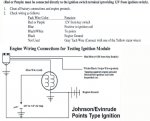
The WHITE-BLACK-POINT wire that goes to the distributor area should produce a spark from the coil when touched to GROUND. If the spark is ONLY to the spark lead from the COIL and not to the plugs then the distributor is the issue. If NO spark then the module (amplifier) is likely bad (assuming12vdc + to module and good ground and coil is OK plus nothing is shorted out). To test the coil ONLY - it should have continuity to ground from both the spark lead and the primary lead. VERY low - near zero on primary and higher on secondary. You can use a 9 volt battery across this coil lead (disconnect from control FIRST) to ground and it should procuce a tiny spark on the output side - SMALL gap ! ! (touch and release contact for spark - ie: not continuous- back EMF will shock you if you touch the coil leads when disconecting the battery so use caution) - see next reply - this did not produce a spark for me
The oposite side of the motor has two leads from the points that go to a voltage regulating diode assembly next to the amplifier. This charges the battery during run (I should say "maintains" as it has a tiny output) and provides a path to ground for the points for spark timing "I think? as it pulses" - it is possible that these leads are just for charging-maintaining the battery. It can be tested with an OHM meter to ground - passes power one way - reverse leads and no continuity.
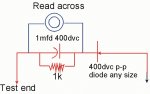
The amplifier feeds power to the points through the WHITE-BLACK-POINT lead .... that said - when the points "break" - the amplifier sees this and feeds 200vdc (give or take) to the primary BLUE coil which produces the spark. I am not certain wether the make-break is done on the plate side to ground or through the larger leads from the other side? Apparently this is done with and SCR in the module\amp (solid state on-off-switch in simple terms) and a simple transformer contained in the box and perhaps a helping capacitor for power boost (hotter spark). You can test for the signals on the WHITE-BLACK-POINT-12vdc or BLUE-COIL-200vdc leads with a meter but need to do so with one that will read peak DC voltage - or make a simple diode and capacitor - with a bleed resistor and read voltage across the capcitor to "catch the peak average". Use 400vdc cap small better and maybe a 1K blead resistor and a diode in series (simple DC power supply if you look it up on-line and read the capcitor's charged voltage). . . .simple electronics 101. . .
I am investigating using a 16vac secondary 120 primary transformer and reversing it so see what happens - I suspect the only reason for the SCR is to isolate the "spark-system" from the "Charge-system" and perhaps to allow HIGHER output current so the points will last? ? ? I may make one with an SCR - I will post how to . . .if it works . . .and how to make one - $25 beats a $300 Plus part and you can fix it when\if it fails if you are like me - BROKE!!!
Best luck - Mike
 . What I did to test the coil was to use an old 24vac doorbell transformer and hooked the primary to one side of the coil and the other primary side to ground (the power input lines) - then touched a 9vdc battery to the secondary leads to produce the 200vdc pulse to the coil to see if it sparked or not (I used the trasformer to reverse the voltage it normally would "reduce" - reversing it makes it increase) - WEAK pulse but it did spark so I knew the coil was good..... carfull not to be touching the transformer lead when you remove the battery as it will shock the crap out ou you with back emf potentially (I did not test this BTW - allergic to electricity). I am sure if you had an OLD car coil you could hook it to the blue lead an produce a heck of a spark if the module was good - that may be my next experiment??